


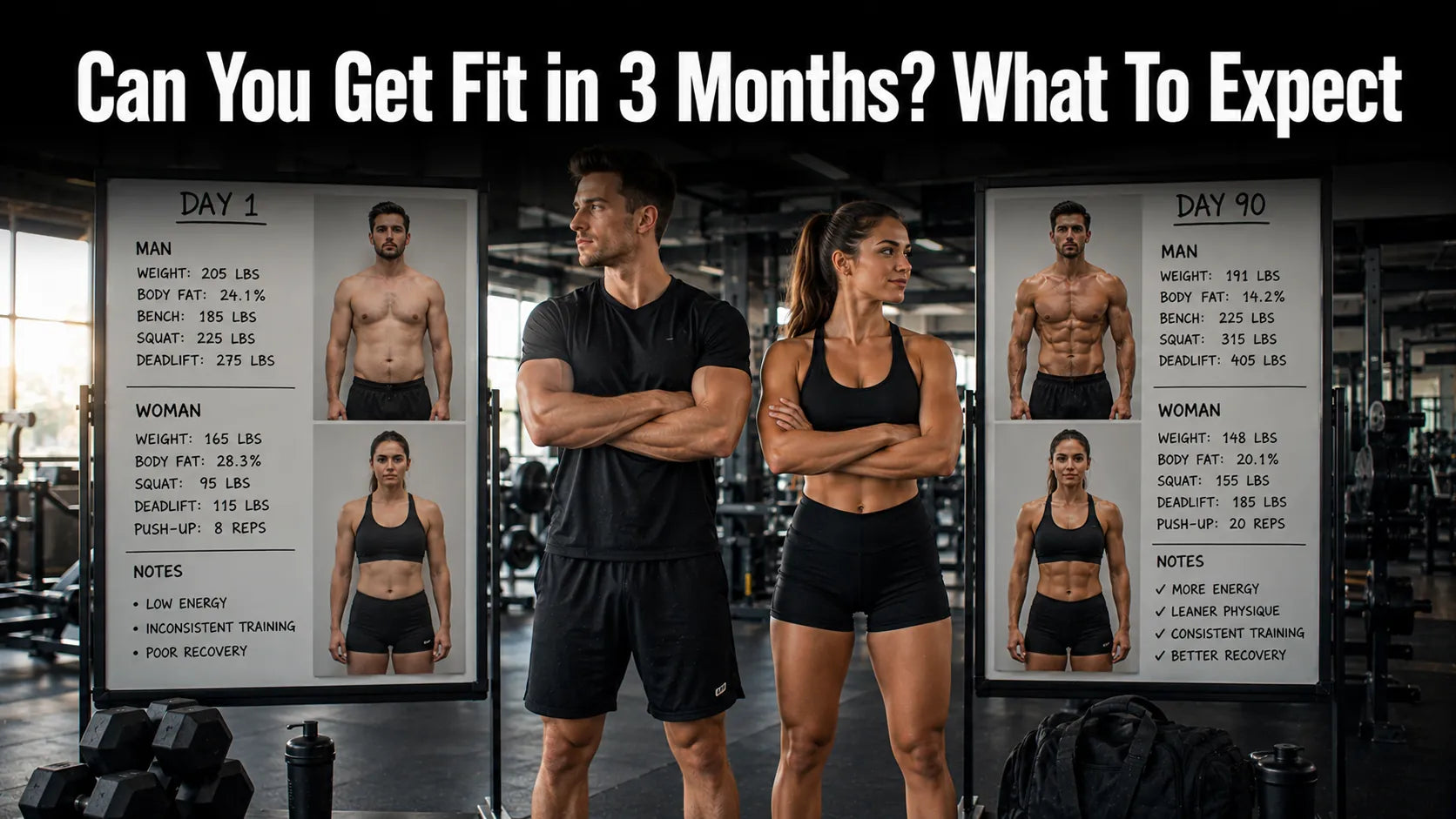
Type "3 month body transformation" into Google and you'll find two very different worlds.
The first is filled with dramatic before-and-after photos.
Six-packs appearing from nowhere.
Huge amounts of weight supposedly disappearing in weeks.
People claiming their lives completely changed in 90 days.
The second world is full of scepticism.
People insisting that meaningful results take years.
That three months isn't enough time to make a real difference.
That expectations should be kept low.
The truth sits somewhere between the two.
Three months is not enough time to become the strongest athlete in your gym.
It's not enough time to build a professional bodybuilder's physique.
And it's not enough time to completely transform every aspect of your health.
But it is long enough to create results that are genuinely noticeable.
For many people, twelve weeks of consistent effort can produce some of the most rewarding changes they've ever experienced.
The key word is:
consistent.
Because three months is a surprisingly powerful amount of time when good habits are repeated over and over again.
The problem is that most people dramatically overestimate what they can achieve in three weeks and underestimate what they can achieve in three months.
Let's look at what realistic progress actually looks like.
1. What can most people realistically achieve in just 3 months?
The biggest mistake people make is expecting perfection.
They imagine a complete transformation.
An entirely different body.
An entirely different life.
Then they become disappointed when reality doesn't match the fantasy.
The reality is far more encouraging.
For beginners especially, three months can produce significant improvements in:
- strength
- fitness
- energy levels
- confidence
- body composition
- training ability
Someone who starts completely untrained can often look noticeably different after twelve weeks.
Not because they've become elite.
But because they have moved from doing nothing to doing something consistently.
That's a huge shift.
Three months is long enough for:
- habits to develop
- fitness levels to improve
- technique to improve
- body composition to start changing
The changes may not always feel dramatic day-to-day.
But compared with where someone started, they can be surprisingly impressive.

2. How much muscle can you build in 12 weeks?
This depends enormously on the individual.
Training history matters.
Age matters.
Genetics matter.
Nutrition matters.
But beginners generally have one major advantage:
They tend to respond quickly.
When someone starts resistance training for the first time, the body often adapts remarkably fast.
Strength increases.
Coordination improves.
Muscles begin receiving a training stimulus they've never experienced before.
This is why the first few months of training are often among the most productive.
Products such as Naughty Boy Prime Creatine 450g can support this process by helping improve training performance and recovery capacity. While creatine doesn't magically build muscle, it can help people train harder and progress more effectively over time.
The important thing to understand is that muscle growth isn't linear.
Some weeks feel productive.
Some weeks feel slow.
What matters is the overall trend across the full twelve-week period.
3. How much body fat can you safely lose in 3 months?
This is where expectations often become unrealistic.
Many people see dramatic online transformations and assume they should be losing weight at an incredible rate.
In reality, sustainable fat loss is usually much slower than social media suggests.
The good news is that slower doesn't mean ineffective.
Three months provides enough time for significant improvements in body composition when:
- nutrition is consistent
- calorie intake is appropriate
- training is regular
- recovery is prioritised
One of the biggest mistakes people make is focusing exclusively on body weight.
The scales tell part of the story.
They don't tell the whole story.
Someone can lose body fat while simultaneously:
- building muscle
- increasing strength
- improving fitness
which means the scale may not move as dramatically as expected.
This is why progress photos, measurements, and performance improvements are often far more useful than body weight alone.
4. Why do some people see dramatic results while others barely change?
Consistency.
It's rarely the exciting answer people want.
But it's usually the correct one.
Most successful transformations aren't built on secret supplements.
They're not built on magic workout plans.
They're not built on extreme diets.
They're built on repeatedly doing basic things well.
The people who make the most progress tend to:
- train consistently
- eat consistently
- sleep consistently
- recover consistently
The people who struggle often bounce between extremes.
One week they're completely committed.
The next week they're doing nothing.
The body responds to repetition.
Not motivation.
That's why some people appear to transform quickly.
In reality, they're simply being far more consistent than everyone else.

5. How important is diet compared to training when getting fit?
Extremely important.
This doesn't mean training isn't valuable.
It means the two work together.
Training provides the stimulus.
Nutrition provides the support.
Without adequate nutrition, progress becomes significantly harder.
For someone trying to build muscle, eating enough quality food matters enormously.
This is where products such as Applied Nutrition Cream of Rice – 1kg can be useful. Many gym-goers use it as an easily digested carbohydrate source around training sessions to help support energy levels and workout performance.


Protein is equally important.
Building muscle requires the body to have access to sufficient amino acids, which is why products such as Per4m Advanced Whey Protein – 2.01kg remain popular among people pursuing physique and performance goals.
The reality is simple:
You can't out-train poor nutrition forever.
At some point, diet becomes impossible to ignore.
Intermission
So far we've explored what realistic three-month progress looks like, how much muscle and fat change is possible, why some people succeed while others struggle, and how nutrition supports training results.
In Part 2, we'll look at the best workout routines for a 90-day transformation, the supplements that can genuinely help, the biggest mistakes that slow progress, how to stay motivated when results feel slow, and what you can realistically expect to look, feel, and perform like after twelve weeks of consistent effort.
Part 2
6. What workout routine delivers the best results in a 90-day period?
The best routine is rarely the most complicated one.
In fact, many successful transformations come from surprisingly simple training plans.
The problem is that beginners often believe they need:
- six-day splits
- advanced techniques
- complicated periodisation
- endless exercise variety
to make progress.
Most don't.
For the average person, the most effective 90-day training plan is usually one they can follow consistently.
That might be:
- three full-body sessions per week
- four upper/lower sessions
- a simple push-pull-legs split
The exact structure matters less than people think.
What matters is that the routine allows:
- progressive overload
- adequate recovery
- consistent effort
The biggest improvements usually come from repeatedly getting stronger at fundamental exercises rather than constantly changing the programme.
A good plan performed for twelve weeks will almost always outperform a perfect plan followed for two weeks.

7. Which supplements can help support your progress over 3 months?
Supplements should never be the foundation of a transformation.
But they can absolutely support one.
The key is focusing on products that help reinforce the basics rather than chasing shortcuts.
A product such as Naughty Boy Prime Creatine 450g can support strength progression and training performance throughout a twelve-week period.
Per4m Advanced Whey Protein – 2.01kg can help people consistently hit protein targets, particularly when busy schedules make meal preparation difficult.
Hydration is another area many people underestimate. Products such as EHP Labs Hydreau can help support hydration and training quality, especially during demanding workouts or warmer weather.
For overall health and recovery support, Per4m Advanced Omega 3 can also play a useful role as part of a balanced nutrition plan.

The important thing to remember is that supplements work best when they support good habits—not replace them.
8. What are the biggest mistakes that slow down transformation results?
Most people don't fail because they lack information.
They fail because they abandon consistency.
Some of the most common mistakes include:
- changing programmes too often
- constantly switching diets
- expecting instant results
- skipping recovery
- relying on motivation alone
The irony is that many people sabotage themselves by trying to progress faster.
They become impatient.
They increase training volume dramatically.
They cut calories too aggressively.
They chase extreme solutions.
Then they burn out.
The people who achieve the best twelve-week transformations are usually the ones who avoid dramatic decisions and simply stay the course.
Consistency often looks boring.
But it works.
9. How can you stay motivated when progress feels slow?
By accepting that progress often feels slow.
This sounds obvious, but it's one of the most important mindset shifts anyone can make.
Most physical changes happen gradually.
You rarely wake up looking dramatically different.
Instead, improvements accumulate quietly.
Strength increases.
Work capacity improves.
Clothes fit differently.
Photos start looking better.
The challenge is that these changes are often difficult to notice day-to-day.
This is why tracking progress matters.
Useful tools include:
- progress photos
- strength logs
- body measurements
- training records
Because when motivation inevitably drops, evidence becomes extremely valuable.
Motivation gets people started.
Evidence keeps them going.

10. What should you expect to look, feel, and perform like after 3 months of consistent effort?
If someone trains consistently, eats appropriately, recovers well, and sticks with the process, twelve weeks can produce meaningful changes.
Physically, many people notice:
- improved muscle definition
- better posture
- increased muscle fullness
- reduced body fat
- better overall shape
Performance-wise, they often experience:
- greater strength
- improved endurance
- higher work capacity
- better exercise technique
But perhaps the biggest changes aren't visible at all.
People frequently report:
- higher confidence
- more energy
- better discipline
- improved self-belief
Those benefits often extend far beyond the gym.
And that's why three months can be so powerful.
Not because it creates perfection.
Because it creates momentum.
Conclusion
Can you get fit in 3 months?
Absolutely.
Can you completely transform your body in twelve weeks?
Sometimes—but probably not in the dramatic way social media suggests.
What three months can do is create meaningful, measurable progress.
It's enough time to:
- build muscle
- lose body fat
- improve fitness
- increase strength
- develop better habits
Most importantly, it's enough time to prove to yourself that change is possible.
The people who achieve the best results aren't usually the ones with the most advanced programme.
They're the ones who keep showing up.
Three months of consistency won't make you perfect.
But it can make you significantly fitter, stronger, healthier, and more confident than you are today.
And that's a result worth pursuing.
FAQ
1. Can you get fit in 3 months from scratch?
Yes. Beginners often experience significant improvements in fitness, strength, and body composition within twelve weeks.
2. How much muscle can you build in 3 months?
This varies considerably, but beginners often see noticeable muscle growth during their first few months of training.
3. How much fat can you lose in 3 months?
Many people can achieve meaningful fat-loss results over twelve weeks when nutrition and training are consistent.
4. What is the best workout routine for a 90-day transformation?
The best routine is one you can follow consistently while progressively improving performance.
5. Do supplements help with a 3-month transformation?
Supplements can support progress, but training, nutrition, and recovery remain the primary drivers of results.
6. Is 3 months enough to see gym results?
For most people, yes. Twelve weeks is usually long enough to notice meaningful physical and performance improvements.
7. Why do some people transform faster than others?
Factors such as genetics, starting point, consistency, nutrition, recovery, and effort all influence results.
8. What should I expect after 12 weeks of training?
Most people can expect improved fitness, greater strength, better body composition, and increased confidence.


