


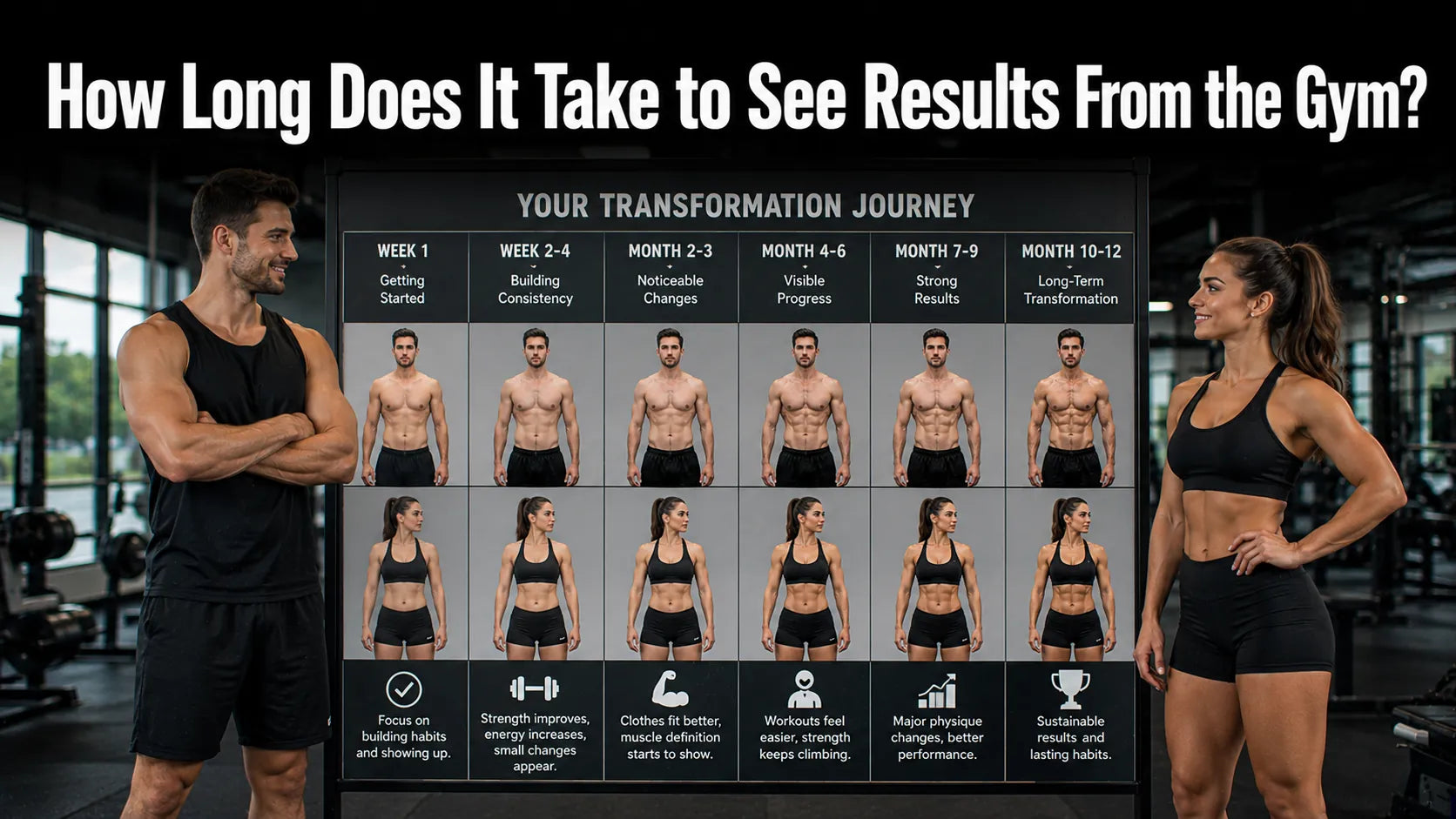
One of the first questions almost everyone asks after joining a gym is:
"How long before I actually see results?"
It's a fair question.
Nobody starts training because they enjoy being a beginner.
People join gyms because they want something to change.
They want to:
- build muscle
- lose body fat
- get stronger
- improve fitness
- feel more confident
The problem is that most people have no idea how quickly those changes actually happen.
Social media doesn't help.
One video claims you can transform your body in 30 days.
Another promises dramatic results in six weeks.
Then someone else says meaningful progress takes years.
It's enough to leave anyone confused.
The reality is that results happen much sooner than many people think.
But they rarely appear in the order people expect.
Most beginners focus entirely on physical changes.
They spend every morning checking the mirror.
Watching the scales.
Looking for visible differences.
Meanwhile, some of the most important improvements are already happening beneath the surface.
Understanding that timeline is crucial because it's often the difference between sticking with training and quitting too early.
1. How soon can you expect to feel fitter after starting the gym?
Usually much sooner than you expect.
This surprises many beginners because they assume visible changes will arrive first.
In reality, performance improvements often appear before physical ones.
Within the first few weeks, many people start noticing:
- better stamina
- improved recovery
- more energy
- less breathlessness
- increased confidence during workouts
These changes aren't always dramatic.
But they're important.
The body adapts surprisingly quickly when exposed to consistent training.
Activities that felt exhausting during Week 1 often feel much easier by Week 3 or Week 4.
This is one reason experienced coaches often encourage beginners to focus on performance rather than appearance during the early stages.
The mirror may take time.
Your fitness often improves first.

2. When do most people start noticing physical changes in the mirror?
This is usually where impatience begins.
Most people expect visible changes within days.
Unfortunately, the body doesn't work that way.
Physical changes are often subtle at first.
You may not notice them every day.
In fact, the people around you often notice before you do.
This happens because you're looking at yourself constantly.
Small changes become difficult to spot.
Yet over several weeks, those small changes begin accumulating.
Clothes may fit differently.
Posture may improve.
Muscles may appear slightly fuller.
Body fat may begin decreasing.
The important thing is that visible changes usually lag behind performance improvements.
Many people are making excellent progress long before they realise it.
3. How long does it take to build visible muscle?
Building visible muscle takes time.
But it often happens faster than beginners expect.
One of the biggest advantages new gym-goers have is that almost any sensible training programme represents a completely new stimulus.
The body responds quickly.
Strength increases.
Movement quality improves.
Muscle-building processes begin.
Products such as Per4m Advanced Whey Protein – 2.01kg can help support this process by making it easier to consistently hit daily protein targets. That doesn't guarantee muscle growth, but it helps provide the nutritional foundation required for it.
The key mistake many people make is expecting visible muscle growth every week.
Muscle development is more like watching a tree grow than watching paint dry.
The changes happen gradually.
But after several months, they become difficult to ignore.
4. How quickly can you lose body fat with consistent training?
This depends on several factors:
- starting body weight
- calorie intake
- activity levels
- training consistency
- recovery
But one thing is almost always true:
Fat loss tends to happen more slowly than social media suggests.
That's not bad news.
It's actually encouraging.
Because sustainable fat loss is usually the kind that stays off.
The people who achieve the best long-term results are rarely the ones chasing extreme diets.
They're the ones creating habits they can maintain.
Training helps.
Nutrition helps.
Consistency helps.
And over time, those small decisions begin creating visible differences in body composition.
The challenge is that most people stop too soon.
They expect three months of results after three weeks of effort.
That's where many transformations fail before they ever truly begin.

5. Why do some people see results much faster than others?
This is one of the most misunderstood parts of fitness.
People often assume fast progress comes from:
- genetics
- expensive supplements
- secret workout plans
Sometimes those factors matter.
Usually, consistency matters more.
The people who progress fastest tend to do the basics extremely well.
They train regularly.
They recover properly.
They eat appropriately.
They show up even when motivation disappears.
Products such as Naughty Boy Prime Creatine 450g can support performance and progression, but they cannot replace consistency.
That's why two people can take the same supplements, follow similar programmes, and experience completely different outcomes.
One follows the plan.
The other follows it occasionally.
The results eventually reflect that difference.
Intermission
So far we've explored how quickly fitness improvements appear, when visible physical changes usually become noticeable, how long muscle growth and fat loss take, and why some people seem to progress much faster than others.
In Part 2, we'll look at the habits that have the biggest impact on gym progress, whether supplements can speed up results, the most common mistakes that hold people back, how to stay motivated when progress feels slow, and what you can realistically expect after 1 month, 3 months, 6 months, and 1 year of consistent training.
Part 2
6. Which habits have the biggest impact on gym progress?
The fitness industry loves complexity.
The human body often rewards simplicity.
When people look back on successful transformations, they rarely say:
"Everything changed when I discovered a secret training technique."
Instead, they usually point to habits they repeated consistently.
The biggest progress drivers tend to be:
- training regularly
- eating enough protein
- sleeping well
- staying hydrated
- managing stress
- remaining consistent
None of those are particularly exciting.
That's precisely why they work.
Most people underestimate how powerful basic habits become when repeated for months.
A good workout can improve a day.
Good habits can improve a year.
This is one reason products such as Applied Nutrition Cream of Rice – 1kg remain popular among gym-goers. It's not because it's magical. It's because having a simple, reliable source of carbohydrates can make it easier to consistently fuel training sessions.


Progress often comes from making good decisions easier to repeat.

7. Can supplements help you see results sooner?
To a degree, yes.
But probably not in the way many people hope.
Supplements work best when they support an already solid plan.
They don't replace effort.
They don't replace nutrition.
And they definitely don't replace consistency.
What they can do is help remove some obstacles.
For example, Naughty Boy Prime Creatine 450g can support strength progression and training performance.
Per4m Advanced Whey Protein – 2.01kg can make it easier to hit protein targets.
EHP Labs Hydreau can support hydration and workout quality.
The important thing is understanding where supplements sit in the hierarchy.
Think of them as assistants rather than drivers.
They can help accelerate progress around the edges.
The core results still come from training and nutrition.
8. What are the most common mistakes that slow progress down?
Most people don't fail because they're doing too little.
They fail because they're trying to do too much.
They become impatient.
They try extreme diets.
They train every day despite being exhausted.
They constantly switch programmes.
They spend more time looking for the perfect plan than following a good one.
Common progress killers include:
- inconsistency
- poor sleep
- unrealistic expectations
- programme hopping
- excessive calorie restriction
- comparing yourself to others
Ironically, many people quit just before results become noticeable.
Fitness rewards patience.
Unfortunately, patience isn't particularly popular.
That's why so many people stop when progress feels slow, even though they're actually moving in the right direction.
9. How do you stay motivated when results aren't showing yet?
By understanding that motivation is unreliable.
Most people expect motivation to carry them through an entire transformation.
It won't.
Motivation comes and goes.
Habits stay.
The people who achieve impressive long-term results aren't usually the most motivated.
They're the most consistent.
One useful strategy is shifting your focus away from appearance and towards performance.
Instead of asking:
"Do I look different?"
Ask:
"Am I stronger than last month?"
Or:
"Can I do more than I could four weeks ago?"
Progress becomes much easier to spot when measured through performance.
Tracking helps too.
Photos.
Measurements.
Training logs.
All of these provide evidence when motivation starts disappearing.
Because when results feel invisible, data often tells a different story.

10. What should you realistically expect after 1 month, 3 months, 6 months, and 1 year of training?
This is where expectations become important.
After 1 Month
Most people notice:
- better fitness
- increased energy
- improved workout confidence
- early strength gains
Visible physical changes are often small but beginning.
After 3 Months
This is where many transformations start becoming noticeable.
People often experience:
- improved body composition
- greater strength
- better muscle definition
- increased confidence
Friends and family may begin noticing changes too.
After 6 Months
The gap between your old self and your current self often becomes obvious.
Many people report:
- significant strength improvements
- visible muscle growth
- meaningful fat loss
- dramatically improved fitness
At this point, the lifestyle often feels normal rather than forced.
After 1 Year
This is where the compound effect becomes remarkable.
People who stay consistent for twelve months frequently look, feel, and perform like completely different individuals compared to where they started.
Not because of any secret.
Because they continued showing up.
This is also where broader health habits start paying dividends. Products such as Per4m Advanced Omega 3 often fit naturally into this stage because long-term success is usually built on maintaining good habits rather than chasing short-term fixes.

Conclusion
So, how long does it take to see results from the gym?
The honest answer is:
Sooner than you think—but probably not in the way you expect.
Fitness improvements often arrive first.
Strength improvements often arrive second.
Visible changes usually take a little longer.
The mistake many people make is quitting before those changes have time to accumulate.
Because fitness isn't built in a single workout.
It's built through hundreds of workouts.
It's built through consistent meals.
Consistent sleep.
Consistent effort.
And while dramatic transformations don't happen overnight, they absolutely happen over time.
The people who achieve them aren't usually the luckiest.
They're simply the ones who stayed in the game long enough for the results to arrive.
FAQ
1. How long does it take to see results from the gym?
Many people notice fitness and strength improvements within the first few weeks, while visible changes often take longer.
2. When do beginners usually start seeing gym results?
Most beginners notice meaningful progress within the first few months of consistent training.
3. How long does it take to build noticeable muscle?
This varies, but visible muscle growth often becomes more noticeable after several months of consistent training and nutrition.
4. How quickly can you lose body fat at the gym?
Fat-loss rates vary, but sustainable progress is usually achieved through consistent training and nutrition over time.
5. Do supplements help you see results faster?
They can support progress, but they work best alongside good training, nutrition, and recovery habits.
6. Why do some people get results faster than others?
Consistency, recovery, nutrition, training quality, and genetics all influence progress.
7. What should I expect after 3 months in the gym?
Many people experience noticeable improvements in strength, fitness, body composition, and confidence.
8. How long does it take to transform your body naturally?
Meaningful changes can occur within months, while major transformations often take years of consistent effort.


