


Walk into almost any commercial gym and you'll see rows of resistance machines.
Chest press machines.
Leg extensions.
Cable stations.
Lat pulldowns.
It's easy to assume they're essential if your goal is building muscle.
But what happens if you don't have access to them?
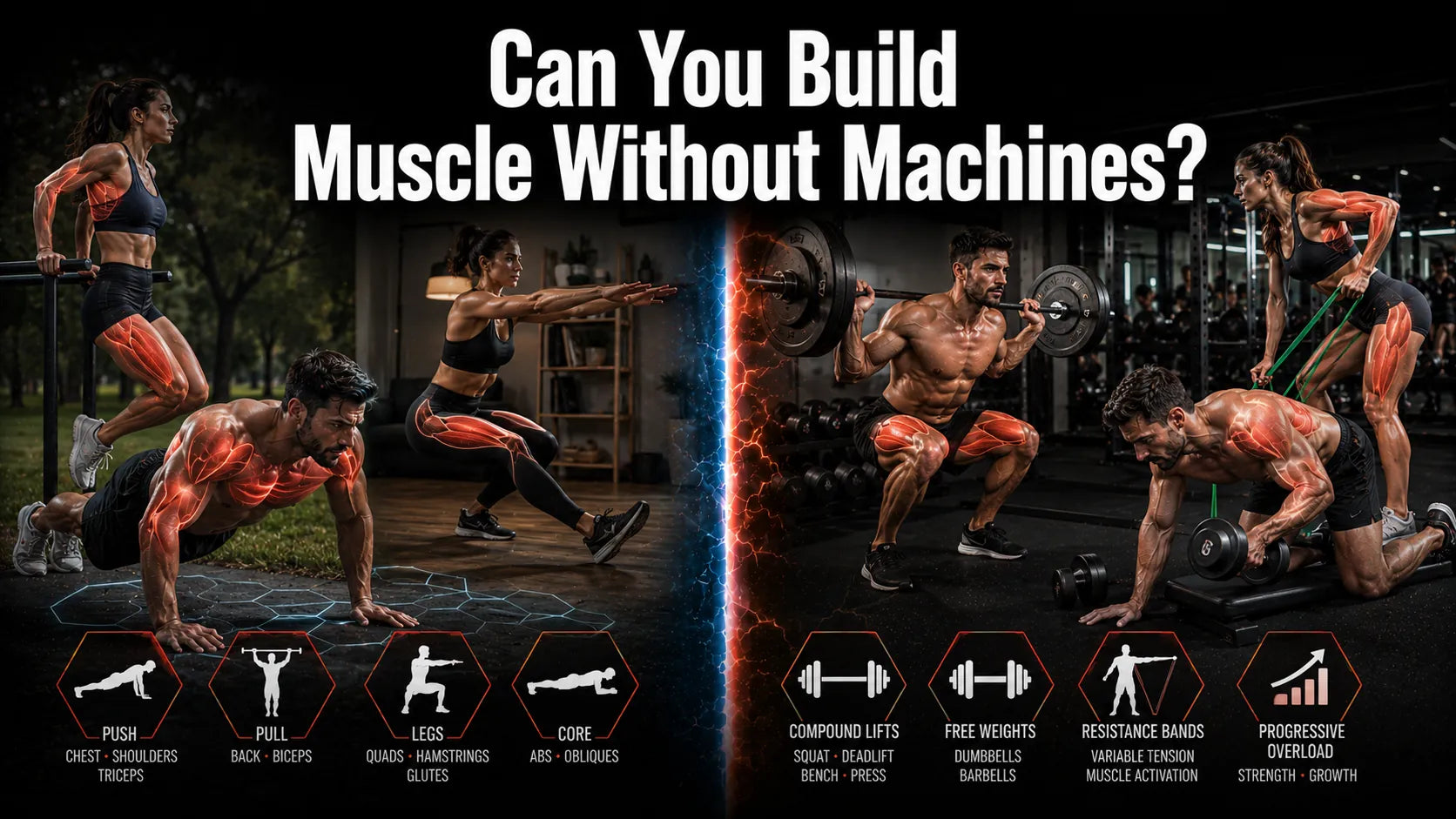
Can you still build an impressive physique with free weights, bodyweight exercises or resistance bands?
The simple answer is yes.
Machines can certainly be useful.
However, they're far from the only way to stimulate muscle growth.
For decades, athletes, powerlifters, gymnasts and bodybuilders built exceptional physiques long before modern selectorised machines became common.
The real drivers of muscle growth aren't machines.
They're:
- progressive overload
- training intensity
- consistency
- recovery
- nutrition
Understanding these principles matters far more than the equipment you're using.
Let's explore how muscle is really built.
1. Can Bodyweight Training Build Muscle?
Absolutely.
Your muscles don't know whether resistance comes from a machine, a dumbbell or your own body weight.
They simply respond to challenge.
Bodyweight exercises such as:
- press-ups
- pull-ups
- dips
- Bulgarian split squats
- pistol squats
- inverted rows
can all stimulate muscle growth when performed with enough effort.
The biggest limitation isn't effectiveness.
It's progression.
Beginners can build significant muscle using nothing more than bodyweight exercises.
As strength improves, however, adding resistance or increasing exercise difficulty becomes increasingly important.
That doesn't make bodyweight training inferior.
It simply means progression must continue.

2. Are Free Weights Better Than Machines?
Neither is universally better.
They simply have different strengths.
Free weights require more stabilisation.
That means more muscles often contribute to each lift.
Exercises such as:
- squats
- deadlifts
- bench presses
- overhead presses
- rows
develop coordination alongside strength.
Machines, meanwhile, reduce the need for stabilisation and allow you to focus more directly on specific muscles.
For overall athletic development, many coaches build programmes around free weights first before adding machines where appropriate.
If you don't have access to machines, you're certainly not at a disadvantage.
Many of the world's strongest athletes rarely depend on them.
3. Do Resistance Bands Really Work?
They do.
Resistance bands are often underestimated because they're lightweight and portable.
In reality, they can provide excellent muscular tension throughout many exercises.
Bands work particularly well for:
- rows
- presses
- shoulder exercises
- glute training
- arm isolation work
They're also ideal for travelling or training at home.
Like every other training tool, results depend on how they're used.
Progressive overload still matters.
Increasing resistance, repetitions or training difficulty remains essential for continued muscle growth.
The equipment changes.
The principles don't.
4. Can You Progress Without Machines?
Definitely.
Progressive overload has nothing to do with machines.
It simply means asking your muscles to do slightly more over time.
That could involve:
- adding weight
- performing more repetitions
- improving technique
- increasing training volume
- slowing the tempo
- reducing rest periods
Naughty Boy Prime Creatine 450g can naturally support a structured strength programme where your goal is gradually improving performance over weeks and months.
The most successful lifters don't chase random workouts.
They measure progress consistently.
Machines can make progression convenient.
They don't make it possible.

5. Which Exercises Build the Most Muscle?
Generally speaking, compound exercises provide the greatest return.
These movements train multiple muscle groups simultaneously while allowing significant progressive overload.
Excellent machine-free exercises include:
- squats
- Romanian deadlifts
- bench press
- overhead press
- pull-ups
- chin-ups
- barbell rows
- lunges
- dips
To perform these exercises well, your body needs sufficient energy.
Applied Nutrition Cream Of Rice – 1kg provides an easy-to-digest carbohydrate source that many people use before training to help fuel demanding strength workouts.


Exercise selection certainly matters.
But effort, consistency and progression matter even more.
Intermission
So far we've explored how bodyweight exercises can build muscle, compared free weights with machines, looked at the effectiveness of resistance bands, explained how progressive overload works without machines, and highlighted the exercises that deliver the greatest muscle-building stimulus.
In Part 2, we'll cover the mistakes that slow muscle growth, which supplements support muscle development, when machines may actually be the better option, how long muscle building typically takes, and how to structure an effective machine-free workout plan.
Part 2
6. What Mistakes Slow Muscle Growth?
One of the biggest misconceptions in fitness is believing that simply turning up is enough to build muscle.
While consistency is important, poor training habits can dramatically slow your progress.
Some of the most common mistakes include:
- never increasing the difficulty of your workouts
- using poor technique
- skipping recovery days
- eating too little
- constantly changing your programme
- not training close enough to muscular fatigue
Many people also underestimate the importance of patience.
Muscle doesn't appear overnight.
It develops gradually through months of consistent training.
Improving one or two of these habits often produces far greater results than constantly searching for the latest training trend.

7. Which Supplements Support Muscle Growth?
Supplements don't build muscle on their own.
Your training and nutrition always come first.
However, once those foundations are in place, certain supplements can make it easier to consistently support muscle growth.
Per4m Plant Protein – 2kg offers a convenient way to increase your daily protein intake, helping you meet the protein requirements needed for muscle repair and growth, particularly if you follow a plant-based diet or simply struggle to eat enough protein from whole foods.


Animal Creatine – 300 Capsules can naturally support strength and high-intensity performance as part of a structured resistance training programme, making progressive overload easier to achieve over time.

Neither supplement replaces hard work.
They simply help support the habits that drive long-term progress.
8. When Are Machines Actually Better?
Although you don't need machines to build muscle, there are situations where they can be extremely useful.
Machines can be particularly beneficial for:
- beginners learning movement patterns
- safely training close to failure
- isolating individual muscles
- training around injuries
- finishing a workout with extra volume
For example, a leg extension machine isolates the quadriceps far more than a squat.
Likewise, a chest press machine allows many people to safely push close to muscular failure without needing a spotter.
Machines aren't inferior.
They're simply another tool.
The best training programmes often combine free weights, bodyweight exercises and machines where available.
If machines aren't available, however, excellent results are still completely achievable.
9. How Long Does It Take to See Results?
One of the biggest mistakes beginners make is expecting dramatic changes within a few weeks.
Real muscle growth takes time.
Most people begin noticing improvements in:
- strength within a few weeks
- muscle definition after several weeks of consistent training
- visible muscle growth over the following months
The exact timeline depends on factors including:
- training quality
- recovery
- nutrition
- genetics
- consistency
Supporting your recovery is equally important.
USN Muscle Fuel Anabolic 4kg can naturally help people with higher calorie and protein requirements meet their daily nutritional targets while working towards muscle-building goals.


Building muscle isn't about finding shortcuts.
It's about consistently doing the right things for long enough.

10. What's the Best Machine-Free Workout Plan?
A good machine-free programme focuses on the movements that deliver the greatest overall return.
A simple full-body approach might include:
- Squats
- Romanian Deadlifts
- Bench Press
- Overhead Press
- Pull-Ups or Chin-Ups
- Bent-Over Rows
- Lunges
- Press-Ups
- Dips
- Planks
Aim to progressively improve your performance by:
- adding small amounts of weight
- performing extra repetitions
- improving technique
- increasing training quality
Combined with sensible nutrition and adequate recovery, this approach can build impressive amounts of muscle without relying on machines.
Remember, muscles respond to tension—not to expensive equipment.
Conclusion
Gym machines are useful.
But they're far from essential.
Muscle growth depends on challenging your muscles consistently, recovering properly and eating enough to support adaptation.
Whether you train with:
- barbells
- dumbbells
- resistance bands
- bodyweight exercises
the principles remain exactly the same.
Focus on progressive overload.
Master the basics.
Stay patient.
Machines may make certain exercises more convenient, but they don't hold the secret to building muscle.
Your consistency does.
FAQ
1. Can you build muscle without machines?
Yes. Free weights, bodyweight exercises and resistance bands can all stimulate muscle growth when used with progressive overload.
2. Are free weights better than machines?
Neither is universally better. Free weights generally develop more stabilising muscles, while machines are useful for isolating specific muscles.
3. Can resistance bands really build muscle?
Yes. When used correctly and progressed over time, resistance bands can provide enough resistance to stimulate muscle growth.
4. Do beginners need gym machines?
No. Beginners can make excellent progress using basic free-weight and bodyweight exercises.
5. Is progressive overload possible without machines?
Absolutely. You can progressively increase weight, repetitions, sets, tempo or exercise difficulty using many different training methods.
6. Which supplements support muscle growth?
Protein supplements and creatine can support muscle-building goals when combined with effective training and good nutrition.
7. How long does it take to build muscle?
Most people notice strength improvements within a few weeks, while visible muscle growth usually takes several months of consistent training.
8. What's the best machine-free workout?
A programme built around compound movements such as squats, presses, rows, pull-ups and lunges provides an excellent foundation for building muscle.


