


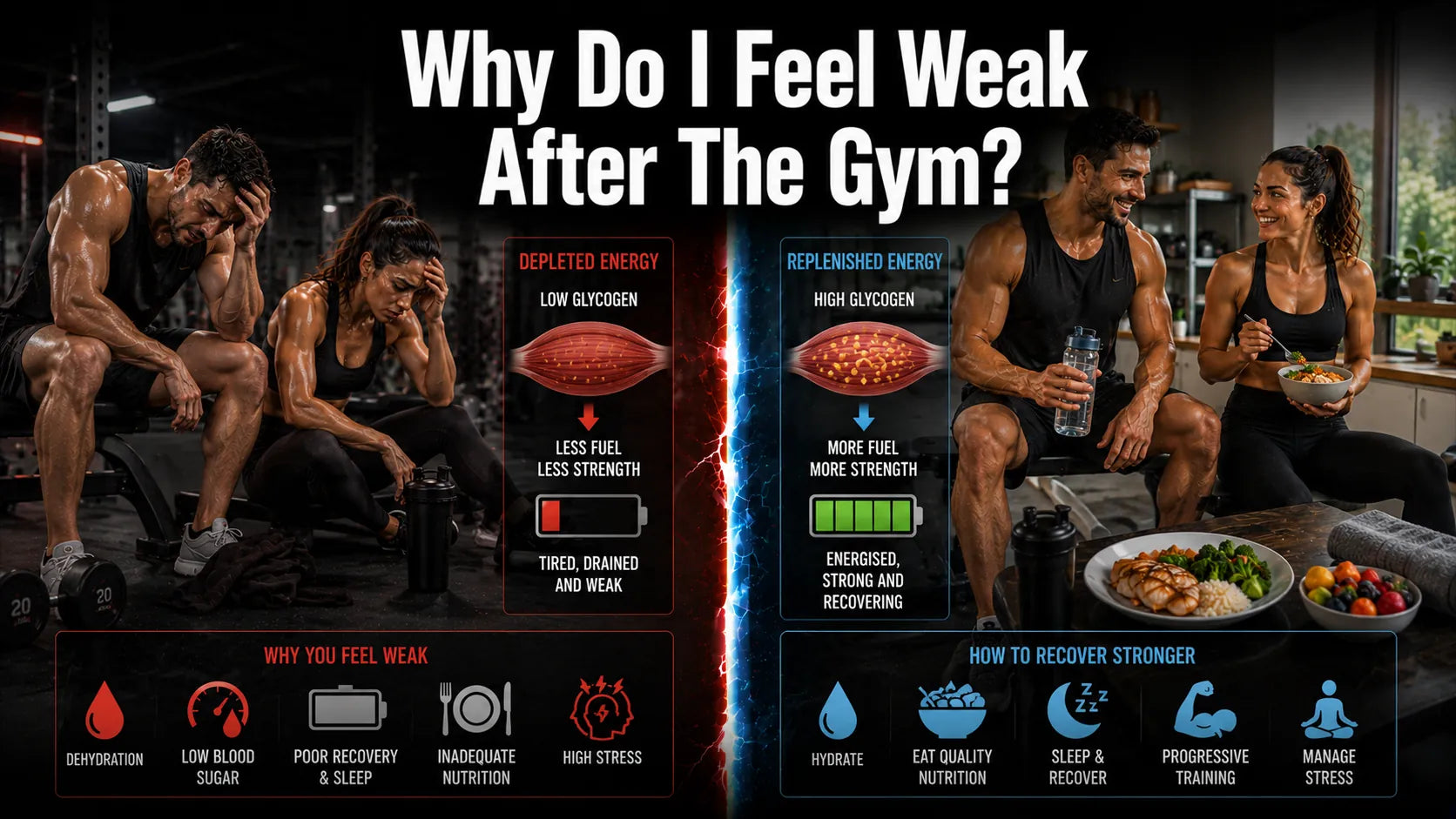
Walking out of the gym feeling tired is completely normal.
Walking out feeling genuinely weak is different.
Perhaps your legs feel like jelly after squats.
Maybe your grip strength disappears after a heavy pull session.
Or perhaps you simply feel drained for the rest of the day.
Experiencing temporary weakness after exercise is incredibly common.
After all, you've just challenged your muscles, nervous system and energy stores.
However, if you feel weak after every workout, or your strength seems to be getting worse instead of better, it's worth understanding why.
In many cases, post-workout weakness isn't caused by a lack of effort.
It's often linked to simple recovery factors such as:
- nutrition
- hydration
- sleep
- training volume
- recovery habits
The encouraging news is that most of these issues can be improved with a few practical changes.
Let's start by looking at the most common causes.
1. Is It Normal to Feel Weak After Exercise?
Yes.
Exercise is designed to challenge your body.
During training, your muscles use stored energy, your nervous system works hard, and fatigue gradually builds.
It's perfectly normal to notice temporary weakness immediately afterwards.
That weakness often disappears once your body begins recovering.
How weak you feel depends on several factors, including:
- workout intensity
- training volume
- muscle groups trained
- nutrition
- hydration
- sleep
Heavy leg sessions, for example, usually leave people feeling far more fatigued than a lighter upper-body workout.
Feeling temporarily weak doesn't necessarily mean you've lost muscle or strength.
It often means your body has worked hard and is beginning the recovery process.

2. Could Low Blood Sugar Be the Cause?
One of the most common reasons people feel weak after training is that they've simply run low on energy.
Your muscles rely heavily on carbohydrates during exercise.
If you've trained:
- on an empty stomach
- after skipping meals
- in a large calorie deficit
- for an extended period
your blood sugar may fall enough to leave you feeling:
- weak
- shaky
- tired
- lightheaded
- unable to concentrate
Replacing those energy stores is an important part of recovery.
Applied Nutrition Body Fuel Energy Shot 12 × 60ml can fit naturally into a demanding training schedule by providing a convenient source of energy around busy workouts when appropriate.


The goal isn't simply consuming more calories.
It's making sure your body has enough available energy to perform well.
3. Does Dehydration Reduce Muscle Strength?
Absolutely.
Even mild dehydration can noticeably affect performance.
Water helps maintain:
- muscle function
- blood circulation
- temperature regulation
- nutrient delivery
When fluid levels fall, muscles often fatigue more quickly.
Heavy sweating without replacing lost fluids can contribute to:
- weakness
- muscle cramps
- headaches
- reduced endurance
Optimum Nutrition Electrolyte – 264g can naturally support your hydration routine by helping replace electrolytes lost during demanding training sessions.


Good hydration begins long before your workout finishes.
Staying hydrated throughout the day often leads to much better performance.
4. Are You Recovering Properly After Training?
Many people focus entirely on the workout itself.
Recovery receives far less attention.
Yet recovery is where your body actually adapts.
Without enough recovery, fatigue accumulates faster than fitness.
Recovery includes:
- eating enough
- replacing carbohydrates
- consuming adequate protein
- staying hydrated
- managing stress
- sleeping well
USN Muscle Fuel Anabolic 4kg can naturally support recovery for people with high energy requirements by providing protein and carbohydrates after demanding training sessions.


Recovering well today helps you perform better tomorrow.
Ignoring recovery often leads to feeling progressively weaker over time.

5. Can Overtraining Leave You Feeling Weak?
Yes.
More training isn't always better training.
Many people respond to slow progress by simply adding:
- more workouts
- more sets
- more exercises
- more intensity
Eventually the body struggles to keep up.
Instead of becoming stronger, performance begins to decline.
Common signs of excessive training include:
- persistent weakness
- declining lifts
- poor motivation
- ongoing soreness
- slower recovery
ABE All Black Everything – Ultimate Pre-Workout is designed to support focused, high-quality workouts, but even the best pre-workout can't compensate for inadequate recovery or excessive training volume.
Training harder only works if your body is recovering well enough to adapt.
Intermission
So far we've explored why temporary weakness after exercise is often completely normal, how low blood sugar and dehydration affect performance, why proper recovery is essential, and how overtraining can gradually reduce your strength instead of improving it.
In Part 2, we'll look at how sleep influences muscle recovery, which supplements may support strength, when weakness could indicate a more serious issue, practical ways to recover faster, and the best habits for staying strong after every workout.
Part 2
6. Does Poor Sleep Affect Muscle Recovery?
Without question.
Sleep is one of the most important parts of recovery.
While you're asleep, your body works hard to:
- repair muscle tissue
- restore energy stores
- support hormone production
- prepare your nervous system for your next workout
Consistently poor sleep often leads to:
- reduced strength
- slower recovery
- lower motivation
- poorer concentration
- increased fatigue
Many people blame their training programme when the real problem starts the night before.
Building a consistent sleep routine often improves gym performance far more than constantly changing workouts.

7. Which Supplements Help Restore Strength?
Supplements won't instantly restore lost strength.
If you're under-eating, dehydrated or sleeping badly, those issues need addressing first.
Once your foundations are in place, certain supplements can complement your recovery routine.
Reflex Nutrition Acetyl-L-Carnitine 90 Caps can naturally fit into a performance-focused routine by supporting mental focus and helping maintain training consistency during demanding periods.

Good recovery isn't about relying on supplements.
It's about using them to support already solid habits.
8. When Is Weakness a Warning Sign?
Feeling tired after a difficult workout is normal.
Persistent weakness isn't.
If weakness continues despite:
- eating well
- recovering properly
- sleeping enough
- following a sensible training programme
it's worth investigating further.
You should also seek medical advice if weakness is accompanied by:
- chest pain
- fainting
- severe dizziness
- difficulty breathing
- unexplained weight loss
- weakness affecting everyday activities
Most cases of post-workout weakness are related to recovery.
However, ongoing symptoms should never be ignored.
9. How Can You Recover Faster After Workouts?
The fastest recovery usually comes from consistently getting the basics right.
Focus on:
- replacing lost fluids
- eating enough carbohydrates
- consuming adequate protein
- cooling down properly
- managing training volume
- getting quality sleep
Many people search for complicated recovery methods when simple daily habits produce the biggest improvements.
Recovery isn't something that happens by chance.
It's something you actively support every day.

10. What's the Best Way to Stay Strong After Training?
Staying strong isn't about one perfect workout.
It's about recovering well enough to train consistently week after week.
Build your recovery around:
- balanced meals
- sufficient hydration
- progressive overload
- quality sleep
- planned rest days
Avoid chasing exhaustion every session.
Instead, aim for sustainable progress.
The strongest athletes aren't necessarily those who train the hardest.
They're often the ones who recover the smartest.
When your recovery improves, your strength usually follows.
Conclusion
Feeling weak after the gym doesn't automatically mean you're losing muscle or getting weaker.
More often than not, it's your body's way of telling you that it needs better recovery.
Whether the cause is:
- low energy
- dehydration
- poor sleep
- excessive training
- inadequate recovery
small improvements can quickly make a noticeable difference.
Focus on giving your body the resources it needs to recover.
When recovery improves, strength, performance and confidence usually improve alongside it.
FAQ
1. Is it normal to feel weak after the gym?
Yes. Temporary weakness after a demanding workout is common as your muscles and nervous system recover.
2. Can low blood sugar make me feel weak after exercise?
Yes. Training without enough available energy can leave you feeling weak, shaky and fatigued afterwards.
3. Does dehydration reduce muscle strength?
Absolutely. Even mild dehydration can negatively affect muscle function, endurance and recovery.
4. Can overtraining make you weaker?
Yes. Excessive training without adequate recovery often causes declining performance and persistent fatigue.
5. Does poor sleep affect muscle recovery?
Yes. Quality sleep is one of the most important factors for repairing muscle tissue and restoring energy.
6. Which supplements may support strength recovery?
Performance and recovery supplements can complement a balanced diet and good recovery habits, but they can't replace them.
7. How can I recover faster after a workout?
Prioritise hydration, balanced nutrition, quality sleep, sensible training volume and adequate recovery time.
8. When should I worry about weakness after exercise?
If weakness is severe, persistent or accompanied by symptoms such as chest pain, fainting or difficulty breathing, seek medical advice.


