


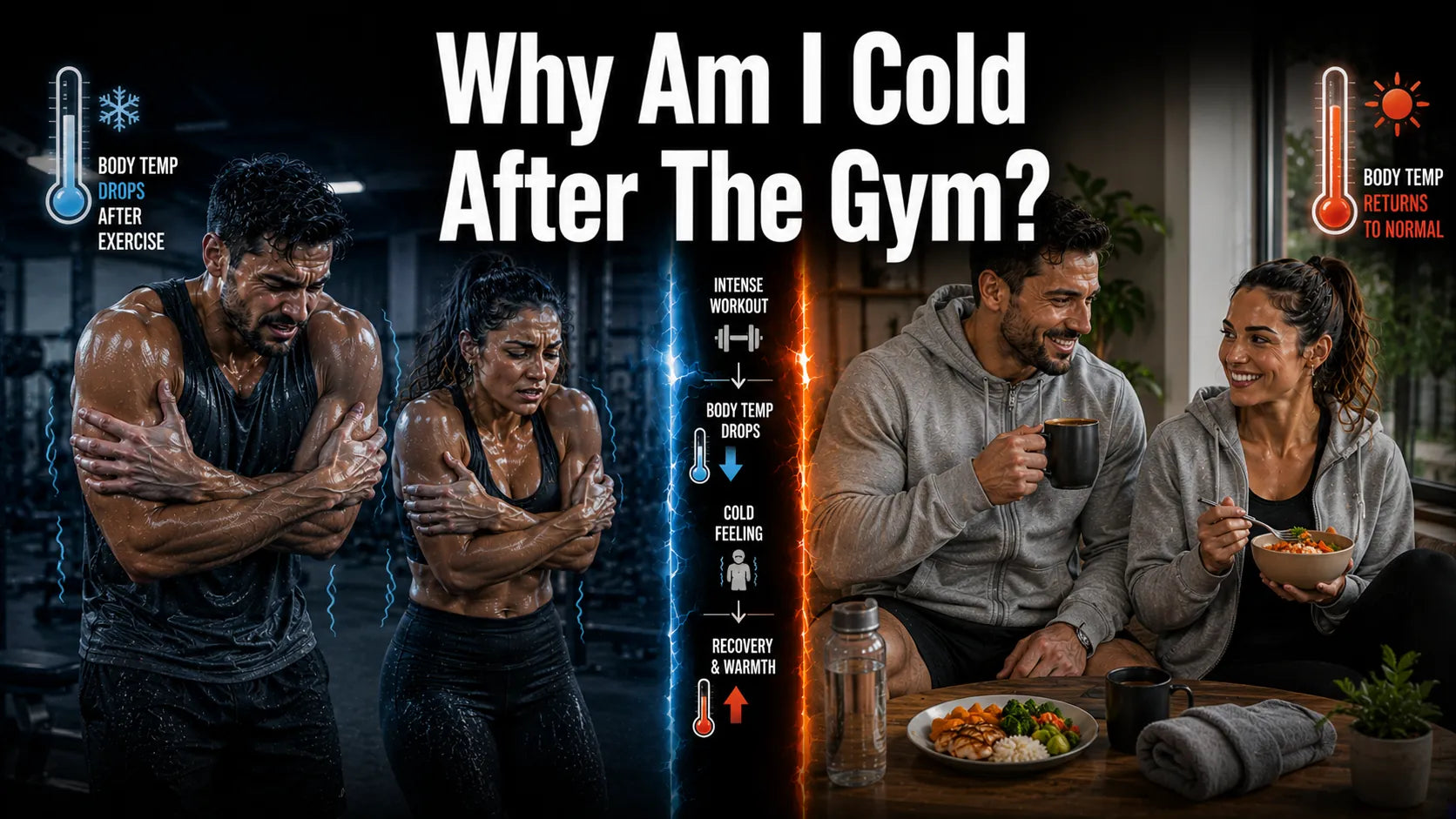
Finishing a workout usually leaves you feeling warm.
Your heart rate is elevated.
Your muscles are working.
You've probably broken a sweat.
So it can feel strange when, just a few minutes later, you suddenly become cold.
Some people even start shivering.
Others notice cold hands, cold feet or a sudden drop in body temperature that seems completely out of place after exercise.
If this happens occasionally, it's usually nothing to worry about.
In many cases, it's simply your body's way of returning to its normal temperature after working hard.
However, feeling cold after the gym can sometimes point towards recovery habits that could be improved.
Factors such as:
- hydration
- calorie intake
- body fat
- nutrition
- recovery
can all influence how your body regulates temperature after exercise.
Understanding why you're getting cold is the first step towards preventing it.
Let's look at the most common reasons.
1. Is It Normal to Feel Cold After Exercise?
Yes.
Many people experience a noticeable drop in body temperature after finishing a workout.
During exercise, your muscles generate large amounts of heat.
Your body responds by increasing blood flow to the skin and producing sweat to help cool you down.
Once exercise stops, however, heat production quickly falls.
If your body continues cooling itself for a short period, you may suddenly feel cold.
This effect is often stronger if:
- you've sweated heavily
- the gym is air conditioned
- you're wearing damp clothing
- you've stopped moving suddenly
In most cases, this feeling passes within a short time as your body returns to its normal resting temperature.
Occasional chills after training are usually a normal part of recovery.

2. Could Low Blood Sugar Be the Cause?
Your body relies on stored carbohydrates to fuel exercise.
After a demanding workout, those energy stores may be partially depleted.
If you've trained:
- on an empty stomach
- in a large calorie deficit
- for a long period
- at high intensity
your blood sugar may temporarily fall.
This can contribute to symptoms such as:
- feeling cold
- shakiness
- dizziness
- fatigue
- weakness
Replacing energy after training helps your body begin recovering.
Applied Nutrition Critical Mass Original 6kg can naturally help increase calorie and carbohydrate intake for people who struggle to consume enough energy to support demanding training sessions.


The goal isn't simply eating more.
It's making sure your body has enough fuel to recover properly.
3. Does Dehydration Affect Body Temperature?
Absolutely.
Hydration plays an important role in temperature regulation.
When you're dehydrated, your body finds it harder to control heat production and cooling efficiently.
Heavy sweating without replacing lost fluids may contribute to:
- feeling cold afterwards
- headaches
- fatigue
- reduced performance
- slower recovery
This becomes more noticeable during longer workouts or hot weather.
BetterYou Magnesium Water – Hydrate provides a convenient way to increase fluid intake after training while replacing important minerals lost through sweat.


Good hydration supports much more than performance.
It also helps your body regulate temperature more effectively.
4. Are You Eating Enough to Recover?
Many people focus so heavily on burning calories that they forget recovery requires energy too.
Training creates stress on the body.
Recovering from that stress requires fuel.
If you're consistently under-eating, your body may respond by conserving energy.
One possible consequence is feeling colder than usual.
Recovery nutrition supports:
- restoring glycogen
- muscle repair
- energy levels
- normal body functions
Eating enough after training doesn't mean undoing your workout.
It means giving your body the resources it needs to recover properly.
Finding the right balance is often one of the biggest improvements people can make.

5. Can Low Body Fat Make You Feel Colder?
For some people, yes.
Body fat acts as insulation.
People carrying very low levels of body fat often lose heat more quickly than those carrying slightly more.
This is particularly common among:
- endurance athletes
- bodybuilders during contest preparation
- people following aggressive diets
Feeling cold doesn't automatically mean your body fat is too low.
However, if you've recently lost a significant amount of weight while eating very little, reduced insulation may contribute to feeling colder after training.
Combined with low calorie intake and heavy exercise, the effect can become even more noticeable.
Understanding your overall recovery—not just your body fat percentage—is often the key to staying healthy while pursuing your fitness goals.
Intermission
So far we've explored why feeling cold after exercise is often completely normal, how low blood sugar and dehydration can contribute to chills, why eating enough supports recovery, and how low body fat may influence your body's ability to retain heat.
In Part 2, we'll examine whether nutrient deficiencies can play a role, which supplements may support recovery, when feeling cold becomes a warning sign, practical ways to stay warm after training, and the best recovery routine to help your body return to normal.
Part 2
6. Could Nutrient Deficiencies Play a Role?
Sometimes they can.
Feeling cold after exercise isn't usually caused by a vitamin or mineral deficiency alone.
However, deficiencies can contribute to symptoms such as:
- fatigue
- reduced energy
- poor recovery
- feeling colder than usual
Iron deficiency, for example, may reduce the body's ability to transport oxygen efficiently, while low vitamin D levels can affect overall health and wellbeing.
If you're eating a varied, balanced diet, deficiencies are less likely.
However, restrictive diets or long-term calorie deficits can increase the risk.
Applied Nutrition Vitality Vitamin D3 can naturally support your daily vitamin D intake, particularly during the darker months when sunlight exposure is often limited.

If you suspect a nutritional deficiency, it's always worth speaking with a healthcare professional rather than self-diagnosing.

7. Which Supplements Support Better Recovery?
No supplement can stop you feeling cold if the real issue is poor recovery or inadequate nutrition.
The foundations always come first.
That means:
- eating enough
- staying hydrated
- sleeping well
- recovering properly
Once those habits are established, supplements can complement your routine.
Per4m Whey Hydrate – 1.8kg provides protein alongside hydration support, making it a convenient option after training when your body is beginning the recovery process.


Recovery starts long before your next workout.
The better you recover today, the better you'll usually perform tomorrow.
8. When Is Feeling Cold a Warning Sign?
Feeling slightly cold after a demanding workout is usually harmless.
Persistent or severe symptoms are different.
Consider seeking medical advice if feeling cold is accompanied by:
- chest pain
- dizziness that doesn't improve
- fainting
- severe weakness
- confusion
- persistent shivering lasting a long time
If you regularly feel extremely cold despite eating well, recovering properly and dressing appropriately, it's sensible to investigate further.
Most cases are linked to normal recovery.
But persistent symptoms deserve proper assessment.
9. How Can You Stay Warm After Training?
Fortunately, staying warm after exercise is often straightforward.
Simple habits make a noticeable difference.
Try to:
- change out of sweaty clothes promptly
- drink fluids regularly
- eat a balanced recovery meal
- avoid standing still immediately after training
- cool down gradually rather than stopping suddenly
Keeping a light hoodie or jacket with you is another simple way to prevent your body temperature dropping too quickly after leaving the gym.
The goal is helping your body transition comfortably from exercise back to rest.

10. What's the Best Recovery Routine After Exercise?
Recovery should begin as soon as your workout finishes.
Rather than rushing home or sitting down immediately, follow a simple routine.
Start with:
- a gradual cool-down
- replacing lost fluids
- eating protein and carbohydrates
- changing into dry clothing
- allowing time for proper recovery
Chaos Crew ZMA – 30 Capsules can naturally become part of your evening recovery routine by helping you prioritise quality sleep, which is one of the most important parts of long-term recovery.

When you consistently recover well, you'll often notice improvements not only in strength and performance, but also in how comfortable you feel after every workout.
Conclusion
Feeling cold after the gym can feel unusual, but in most cases it's simply part of your body's recovery process.
As your heart rate slows and your body returns to its normal temperature, temporary chills are often completely normal.
Simple improvements such as:
- staying hydrated
- eating enough
- replacing lost energy
- changing out of wet clothing
- prioritising sleep
can make a significant difference.
Rather than ignoring how you feel after training, use it as feedback.
Small improvements to your recovery routine often lead to better performance, better recovery and fewer uncomfortable post-workout symptoms.
FAQ
1. Is it normal to feel cold after the gym?
Yes. Temporary chills after exercise are common as your body cools down and returns to its normal temperature.
2. Can low blood sugar make you feel cold?
Yes. Low blood sugar can contribute to feeling cold, shaky and fatigued after demanding exercise.
3. Does dehydration affect body temperature?
Absolutely. Dehydration makes it harder for your body to regulate temperature and recover efficiently.
4. Can being very lean make you feel colder?
Yes. People with lower body fat often lose heat more quickly because they have less natural insulation.
5. Should I eat after the gym if I feel cold?
Yes. Replacing energy with a balanced meal supports recovery and helps restore normal body function.
6. Which supplements support post-workout recovery?
Protein supplements, hydration products and recovery-focused supplements can complement good nutrition and healthy recovery habits.
7. When should I worry about feeling cold after exercise?
If it's persistent, severe or accompanied by symptoms such as fainting, chest pain or prolonged shivering, seek medical advice.
8. How can I stop feeling cold after the gym?
Stay hydrated, eat enough, cool down gradually, change into dry clothes and prioritise quality recovery.


