


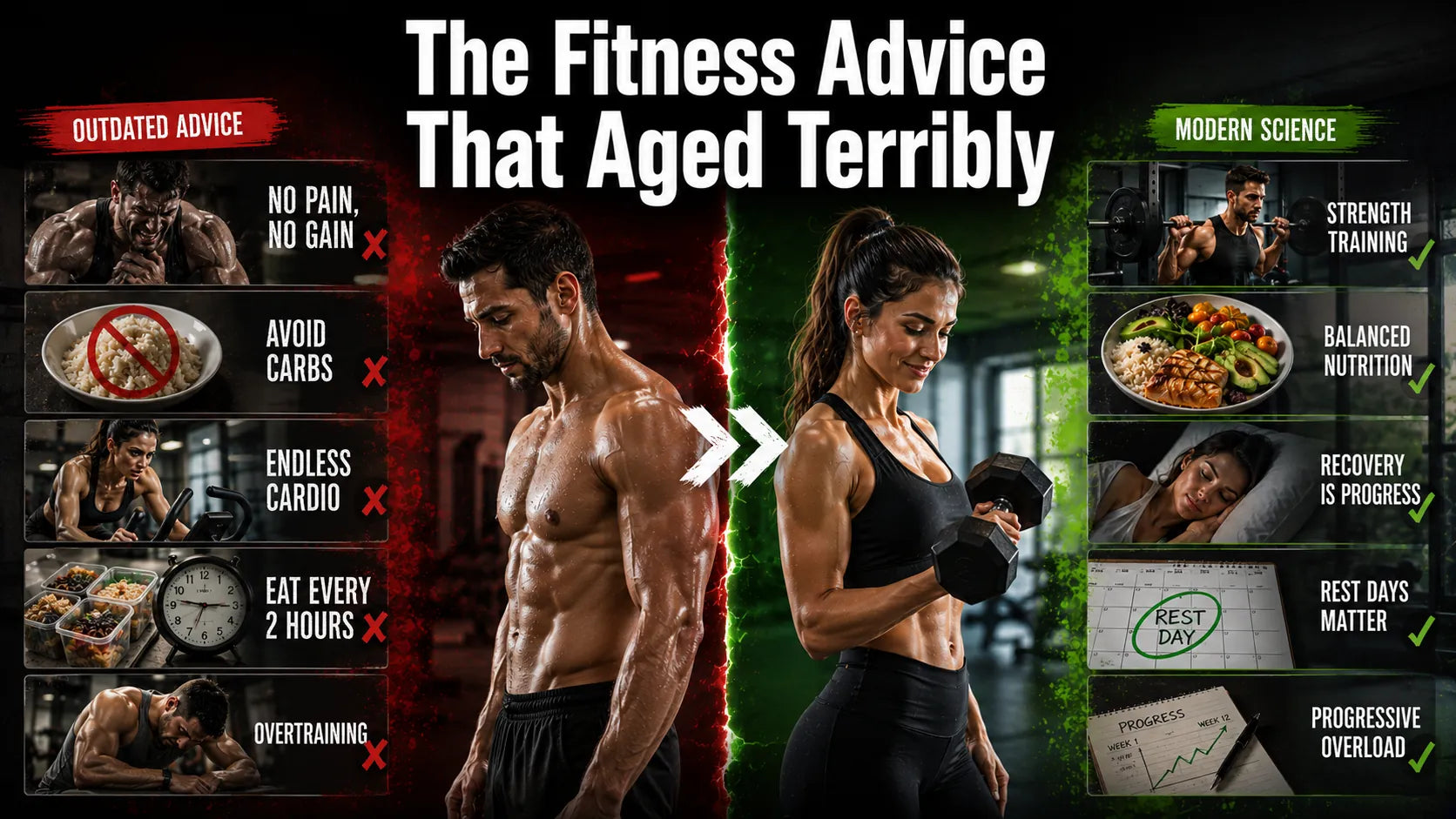
Fitness advice has changed dramatically over the past few decades.
There was a time when people were told to:
- avoid carbohydrates at all costs
- train until they couldn't move
- eat every two hours
- never miss a workout
- spend hours doing cardio
Much of that advice was repeated so often that it became accepted as fact.
But science doesn't stand still.
As researchers have learned more about exercise, nutrition and recovery, many of these once-popular beliefs have been challenged—or completely disproved.
Unfortunately, outdated advice is still everywhere.
It continues to circulate on social media, in gyms and even among well-meaning friends.
The result is that many people waste time following rules that simply aren't helping them.
Let's separate old myths from modern evidence.
1. Why Fitness Advice Changes Over Time
Fitness isn't a fixed subject.
Our understanding of the human body improves every year.
New research helps us understand:
- how muscles grow
- how fat loss really works
- the importance of recovery
- how nutrition affects performance
- which methods actually produce long-term results
Some advice survives because it's proven.
Other advice survives simply because it's familiar.
The best coaches don't cling to outdated ideas.
They adapt as better evidence becomes available.
That's why it's important to remain open-minded.
Something that was considered good advice twenty years ago may no longer represent the best approach today.

2. The Myth of No Pain, No Gain
Few fitness sayings have lasted longer than this one.
The message sounds motivating.
Push through pain.
Never stop.
Always suffer.
In reality, there's a huge difference between effort and pain.
A challenging workout should feel demanding.
Your muscles may burn.
Your breathing becomes heavier.
That's completely normal.
Sharp pain is different.
Pain often signals that something isn't right.
Ignoring it can turn a small issue into a much bigger problem.
Training intelligently means understanding when to push—and when to stop.
Progress comes from consistency.
Not from collecting injuries.
3. Why More Exercise Isn't Always Better
Many people assume that doubling their workouts will double their results.
The body simply doesn't work that way.
Every workout creates stress.
Without enough recovery, that stress eventually becomes fatigue.
Instead of improving, performance starts going backwards.
Signs that you're doing too much can include:
- declining strength
- poor motivation
- persistent soreness
- reduced performance
- difficulty recovering
Quality almost always beats quantity.
One focused workout is often more productive than two rushed ones.
Naughty Boy Menace V2 – 420g can naturally support high-quality training sessions by helping you stay focused and train with purpose rather than simply spending longer in the gym.


The goal isn't doing more.
It's getting more from the work you already do.
4. The Truth About Carbs and Fat Loss
For years, carbohydrates were blamed for almost every weight-loss struggle.
Bread became the enemy.
Rice was avoided.
Potatoes disappeared from plates.
The reality is much less dramatic.
Carbohydrates don't automatically cause fat gain.
Eating more calories than your body needs causes fat gain.
Carbohydrates remain one of the body's preferred fuel sources, especially for:
- resistance training
- sprinting
- high-intensity exercise
- recovery
Removing them unnecessarily often leaves people feeling:
- tired
- weak
- less motivated
- unable to perform well
Applied Nutrition Cream Of Rice – 1kg is an excellent example of a simple carbohydrate source that can provide energy before demanding training sessions without overcomplicating your nutrition.


Carbohydrates aren't the problem.
Poor overall eating habits usually are.

5. Do You Really Need to Eat Every 2 Hours?
This idea was incredibly popular for years.
Many people believed eating six or seven small meals each day would "keep the metabolism burning."
Modern research paints a different picture.
Your metabolism is influenced far more by:
- your total calorie intake
- your activity levels
- your body composition
- your overall diet
Meal frequency is largely a matter of personal preference.
Some people perform well eating three larger meals.
Others prefer smaller meals spread throughout the day.
Neither approach is automatically superior.
The best meal schedule is the one that helps you consistently eat well and supports your lifestyle.
Trying to force yourself to eat every two hours simply because someone once said you should usually creates unnecessary stress rather than better results.
Intermission
So far we've explored why fitness advice evolves, why "no pain, no gain" is misleading, why more exercise doesn't always produce better results, the truth about carbohydrates and fat loss, and why eating every two hours isn't essential.
In Part 2, we'll tackle the protein timing myth, whether supplements can replace good nutrition, why rest days are essential, which social media advice deserves to be ignored, and what modern fitness science actually recommends.
Part 2
6. The Protein Timing Myth Explained
For years, people believed they had just thirty minutes after training to drink a protein shake.
Miss that so-called "anabolic window," and your workout was supposedly wasted.
Fortunately, modern research tells a much more reassuring story.
While consuming protein after training is certainly sensible, your total daily protein intake has a much greater influence on muscle growth than drinking a shake at an exact minute.
What matters most is consistently eating enough protein throughout the day.
That gives your body a regular supply of amino acids to support:
- muscle repair
- muscle maintenance
- muscle growth
- recovery
Per4m Plant Protein – 2kg offers a convenient way to increase your daily protein intake, particularly for those following a plant-based diet or simply looking for another high-quality protein option.


Don't stress over the clock.
Focus on meeting your daily nutrition goals.

7. Can Supplements Replace Good Nutrition?
Supplements have an important role.
But they're often expected to perform miracles.
Many people spend more time researching supplements than improving their diet.
That's backwards.
Good nutrition remains the foundation of every successful fitness programme.
Supplements should support that foundation—not replace it.
Optimum Nutrition Amino Energy + Electrolyte RTD – 24 × 250ml can naturally support an active lifestyle by providing a convenient option before or during training.


That doesn't remove the need for balanced meals.
It simply complements an already well-structured routine.
The biggest improvements will almost always come from:
- consistent training
- sensible nutrition
- adequate sleep
- patience
Supplements help.
Good habits produce results.
8. Why Rest Days Aren't a Sign of Laziness
Many people still feel guilty taking a day off.
They worry they're losing progress.
In reality, recovery is where much of the progress actually happens.
Every workout creates stress.
Rest allows your body to:
- repair muscle tissue
- restore energy
- reduce fatigue
- prepare for the next session
Without recovery, training quality gradually declines.
That's why many successful athletes schedule rest days just as carefully as training days.
Applied Nutrition Sleep – 300g can naturally become part of an evening routine that prioritises quality sleep, helping support recovery before your next workout.


Taking a rest day isn't avoiding progress.
It's investing in it.
9. Social Media Fitness Advice You Should Ignore
Social media has made fitness information more accessible than ever.
Unfortunately, it's also made misinformation easier to spread.
Every week there's a new:
- miracle exercise
- revolutionary diet
- secret supplement
- "must-follow" workout
Many of these trends disappear as quickly as they arrive.
Good fitness advice rarely needs dramatic headlines.
It usually focuses on proven principles like:
- consistency
- progressive overload
- balanced nutrition
- quality recovery
- patience
If something sounds too good to be true, it usually is.
Be cautious about taking advice from people whose main goal is gaining views rather than helping you achieve lasting results.

10. What Modern Fitness Science Actually Says
Once you remove the outdated advice, modern fitness science becomes refreshingly straightforward.
The people who consistently make progress usually focus on the same core principles.
They:
- train consistently
- progressively challenge themselves
- eat enough protein
- recover properly
- stay active outside the gym
- remain patient
None of these ideas are particularly glamorous.
None promise overnight transformations.
But together, they consistently outperform shortcuts.
Science hasn't made fitness more complicated.
It's made it simpler.
Conclusion
Fitness advice has evolved dramatically over the years.
Ideas that were once treated as unquestionable facts have been replaced by evidence-based approaches that are more effective and far more sustainable.
You don't need to:
- train until you're in pain
- avoid carbohydrates
- eat every two hours
- fear rest days
- rely on supplements
Instead, focus on:
- consistent training
- balanced nutrition
- quality recovery
- progressive overload
- patience
The best fitness advice isn't necessarily the newest.
It's the advice that's repeatedly supported by good evidence and delivers results in the real world.
Ignore the outdated myths.
Trust the habits that actually work.
FAQ
1. Why has fitness advice changed so much?
As exercise science has improved, researchers have gained a better understanding of training, nutrition, recovery, and long-term health.
2. Is "no pain, no gain" still good advice?
No. Challenging workouts are important, but pain often signals that something is wrong rather than something is working.
3. Do carbohydrates stop fat loss?
No. Fat loss depends primarily on maintaining a calorie deficit rather than avoiding carbohydrates.
4. Do I need to eat every two hours?
No. Total calorie and protein intake matter much more than meal frequency.
5. Is the anabolic window real?
It's much less important than previously believed. Consistently meeting your daily protein requirements is far more influential.
6. Can supplements replace a healthy diet?
No. Supplements support a balanced lifestyle but should never replace nutritious meals.
7. Why are rest days important?
Rest allows your body to recover, adapt, and become stronger after training.
8. What does modern fitness science recommend?
Consistent training, sensible nutrition, progressive overload, quality recovery, and patience remain the foundations of long-term success.


