


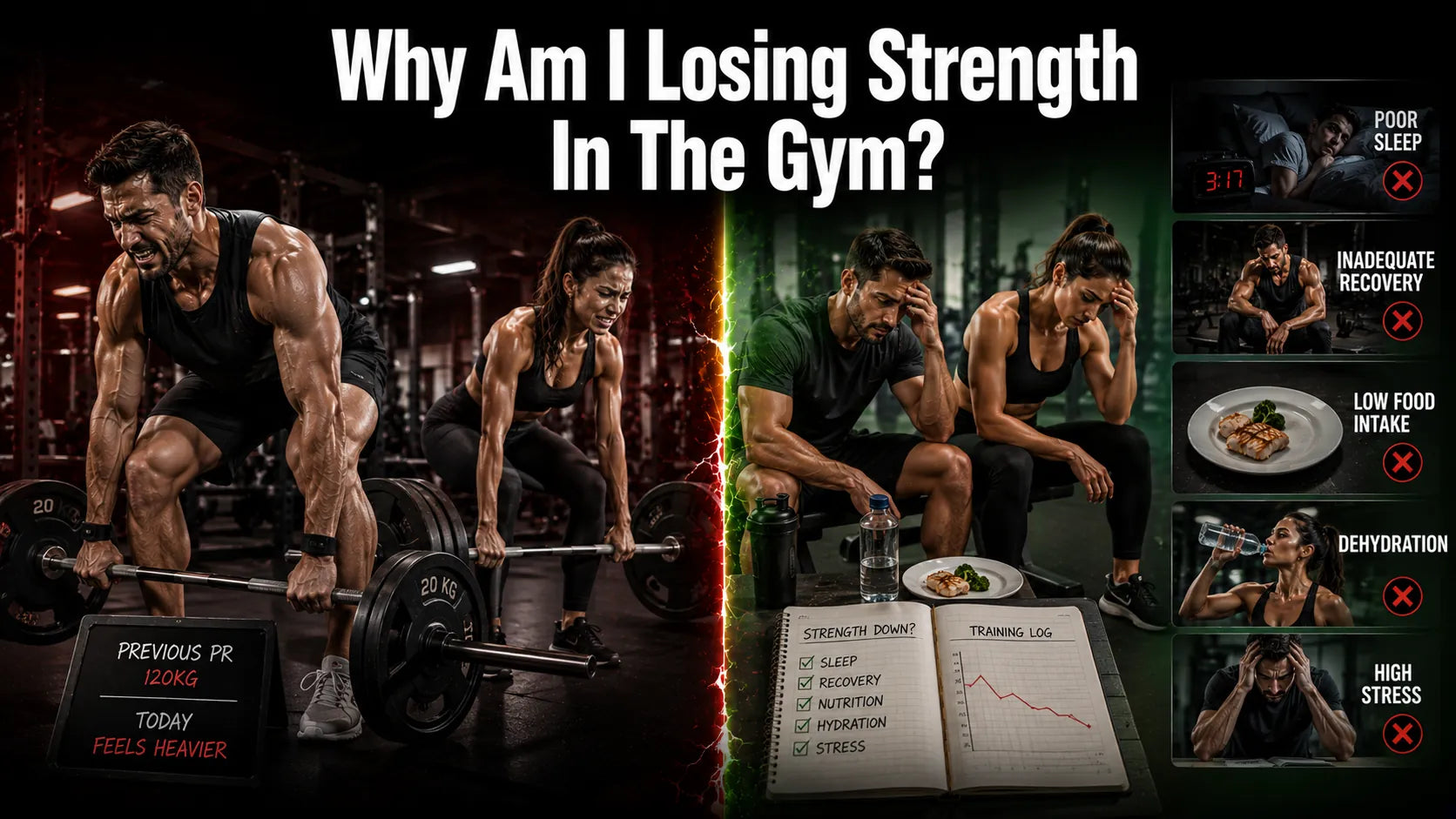
Few things are more frustrating than walking into the gym and realising you're weaker than you were a few weeks ago.
The weights that once felt comfortable suddenly feel heavy.
Your usual number of repetitions drops.
Progress seems to have stalled—or worse, gone backwards.
It's easy to assume you've lost muscle or that all your hard work has disappeared.
Fortunately, that's rarely the case.
Strength naturally fluctuates.
Some days you'll feel stronger than ever.
Other days your performance may temporarily decline.
The important question isn't whether you've had one bad workout.
It's understanding why your strength has dropped and what you can do to get it back.
In many cases, the solution is surprisingly simple.
Let's explore the most common reasons strength decreases and how to start moving forwards again.
1. Is It Normal to Lose Strength Sometimes?
Absolutely.
Many people panic after one or two disappointing gym sessions.
In reality, temporary drops in strength are completely normal.
Your performance can vary depending on:
- recovery
- sleep
- nutrition
- hydration
- stress
- previous training sessions
Even experienced lifters have days where the bar feels unusually heavy.
One poor workout doesn't automatically mean you've lost muscle.
Instead of judging your progress by a single session, look for trends over several weeks.
Ask yourself:
- Are all of your lifts decreasing?
- Have you felt tired for several days?
- Has anything changed outside the gym?
Temporary strength fluctuations are part of training.
Long-term decline is what deserves attention.

2. Are You Recovering Enough Between Workouts?
Recovery is where strength is rebuilt.
Every workout creates fatigue.
Your body needs time to repair muscle tissue, restore energy and prepare for the next session.
Without enough recovery, strength often starts falling.
Common signs of poor recovery include:
- persistent soreness
- heavy legs
- reduced motivation
- slower warm-ups
- declining performance
Many people respond by training even harder.
Unfortunately, that usually makes the problem worse.
Sometimes the strongest thing you can do is allow your body to recover properly before attacking your next workout.
Quality training depends on quality recovery.
3. Could You Be Eating Too Little?
One of the most overlooked reasons for strength loss is simply not eating enough.
Your body needs energy to perform.
If calorie intake remains too low for long periods, you'll often notice:
- reduced training intensity
- slower recovery
- lower energy
- stalled strength gains
This becomes particularly common during aggressive fat-loss phases.
Many people unintentionally create such a large calorie deficit that gym performance begins to suffer.
Applied Nutrition Critical Mass Original 6kg can naturally help increase calorie intake for people who struggle to eat enough through food alone, making it easier to support demanding training sessions.


Strength doesn't only depend on how hard you train.
It also depends on whether your body has enough fuel to perform.
4. Does Poor Sleep Affect Strength?
Absolutely.
Sleep may be the most underrated performance enhancer available.
During quality sleep, the body repairs damaged tissue, restores energy and prepares for future training.
Poor sleep often leads to:
- slower reaction times
- reduced concentration
- lower motivation
- decreased power output
- slower recovery
Many people blame their workout programme when the real issue started the night before.
Per4m Sleep – 120 Caps can naturally become part of an evening routine designed to help prioritise consistent, high-quality sleep before demanding training sessions.
Better recovery often begins with better sleep.

5. Are You Training Too Hard Too Often?
More isn't always better.
Many lifters become convinced that if progress slows, the answer is simply to train harder.
They add:
- more sets
- more exercises
- extra gym sessions
- additional intensity
Eventually, fatigue begins to outweigh adaptation.
Instead of getting stronger, performance starts declining.
Signs you may be pushing too hard include:
- constant tiredness
- declining lifts
- reduced enthusiasm
- slower recovery
- nagging aches and pains
ABE All Black Everything – Ultimate Pre-Workout can support focused, high-quality workouts where intensity is applied intelligently rather than simply extending the length or frequency of your training.
The goal isn't to do more.
The goal is to recover well enough that every workout counts.
Intermission
So far we've explored why temporary strength loss is normal, how recovery affects performance, why eating too little can reduce strength, the impact of poor sleep, and why training harder isn't always the answer.
In Part 2, we'll look at how stress can affect gym performance, whether supplements can help maintain strength, why hydration matters more than many people realise, when strength loss might signal a bigger issue, and the practical steps you can take to start getting stronger again.
Part 2
6. Can Stress Reduce Gym Performance?
Most people think of stress as something that affects the mind.
In reality, it affects the body just as much.
Work pressures.
Financial worries.
Poor sleep.
Family responsibilities.
All of these place extra demands on your body.
When stress remains high for prolonged periods, you may notice:
- reduced motivation
- slower recovery
- lower training intensity
- poorer concentration
- declining strength
This doesn't mean you should stop exercising.
Exercise is one of the best ways to manage stress.
However, it may mean adjusting your expectations during particularly demanding periods of life.
Sometimes maintaining your strength is a victory in itself.
Learning to train around stress rather than ignoring it often leads to much better long-term progress.

7. Which Supplements Help Maintain Strength?
No supplement can completely prevent strength loss.
If you're under-recovered, under-eating or sleeping badly, those problems need fixing first.
Once those foundations are in place, certain supplements can support performance.
Chaos Crew ZMA – 30 Capsules can naturally become part of an evening recovery routine, particularly for people looking to prioritise quality rest and recovery between training sessions.

Improving recovery often helps you return to the gym feeling stronger and more prepared.
Reflex Nutrition Acetyl-L-Carnitine 90 Caps fits naturally into a routine focused on maintaining mental focus and training consistency, especially during demanding periods when motivation and concentration may fluctuate.

Remember, supplements don't replace good habits.
They help support them.
8. Could Dehydration Be Holding You Back?
Hydration is one of the easiest things to overlook.
Even mild dehydration can influence how you perform during a workout.
Many people don't realise they're under-hydrated until they notice:
- reduced endurance
- earlier fatigue
- lower concentration
- poorer workout quality
Water plays an important role in almost every process involved in exercise.
Staying hydrated supports:
- muscle function
- temperature regulation
- training performance
- recovery
If you're sweating heavily during workouts or training in warmer conditions, paying closer attention to hydration can make a noticeable difference.
Sometimes feeling stronger isn't about changing your workout.
It's about arriving better prepared.
9. When Should You Worry About Strength Loss?
Temporary dips in performance are completely normal.
Persistent strength loss is different.
If your lifts continue declining for several weeks despite:
- eating well
- recovering properly
- sleeping enough
- following a sensible programme
it's worth taking a closer look.
Ask yourself:
- Have I recently lost body weight?
- Am I recovering properly?
- Have my stress levels increased?
- Have I been ill?
- Am I trying to progress too quickly?
Occasionally, ongoing strength loss can also have medical causes.
If your decline is significant, unexplained or accompanied by other symptoms, it's sensible to seek advice from a healthcare professional.
Most of the time, though, the cause is much simpler than people fear.

10. How Can You Start Getting Stronger Again?
The first step isn't changing everything.
It's identifying what's causing the problem.
For most people, strength returns when they consistently improve the fundamentals.
Focus on:
- eating enough
- prioritising sleep
- recovering properly
- staying hydrated
- progressively overloading your lifts
- managing stress
Strength isn't built through one perfect workout.
It's built through hundreds of good ones.
When the foundations improve, performance usually follows.
The strongest lifters aren't always the people who train the hardest.
They're often the people who recover the smartest.
Conclusion
Losing strength in the gym can feel discouraging.
But it doesn't automatically mean you're losing muscle or moving backwards.
More often than not, it's your body telling you that something needs attention.
Whether that's:
- poor recovery
- insufficient calories
- lack of sleep
- dehydration
- excessive training
- high stress
identifying the cause is the first step towards fixing it.
Instead of panicking after one bad session, look at the bigger picture.
Small adjustments to your recovery, nutrition and training habits often restore strength surprisingly quickly.
Progress isn't about never having setbacks.
It's about responding to them intelligently.
FAQ
1. Is it normal to lose strength in the gym?
Yes. Temporary decreases in strength are common and can be caused by fatigue, poor recovery, stress, or nutrition.
2. Can poor sleep make you weaker?
Absolutely. Sleep plays a vital role in muscle recovery, energy levels, and overall gym performance.
3. Why am I getting weaker even though I'm training?
Common causes include inadequate recovery, insufficient calories, dehydration, stress, or training too intensely for too long.
4. Can eating too little reduce strength?
Yes. If your body doesn't have enough energy, training performance and recovery often suffer.
5. Does stress affect strength?
Yes. High stress levels can reduce recovery, motivation, and overall performance in the gym.
6. Can dehydration affect strength?
Even mild dehydration can reduce exercise performance, making lifts feel heavier and workouts more difficult.
7. Which supplements help maintain strength?
Supplements can support recovery and performance, but they work best alongside consistent training, proper nutrition, quality sleep, and adequate hydration.
8. How do I start getting stronger again?
Focus on improving recovery, nutrition, sleep, hydration, and gradually applying progressive overload rather than making dramatic changes.


