


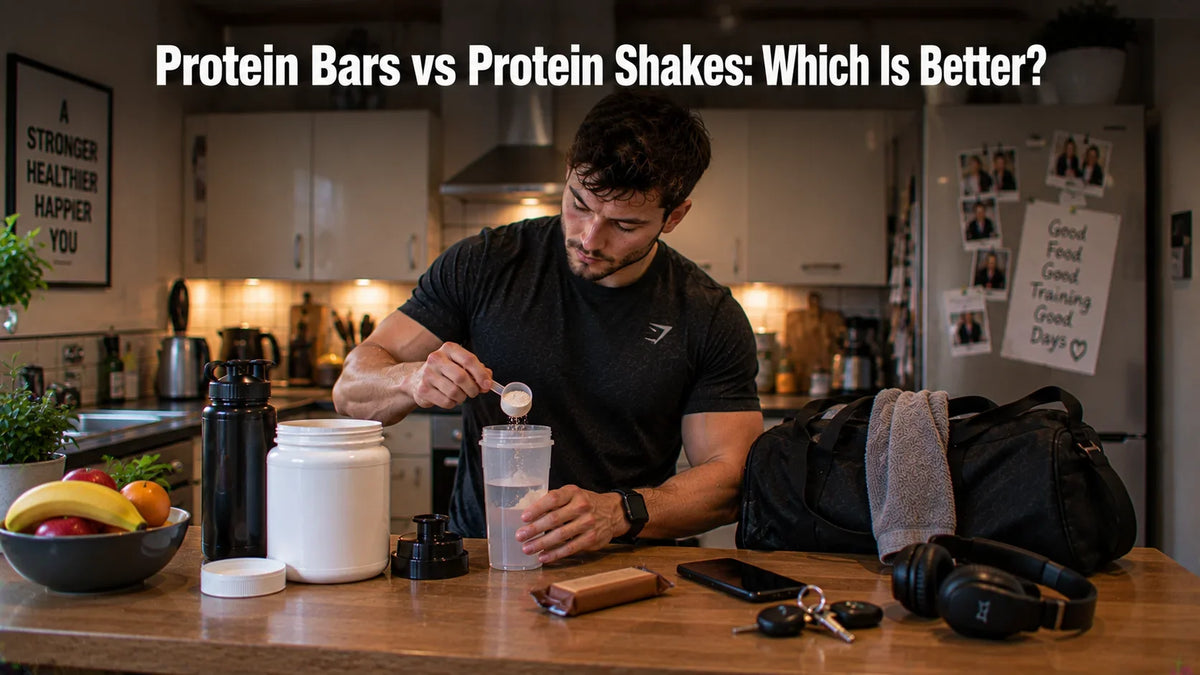
Protein bars and protein shakes are built around the same basic promise: an easier way to get more protein.
But they deliver it in very different forms.
A protein shake is usually built around concentrated protein powder mixed with water or milk. A protein bar combines protein with enough additional ingredients to turn it into something you can unwrap, chew and eat like a snack.
That difference affects more than texture.
Calories, carbohydrates, fat, fibre, fullness, convenience and even how quickly you can consume the product can all change.
So when comparing protein bars vs protein shakes, there isn't a universal winner.
A shake can be an exceptionally efficient way to add protein without many additional calories. A bar can feel more like food, require no preparation and potentially be more satisfying when hunger is part of the problem.
Then there are the extremes. Some shakes are light clear-protein drinks. Others are mass gainers containing hundreds of calories. Likewise, protein bars vary enormously in their nutritional profiles.
The better question isn't simply:
"Are protein bars better than protein shakes?"
It's:
"Which format better solves the nutritional problem I actually have?"
Let's compare them properly.
1. What’s the Difference Between Protein Bars and Protein Shakes?
The most obvious difference is physical form.
A protein shake is a drink. A protein bar is solid food.
That sounds almost too obvious to mention, but it influences much of the comparison.
A shake generally starts with protein powder—such as whey, milk protein, casein, soya, pea or another protein source—which is mixed with liquid. Depending on the formula, it may contain relatively little beyond the protein itself.
A bar has a harder job.
Manufacturers need to create something that holds its shape, tastes pleasant and has an acceptable texture while still delivering a useful amount of protein. That normally requires additional ingredients contributing varying amounts of carbohydrate, fat, fibre and calories.
A product such as Per4m Protein Bar is a good example of the practical appeal: it provides 20g of protein in a ready-to-eat snack that doesn't require a shaker, water or preparation.


Neither format is automatically healthier.
Neither is automatically better for muscle growth.
And neither should be judged simply because one looks more like conventional food.
The meaningful differences are in the actual protein source, protein quantity, total calories and wider nutritional profile of the individual products.

2. Do Protein Bars and Protein Shakes Provide the Same Quality of Protein?
They can—but being a bar or shake doesn't tell you enough to know.
Protein quality depends partly on factors such as amino-acid composition and digestibility.
High-quality complete proteins provide all nine essential amino acids, including leucine, which plays an important signalling role in muscle protein synthesis.
Whey is particularly popular in sports nutrition because it is a complete, highly digestible protein with a strong essential amino-acid profile.
A conventional shake such as Per4m Advanced Whey Protein uses a dairy-protein blend including whey concentrate and isolate, providing a straightforward example of a shake built around complete protein.
Protein bars can also use high-quality dairy proteins.
Others may use combinations of milk proteins, collagen, soya or plant proteins. The exact composition therefore matters more than whether you chew or drink it.
This becomes particularly important if you're relying heavily on supplements to meet your protein requirements.
Don't assume:
"20g protein = nutritionally identical to every other 20g protein."
Look at where the protein comes from.
For muscle-building purposes, a product supplying a strong profile of essential amino acids is generally more relevant than simply chasing the biggest protein number on the front of the wrapper.
3. Which Usually Has More Protein: Protein Bars or Protein Shakes?
There's no fixed rule.
A typical serving of protein powder often lands somewhere around the 20–30g protein range, while many protein bars occupy a similar territory.
But serving sizes vary enormously.
A smaller bar might provide considerably less protein. A larger shake made with multiple scoops might provide considerably more.
You can also change a shake yourself.
Mix protein powder with milk rather than water and the drink gains additional protein, calories and other nutrients. Add yoghurt, oats or nut butter and you've transformed a simple shake into something closer to a meal.
That's harder to do with a bar because its nutritional profile is largely fixed when you open the wrapper.
So when asking which has more protein, bars or shakes, compare realistic servings rather than categories.
More isn't automatically better either.
If one option conveniently gives you the amount of protein you need at that meal, doubling the serving merely to make the number larger doesn't necessarily make it more useful.
Match the serving to your overall protein requirements rather than treating protein grams like a high score.
4. Are Protein Bars or Protein Shakes Better for Building Muscle?
Your muscles don't know whether the amino acids arriving in your bloodstream started the day inside a wrapper or a shaker.
What matters much more is whether you're providing sufficient high-quality protein and energy while following an effective resistance-training programme.
For muscle gain, think about:
- total daily protein intake
- protein quality
- useful distribution of protein across the day
- adequate calorie intake
- progressive resistance training
- sleep and recovery
A bar can contribute towards all-important daily protein intake.
So can a shake.
Shakes have an advantage when you want a particularly efficient way of adding protein because a scoop of protein powder can deliver a substantial amount without requiring a large snack or meal.
Bars have an advantage when you'd rather eat something solid or need a portable snack that also contributes protein.
If both provide an appropriate quantity of high-quality protein and fit your overall diet, there's little reason to expect muscle growth to depend on whether that serving was solid or liquid.
The mistake is expecting either product to cause muscle growth independently.
Protein supports the process. Training gives your body the reason to adapt.

5. Are Protein Bars or Protein Shakes Better After a Workout?
Protein shakes have become almost synonymous with finishing a workout.
There's a practical reason for that.
They're quick to prepare, easy to consume and can provide a substantial dose of high-quality protein without requiring you to sit down and eat.
A light product such as Applied Nutrition Clear Whey takes that convenience further by delivering whey protein isolate in a juice-style drink rather than a conventional creamy shake.


That can be appealing if you don't feel like eating immediately after a hard session.
But a protein bar isn't somehow disqualified because you have to chew it.
If a bar supplies high-quality protein and you prefer eating one on the journey home, that's a perfectly workable way to start adding protein after training.
You also don't need to panic about consuming either one before an imaginary anabolic window slams shut.
Your wider meal timing matters.
If you ate a protein-rich meal before training, amino acids from that meal don't disappear the moment your workout ends.
Likewise, if you're heading home to a proper meal shortly afterwards, you may not need a post-workout supplement at all.
Protein shakes are exceptionally convenient after training. Convenience is not the same as necessity.
Intermission
So far, the protein bar vs protein shake debate is looking less like a battle and more like a choice of format.
Both can provide useful protein.
Both can support muscle-building nutrition.
Both can work after training.
But the differences become more interesting when your goal isn't simply "get more protein".
What if you're hungry?
What if you're dieting?
What if you're deliberately trying to eat substantially more?
That's where the surrounding calories, fibre, carbohydrates, fat, food volume and convenience start to matter as much as the protein number itself.
A 20g protein bar and a 20g protein shake might look equivalent if protein is the only number you read.
They can feel very different once they're inside an actual diet.
Part 2
6. Do Protein Bars Keep You Fuller Than Protein Shakes?
They can, but don't turn that into a universal rule.
Solid foods generally require chewing and take longer to eat than drinking a shake. Protein bars can also contain fibre, fat and carbohydrate, all of which can influence the eating experience and subsequent fullness.
For some people, actually eating something simply feels more satisfying than drinking the equivalent calories.
But satiety is complicated.
A small protein bar isn't automatically more filling than a large shake blended with milk, fruit and oats.
Likewise, a protein shake made with water can be much less substantial than the same powder incorporated into yoghurt or porridge.
This means the question isn't really:
"Are bars more filling than shakes?"
It's:
"Which of these specific foods, in these specific portions, keeps me satisfied for the calories it provides?"
If hunger is a major problem for you, test how each format actually affects your appetite.
Some people find a bar much more satisfying.
Others would rather have a shake alongside fruit or another whole food.
Personal response matters.

7. Are Protein Bars or Protein Shakes Better for Weight Loss?
Neither format causes fat loss.
Weight loss ultimately requires your energy intake to remain below your energy expenditure over time.
Protein can be useful during that process because adequate protein helps support the maintenance of muscle mass, particularly when combined with resistance training, and protein-rich foods can help with satiety.
But the word "protein" doesn't make calories disappear.
A shake can make it particularly easy to obtain protein for relatively few calories if you choose an appropriate powder and mix it with water.
Plant-based options can do the same job. Per4m Plant Protein, for example, combines pea and rice protein and provides a convenient dairy-free route to increasing protein intake.


Bars can still work extremely well during a calorie deficit, especially when they replace a more calorie-dense snack and their solid format helps control hunger.
The problem starts when someone treats every protein-labelled snack as a "weight-loss food" without checking the nutritional information.
A bar can contain considerably more calories than a simple shake.
A shake can also become extremely calorie-dense once you add milk, oats, nut butter, fruit and other ingredients.
So for protein bars vs protein shakes for weight loss, compare:
- total calories
- protein per serving
- how filling you find it
- what it replaces in your diet
- whether it helps you stick to your calorie deficit
The better dieting option is the one that helps you control calories while meeting your protein needs—not whichever product looks more "fitness".
8. Which Is Better for Bulking: Protein Bars or Protein Shakes?
Bulking reverses one of the biggest problems encountered during weight loss.
Instead of trying to control calorie intake, you need enough energy to support muscle gain and training while maintaining an appropriate calorie surplus.
For people with large calorie requirements or poor appetite, liquid calories can be particularly useful because drinking calories may be easier than adding another substantial meal.
This is where it's important to distinguish an ordinary protein shake from a mass gainer.
Applied Nutrition Critical Mass, for example, is deliberately formulated as a high-calorie mass-gain product, combining protein with a substantial carbohydrate component and other ingredients rather than functioning like a conventional lean protein shake.


That can make a shake-style product particularly practical for someone struggling to consume enough energy through meals.
Protein bars can still be useful when bulking.
They're easy to add between meals, portable and can contribute additional protein and calories without requiring preparation.
But don't assume that more calories automatically means more muscle.
A massive calorie surplus can increase the likelihood of gaining unnecessary body fat alongside muscle. The objective is to support training and gradual weight gain, not simply consume as much energy as possible.
So if appetite is limiting your bulk, shakes can have a practical advantage.
If you already eat enough calories and simply need a convenient snack, a bar may fit perfectly.
9. Are Protein Bars More Convenient Than Protein Shakes?
In pure portability terms, protein bars are difficult to beat.
There's no shaker.
No water.
No scoop.
No powder cloud over your desk because you missed the bottle opening.
You can keep a bar in a work bag, gym bag or desk drawer and eat it when needed.
That's genuinely useful for commuting, travelling, long workdays or situations where mixing a shake is awkward.
Shakes have their own version of convenience.
Protein powder is easy to store at home, servings can be adjusted and a shake can be consumed quickly when appetite is low or time is limited.
You can also put dry powder into a shaker before leaving home and add water later.
So convenience depends on where you are.
Bar: easier when you need something completely ready to eat.
Shake: easier when you want fast, adjustable protein and have access to liquid.
There's no reason you can't use both according to circumstance.
Your supplement cupboard doesn't require brand loyalty to a physical state of matter.

10. Should You Choose Protein Bars or Protein Shakes?
Choose according to what your diet needs at that moment.
If you want to add protein efficiently without many additional calories, a straightforward protein shake can be difficult to beat.
If you're hungry and want something solid that can live in your bag until you need it, a protein bar may be more satisfying and convenient.
If you're bulking and struggling to eat enough calories, a higher-calorie shake can make increasing intake easier.
If you're dieting, either can work provided the calories fit your plan and the product helps you control hunger while meeting your protein requirements.
If you've just finished training, either can contribute useful protein—and neither needs to be consumed before you've even left the changing room.
A simple decision framework looks like this:
- Want efficient protein with relatively few extra calories? A simple shake often makes sense.
- Want something solid and ready to eat? Choose a protein bar.
- Want maximum portability? A bar has the edge.
- Struggling to eat enough while bulking? Liquid calories can be useful.
- Trying to lose weight? Compare calories and satiety rather than choosing by format.
- Want both? Use each where it makes your diet easier.
And remember that neither one needs to dominate your protein intake.
Meat, fish, eggs, dairy, beans, pulses, tofu and other protein-rich foods can still form the foundation of your diet.
Bars and shakes are tools.
Use whichever tool solves the problem.
Conclusion
So, protein bars vs protein shakes: which is better?
Neither wins every category.
Protein shakes are usually exceptionally efficient, flexible and easy to consume. They can provide high-quality protein without requiring many additional calories, or they can be deliberately turned into high-calorie shakes when gaining weight is the goal.
Protein bars offer something different.
They're solid, portable, require no preparation and can feel more like eating a genuine snack than drinking a supplement.
For muscle growth and recovery, the quality and quantity of protein matter more than whether you chew or drink it.
For weight loss, total calories and satiety matter.
For bulking, your calorie requirements and appetite matter.
For convenience, your situation matters.
Choose a protein shake when drinking your protein makes life easier. Choose a protein bar when eating it does. And use both if each earns a useful place in your diet.
FAQ
1. What is the difference between protein bars and protein shakes?
Protein bars are solid ready-to-eat snacks, while protein shakes are generally made by mixing protein powder with liquid. Bars often contain additional carbohydrate, fat and fibre to create their texture, whereas a basic shake can provide protein with relatively few additional ingredients or calories.
2. Do protein bars and shakes have the same protein?
Not necessarily. Both can use whey, milk, plant or other proteins, but formulas differ. Check the ingredients and nutritional information rather than assuming every bar and shake provides the same protein sources or amino-acid profile.
3. Which has more protein: bars or shakes?
Neither category always contains more. Many bars and standard protein-powder servings provide roughly similar amounts, but individual products and serving sizes vary considerably. Compare the protein per realistic serving.
4. Are protein bars or shakes better for building muscle?
Either can contribute towards muscle growth if it provides suitable high-quality protein and helps you meet your overall protein requirements. Progressive resistance training, adequate calories and total daily protein are much more important than choosing solid versus liquid protein.
5. Should you have a protein bar or shake after the gym?
Either can work. Shakes are particularly convenient when you want protein quickly and don't feel like eating, while a bar can be useful when you prefer solid food. A normal protein-rich meal is another perfectly valid option.
6. Do protein bars keep you fuller than protein shakes?
They may for some people because they are solid, require chewing and can contain fibre and fat. However, satiety depends on the specific products, portion sizes, total calories and what else you consume alongside them.
7. Are protein bars or shakes better for weight loss?
Neither causes weight loss by itself. A simple shake can provide substantial protein for relatively few calories, while a bar may be more satisfying as a snack. The better option is whichever helps you maintain an appropriate calorie deficit while consuming enough protein.
8. Are protein bars or shakes better for bulking?
Shakes can have an advantage when appetite is low because it's easy to add protein, carbohydrate and other calorie-dense ingredients in liquid form. Bars remain useful as convenient additional snacks. Your overall calorie surplus matters more than the format.
9. Can protein bars replace protein shakes?
They can serve a similar role in helping increase protein intake, provided the bar offers an appropriate amount and quality of protein. You don't specifically need protein shakes if your diet and other foods already allow you to meet your protein requirements.
10. Can you use protein bars and protein shakes together?
Yes. There's no reason to choose one exclusively. You might use a shake after training and keep a bar available for busy periods when eating a normal protein-rich meal isn't practical.


