


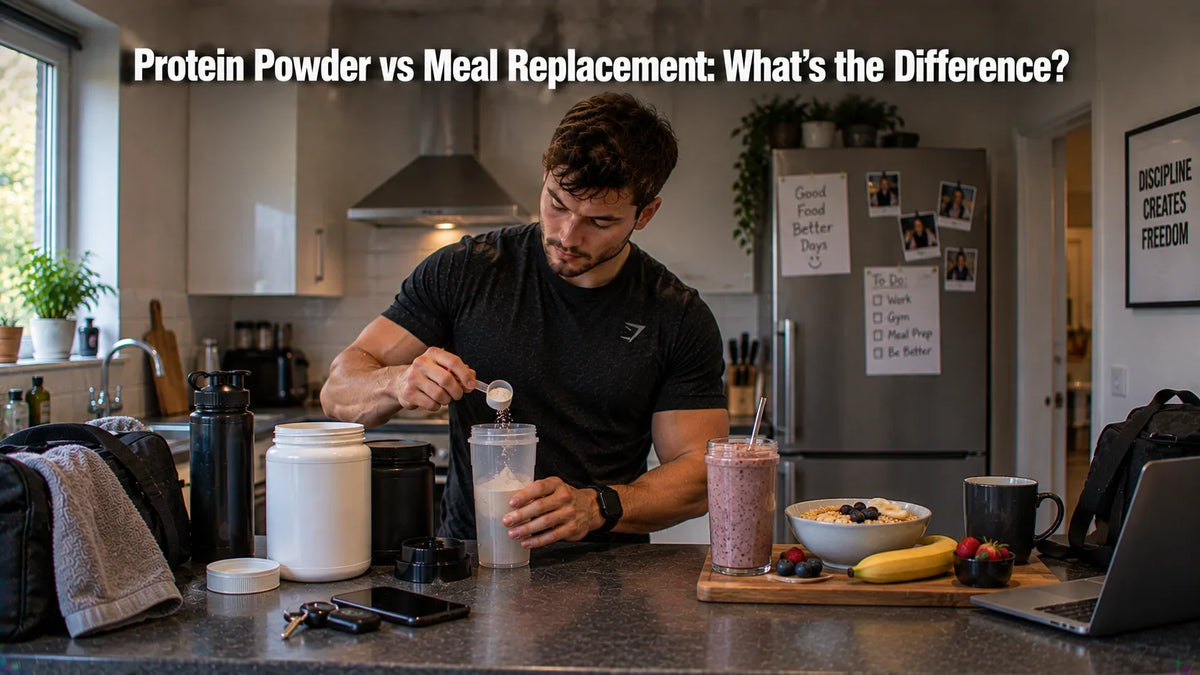
Protein shakes and meal replacement shakes can look almost identical from the outside.
Both come as powders. Both can be mixed with water or milk. Both may contain plenty of protein. And both are marketed as convenient options when normal food isn't practical.
But nutritionally, they are designed to do different jobs.
A protein powder is primarily a concentrated way of increasing your protein intake. A meal replacement is intended to stand in for a meal, so it will usually need to provide a broader nutritional package involving energy, protein, carbohydrate, fat and micronutrients.
That distinction matters.
If you take an ordinary scoop of whey, mix it with water and call it lunch, you've changed the name of the drink. You haven't magically turned it into a balanced meal.
At the same time, not every substantial shake is a meal replacement. Mass gainers, for example, can contain considerably more protein, carbohydrate and calories than an ordinary protein shake while being formulated primarily to help increase calorie intake rather than replace meals in the conventional sense.
So the protein powder vs meal replacement debate isn't really about which shake is better.
It's about choosing the right nutritional tool for the job.
Let's separate them properly.
1. What’s the Difference Between Protein Powder and a Meal Replacement?
The simplest difference is purpose.
Protein powder is primarily designed to provide protein.
A meal replacement is designed to provide a broader selection of nutrients in place of a conventional meal.
A straightforward protein product such as Per4m Whey Hydrate makes the distinction particularly clear. A serving provides 23g of protein for around 100 calories, with very little carbohydrate or fat. It also contains added electrolytes, but its fundamental nutritional role remains providing protein rather than recreating an entire meal.


A genuine meal replacement will generally be more nutritionally broad.
Depending on the product, that may mean:
- protein
- carbohydrates
- fat
- fibre
- vitamins
- minerals
- more substantial total calories
That doesn't mean every meal replacement is nutritionally identical to a well-planned whole-food meal.
It means the product has been formulated with a different objective from a simple protein powder.
So when comparing a protein shake vs meal replacement, don't judge them by appearance.
Two powders can make two very similar-looking drinks while having completely different nutritional purposes.

2. Do Protein Powder and Meal Replacements Contain the Same Nutrients?
Usually not.
Protein powders are generally concentrated around one macronutrient: protein.
Depending on the formula, they can contain small amounts of carbohydrate and fat alongside flavourings, sweeteners and other ingredients. Some products also contain added vitamins, minerals, digestive enzymes, electrolytes or performance ingredients.
Meal replacements are normally broader because replacing a meal requires more than simply supplying amino acids.
But there's a third category that makes supermarket and supplement-shop shelves more confusing: all-in-one and mass-gain shakes.
USN Muscle Fuel Anabolic, for example, goes far beyond a simple protein powder. Its formula combines multiple protein sources with substantial carbohydrate, creatine and additional ingredients, including vitamins and minerals.


That doesn't automatically make it a conventional meal replacement.
It's an all-in-one mass gainer designed around increasing calorie and nutrient intake for training and mass-gain goals.
This illustrates why categories matter less than labels sometimes suggest.
Instead of asking whether something is called a "shake", turn the product around and ask:
- How many calories does it provide?
- How much protein?
- How much carbohydrate and fat?
- Does it contain fibre?
- Does it provide vitamins and minerals?
- What is the product actually designed to achieve?
The nutritional information tells you considerably more than the picture of a shaker on the front.
3. Which Has More Protein: Protein Powder or a Meal Replacement?
Neither category automatically contains more.
A conventional protein powder is usually highly concentrated in protein relative to its total calories because providing protein is its primary purpose.
A meal replacement has more nutritional jobs to do.
Some of its calories may come from carbohydrate and fat, while the formula may also contain fibre and micronutrients.
That means a protein powder can provide a higher percentage of its calories from protein without necessarily providing more grams of protein in every possible serving.
Serving size complicates things further.
A scoop of protein powder might weigh 25–40g.
A complete meal-replacement serving could be substantially larger.
So don't compare numbers without checking serving sizes.
If your sole objective is to add another 20–30g of protein to your day efficiently, a conventional protein powder is usually a very straightforward way of doing it.
If you're trying to replace an entire meal, asking only which product has the most protein misses the point.
A meal needs to do more than win a protein-per-scoop competition.
4. Can You Use Protein Powder as a Meal Replacement?
You can drink protein powder instead of eating a meal.
That doesn't necessarily make it a nutritionally appropriate meal replacement.
This distinction becomes obvious with a lean protein product such as Applied Nutrition Clear Whey. A serving provides more than 21g of protein for around 90 calories, with very little carbohydrate and fat.


That's useful if what you need is additional protein.
It's very different from eating a balanced lunch.
A proper meal might provide protein alongside carbohydrate, healthy fats, fibre, vitamins, minerals and enough total energy to keep you fuelled.
You can make a basic protein shake more meal-like by adding other foods.
For example, depending on your requirements, you might blend protein powder with:
- milk or a fortified plant drink
- fruit
- oats
- yoghurt
- nut butter
- seeds
Now you're adding energy, carbohydrate, fat, fibre and micronutrients that weren't necessarily present in the protein powder itself.
At that point, however, it's the whole recipe functioning as the meal—not the scoop of protein powder alone.
That's an important distinction whenever somebody asks, "Is a protein shake a meal replacement?"
Sometimes the finished shake can be.
Protein powder by itself generally isn't nutritionally equivalent to a balanced meal.

5. Are Meal Replacements More Filling Than Protein Shakes?
They can be, particularly if the meal replacement provides substantially more calories, fibre, carbohydrate and fat than a simple protein shake.
But fullness isn't determined by the words "meal replacement" on the packaging.
Protein itself can be satiating.
Fibre can influence fullness.
Fat, total calories, volume, thickness and how quickly you consume something can all alter the experience.
Then there's individual response.
Some people can drink a large shake and feel satisfied for hours.
Others can drink several hundred calories and still feel as though they haven't eaten because they miss chewing solid food.
This is one reason liquid meal replacements don't automatically outperform conventional meals for appetite control.
If fullness is important to you, compare the actual products and how you personally respond to them.
A 100-calorie protein drink and a 400-calorie meal replacement aren't really competing on equal terms.
And a shake containing oats, fruit and yoghurt will behave very differently from the same protein powder mixed only with water.
Compare the finished drinks—not just the labels on the tubs.
Intermission
By now, the central distinction should be clear.
A protein shake is primarily a convenient protein-delivery system.
A meal replacement is supposed to do a broader nutritional job.
But real life isn't divided into perfectly labelled tubs.
You can turn protein powder into a more substantial shake by adding food.
You can find high-calorie sports-nutrition powders containing protein, carbohydrate and additional ingredients that still aren't conventional meal replacements.
And you can eat an ordinary meal that takes less time to prepare than some elaborate blender recipe.
So the useful question isn't whether one category is universally superior.
It's how each fits your goal.
Weight loss changes the calculation.
Building muscle changes it again.
Training before or after drinking the shake adds another layer.
That's where the comparison becomes much more practical.
Part 2
6. Is Protein Powder or a Meal Replacement Better for Weight Loss?
Neither causes weight loss by itself.
Fat loss requires an appropriate calorie deficit over time.
Both protein powders and meal replacements can potentially make that easier—or harder—depending on how you use them.
A lean protein powder has an obvious advantage when you simply want to increase protein without adding many calories.
That can be useful during a calorie deficit because adequate protein helps support the maintenance of muscle mass, particularly alongside resistance training.
A meal replacement can serve a different purpose.
A portion-controlled product may make calorie intake easier to predict when it genuinely replaces a higher-calorie meal.
But there's nothing magical about drinking those calories.
If you consume the meal replacement and then eat the meal you would have eaten anyway, you've added calories rather than replaced them.
Likewise, replacing every satisfying meal with a thin shake can backfire if it leaves you ravenously hungry later.
For protein shake vs meal replacement for weight loss, consider:
- total calories
- protein content
- fibre
- how filling you find it
- what the shake actually replaces
- whether you can sustain the routine
The calorie deficit drives fat loss. The product is simply one way of organising the diet around it.

7. Is Protein Powder or a Meal Replacement Better for Building Muscle?
Muscle growth requires more than protein, but protein remains central to the process.
Resistance training provides the stimulus.
Dietary protein supplies amino acids used to support muscle protein synthesis, repair and maintenance.
Energy intake and the rest of your diet matter too.
If you're already eating enough calories and simply need a convenient way to increase your daily protein intake, a dedicated protein powder can make excellent sense.
It doesn't have to come from dairy either. Per4m Plant Protein combines pea and rice protein, providing a plant-based way to add protein without turning every shake into a full meal.


A meal replacement may be useful if your problem is broader.
Perhaps a busy schedule causes you to miss meals entirely, leaving both protein and total calorie intake too low.
In that situation, replacing the missed meal with something nutritionally substantial may be more useful than adding protein alone.
But don't confuse "more nutrients" with "more muscle".
A meal replacement doesn't automatically stimulate greater muscle growth than an appropriate serving of high-quality protein.
Likewise, protein powder doesn't compensate for chronically insufficient calories, poor training or inadequate recovery.
For building muscle, solve the actual bottleneck.
Low protein? Add protein. Missing entire meals? Fix the meal problem.
8. Can Meal Replacements Be Used Before or After a Workout?
Potentially, yes.
But the composition and timing matter more than the category name.
Before training, a meal replacement containing protein and carbohydrate could provide useful fuel if you don't have time for a conventional meal.
However, a large shake containing substantial fat, fibre or total calories immediately before intense exercise may feel uncomfortable for some people.
The closer you are to training, the more important individual digestive tolerance becomes.
After training, a product supplying protein can contribute towards recovery nutrition, while carbohydrate may be useful for replenishing glycogen—particularly when training volume is high or another demanding session follows relatively soon.
But you don't automatically need a complete meal-replacement formula the moment your workout ends.
If you're heading home for dinner, dinner can perform that job perfectly well.
If you have several hours before you can eat, a more substantial shake may be practical.
This is why post-workout nutrition shouldn't be reduced to one compulsory product.
Protein powder, a meal replacement, a homemade shake or normal food can all fit depending on timing and your wider nutritional requirements.
9. When Should You Choose Protein Powder Instead of a Meal Replacement?
Choose protein powder when the thing you're actually missing is protein.
Imagine your normal meals already provide plenty of carbohydrate, fat, fibre and micronutrients, but you're consistently falling short of your protein target.
Adding an entire replacement meal makes little sense if you don't need another meal.
A scoop of protein is much more targeted.
Protein powder can also be particularly useful when:
- you want additional protein for relatively few calories
- you're adding protein to breakfast or another existing meal
- you want a convenient post-workout drink
- you want to increase the protein content of oats, yoghurt or recipes
- you already have a balanced diet and simply need help reaching your protein requirement
A meal replacement becomes more relevant when the problem is genuinely the absence of a meal.
Maybe you're travelling.
Maybe work makes eating difficult.
Maybe you need a convenient, structured option when conventional food isn't available.
Even then, normal food doesn't suddenly become nutritionally obsolete.
Protein powder supplements a diet particularly well. A meal replacement is trying to substitute for a larger piece of it.

10. Should You Choose Protein Powder or a Meal Replacement?
Start with your objective rather than the product category.
If you want a straightforward way to increase protein, choose an appropriate protein powder.
If you genuinely need something designed to replace a meal, look for a product formulated to provide broader nutrition rather than assuming any protein shake qualifies.
And if your real objective is dramatically increasing calories for a bulk, you may actually be looking for a third category altogether.
Applied Nutrition Critical Mass, for example, is a mass gainer rather than a conventional meal replacement. Its formula deliberately combines a substantial amount of protein and carbohydrate with other sports-nutrition ingredients to make increasing calorie intake easier during mass-gain phases.


That distinction matters because three powders can all go into a shaker while serving three very different purposes:
- Protein powder: primarily increases protein intake.
- Meal replacement: aims to replace the broader nutrition of a meal.
- Mass gainer: primarily makes increasing calories, carbohydrate and protein easier.
There can be overlap between those categories, but they aren't synonyms.
So before buying anything, ask yourself:
What am I actually trying to replace or add?
If the answer is protein, buy for protein.
If the answer is a missed meal, assess the whole nutritional profile.
If the answer is calories for gaining weight, assess whether a higher-calorie option genuinely fits your requirements.
That's much more useful than choosing whichever tub has the longest ingredient list.
Conclusion
So, protein powder vs meal replacement: what's the difference?
Protein powder is primarily designed to help you consume more protein.
A meal replacement is intended to provide a broader package of nutrition when it takes the place of a conventional meal.
That means an ordinary protein shake isn't automatically a balanced meal just because you drink it at lunchtime.
You can build a more complete homemade meal shake around protein powder by adding foods containing carbohydrate, fats, fibre and micronutrients, but it's the complete recipe doing the nutritional work.
Meal replacements can be convenient when normal food genuinely isn't practical.
Protein powders can be more efficient when all you actually need is additional protein.
And mass gainers occupy another space again, deliberately supplying considerably more energy for people trying to increase calorie intake.
Don't choose according to which shake sounds more complete. Choose according to what your diet is actually missing.
FAQ
1. What is the difference between protein powder and a meal replacement?
Protein powder is primarily designed to provide concentrated dietary protein. A meal replacement is generally formulated to replace a broader meal, so it may contain more calories, carbohydrate, fat, fibre, vitamins and minerals alongside protein.
2. Is protein powder the same as a meal replacement?
No. Although both can be mixed into shakes, an ordinary protein powder isn't automatically formulated to provide the broader nutritional profile expected from a meal. Always compare the complete nutritional information rather than assuming all powdered drinks are interchangeable.
3. Can you use protein powder as a meal replacement?
Protein powder can form part of a homemade meal shake, but protein powder mixed with water alone may provide little beyond protein. Adding appropriate foods such as fruit, oats, milk, yoghurt, seeds or nut butter can create a more nutritionally substantial drink depending on your requirements.
4. Which has more protein: a meal replacement or protein shake?
It depends on the individual products and serving sizes. Dedicated protein powders often contain a higher proportion of protein relative to their calories, while meal replacements distribute their calories across protein, carbohydrate, fat and potentially other nutrients.
5. Are meal replacement shakes more filling than protein shakes?
They can be if they provide more calories, fibre, fat and overall volume, but appetite responses vary. A basic protein shake can also become considerably more filling when blended with foods rather than simply mixed with water.
6. Is protein powder or a meal replacement better for weight loss?
Neither automatically causes weight loss. A lean protein powder can help increase protein while controlling calories, whereas a portion-controlled meal replacement may simplify calorie intake if it genuinely replaces a larger meal. Maintaining an appropriate calorie deficit remains the key factor.
7. Is protein powder or a meal replacement better for muscle gain?
Protein powder can efficiently help you meet the protein requirements that support muscle growth. A more substantial shake may be useful when you're also struggling to consume enough calories. Resistance training, adequate daily protein and appropriate energy intake matter more than the product label.
8. Can you use meal replacement shakes after a workout?
Yes, provided the nutritional profile suits your needs. Protein can contribute towards muscle recovery, while carbohydrate may be useful for restoring glycogen. However, an ordinary meal or straightforward protein shake can also work depending on when you're eating next.
9. Can you use meal replacement shakes before a workout?
Yes, but consider timing and digestion. A shake containing protein and carbohydrate may provide useful pre-training nutrition, while a particularly large serving high in fat or fibre may feel uncomfortable if consumed too close to exercise.
10. When should you use a meal replacement instead of protein powder?
A meal replacement makes more sense when you genuinely need a convenient substitute for a meal and want broader nutrition. Protein powder is generally the more targeted choice when your normal diet is otherwise adequate and you simply need additional protein.


