


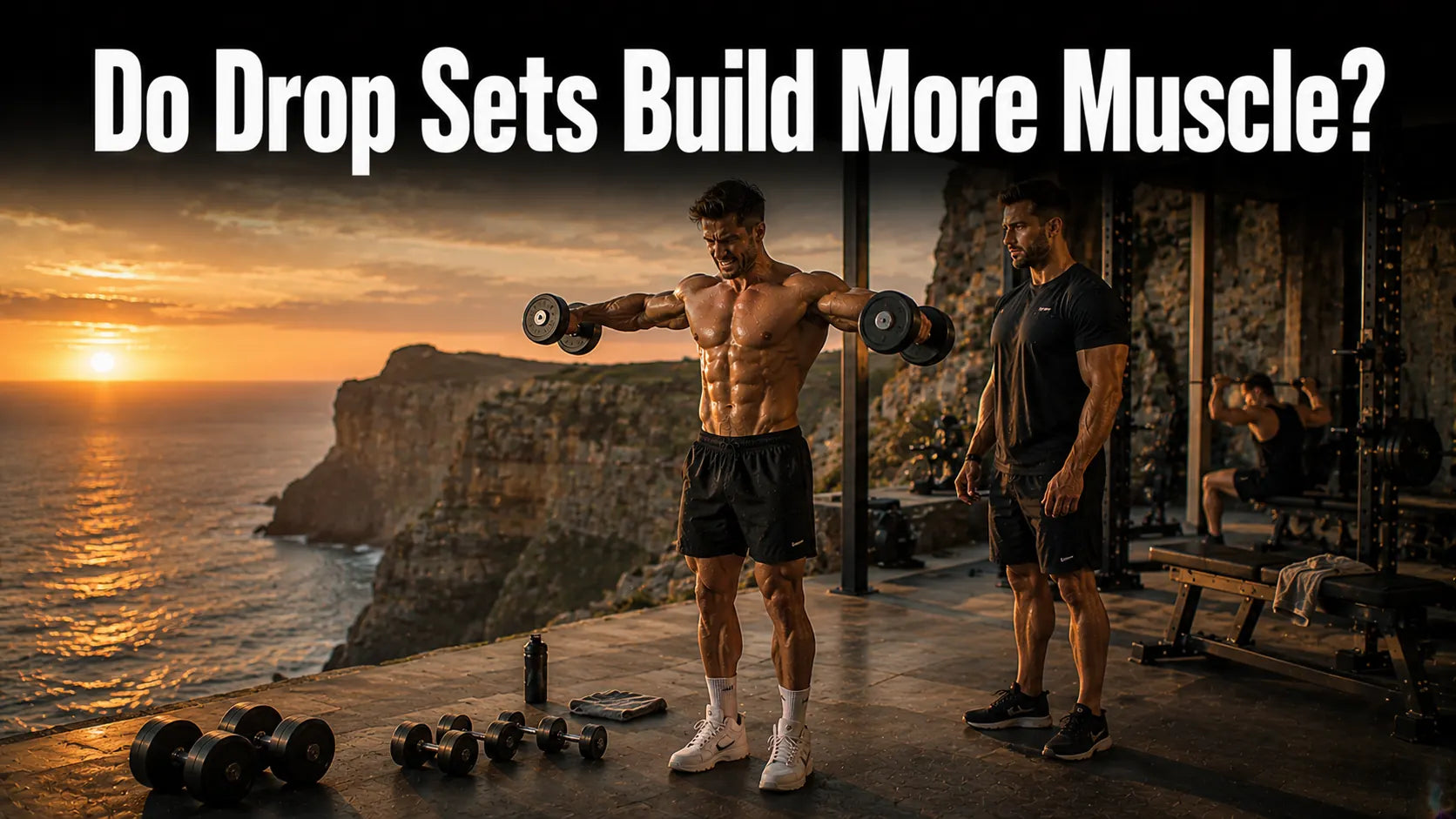
You finish a hard set of lateral raises.
Instead of putting the dumbbells down and resting, you immediately grab a lighter pair.
You keep going.
Your shoulders start burning.
You drop the weight again.
Another eight reps.
By the time the set finally ends, your delts feel enormous, your heart rate is elevated and what would normally have been several minutes of training has been compressed into one brutally difficult sequence.
That's a drop set.
Few bodybuilding techniques create such an immediate feeling that you've done something productive.
The pump is enormous.
The fatigue arrives quickly.
And because you're reducing the weight whenever the current load becomes too difficult, you can continue performing repetitions well beyond the point where a traditional set would normally finish.
Surely that must build more muscle?
Not necessarily.
Drop sets can absolutely stimulate hypertrophy. They're also particularly interesting because they can potentially deliver a substantial training stimulus in considerably less time than traditional straight sets.
But harder doesn't automatically mean better.
A drop set creates enormous local fatigue, yet the amount of discomfort produced by a training technique isn't a reliable measurement of how much muscle it will build.
So rather than asking whether drop sets "work," the more useful questions are:
Do they build more muscle than traditional sets?
Can they produce similar results in less time?
And if they generate so much fatigue, how should you actually programme them without turning every workout into an endurance test?
Let's get into it.
1. What Are Drop Sets?
A drop set involves performing a set, immediately reducing the resistance and then continuing to perform more repetitions with little or no rest.
You can repeat that process multiple times.
For example:
Dumbbell lateral raise
12kg × 10 reps
↓ immediately reduce the weight
8kg × 8 reps
↓ reduce again
5kg × 10 reps
That entire sequence could be considered one extended drop set.
The exact structure varies.
You might perform only one weight reduction.
Or you might use two or three.
The size of each reduction can also change depending on the exercise and how fatigued you are.
What makes drop sets different from ordinary straight sets is primarily the lack of conventional recovery between efforts.
With straight sets, you might perform:
10 reps.
Rest two minutes.
10 reps.
Rest two minutes.
9 reps.
With a drop set, you reduce the resistance and continue almost immediately.
That allows you to keep performing repetitions even though fatigue has made the original load too difficult.
Drop sets are therefore a form of intensification technique.
They're not a completely different mechanism for building muscle.
You're still performing resistance exercise.
You're simply manipulating load and rest periods to pack a lot of work into a short period.

2. Do Drop Sets Actually Build More Muscle?
Drop sets can build muscle.
The evidence that they inherently build more muscle than well-programmed conventional training is much less convincing.
That's an important distinction.
If two training approaches both expose a muscle to sufficient mechanical tension, involve appropriately challenging sets and provide enough overall training stimulus, both can support hypertrophy.
Drop sets don't unlock a separate muscle-building pathway unavailable to normal sets.
What they do exceptionally well is make relatively light loads become extremely difficult very quickly.
Imagine you've performed ten repetitions of a biceps curl and cannot complete another good rep with that weight.
Reduce the load immediately.
You can suddenly continue.
As fatigue increases, even that lighter weight eventually becomes extremely challenging.
This allows you to accumulate additional demanding repetitions without taking several minutes of rest.
That's useful.
But it doesn't automatically mean the muscle receives a superior hypertrophy stimulus compared with performing additional conventional sets with adequate recovery.
The better way to think about drop sets is:
They're another effective method of creating challenging resistance-training volume.
Their biggest advantage may not be dramatically greater muscle growth.
It may be how efficiently they can deliver that stimulus.
3. Are Drop Sets Better Than Normal Sets for Muscle Growth?
For most people, traditional straight sets should still form the foundation of a hypertrophy programme.
Why?
Because they're easy to standardise.
Suppose you're performing a machine chest press.
You complete:
80kg × 10
Rest.
80kg × 10
Rest.
80kg × 9
Next week, you can return and try to improve those numbers.
Progress is easy to measure.
Drop sets introduce more variables.
You have:
- the starting weight
- repetitions before the first drop
- size of the weight reduction
- repetitions after the drop
- number of drops
- rest between reductions
- total fatigue accumulated
That doesn't make progression impossible.
It simply makes it slightly less straightforward.
Traditional sets also allow you to recover between efforts, which helps maintain performance and load across multiple sets.
With a drop set, fatigue is deliberately allowed to accumulate.
That can be excellent for making the target muscle work hard.
But fatigue itself isn't the goal.
For hypertrophy, drop sets therefore make more sense as an alternative or addition to straight sets rather than something that automatically replaces your entire programme.
You might perform two conventional working sets and finish with one drop set.
Or use drop sets selectively on exercises where they're particularly convenient.
There's no need to choose a side.
Straight sets and drop sets can comfortably exist within the same muscle-building programme.
4. Why Do Drop Sets Feel So Much Harder?
Because you're deliberately removing one of the things that normally allows you to maintain performance:
rest.
During a conventional workout, the rest between sets gives you time to partially recover before asking the same muscles to produce another hard effort.
Drop sets dramatically shorten that recovery period.
Instead, you compensate for fatigue by reducing the resistance.
The result is an escalating combination of:
local muscular fatigue
metabolic stress
high perceived effort
increasing discomfort
That familiar burning sensation can become particularly intense.
And because drop sets often involve moderate or higher repetitions, you can develop a substantial muscle pump.
This creates a psychological trap.
A drop set feels much harder than many traditional sets.
Therefore, it can be tempting to assume it must be producing substantially more muscle growth.
But the sensations created during a workout aren't direct measurements of hypertrophy.
Burning doesn't equal growth.
Sweating doesn't equal growth.
A huge pump doesn't guarantee growth.
And leaving the gym barely able to move the muscle you've trained certainly doesn't guarantee growth.
Those sensations can accompany productive training, but they aren't the objective themselves.
Hydration is also worth considering during demanding sessions, particularly when you're training for longer periods or sweating heavily. Optimum Nutrition Electrolyte – 264g can provide a convenient way to incorporate electrolytes into a broader hydration strategy where appropriate.


But hydration won't make excessive fatigue productive.
Drop sets are supposed to be hard.
They don't need to become punishment.

5. Can Drop Sets Save Time Without Sacrificing Muscle Growth?
This is arguably where drop sets become most interesting.
Traditional resistance training can be surprisingly time-consuming.
Three sets of an exercise might involve only 60 seconds of actual lifting but another four or five minutes spent resting.
Multiply that across six exercises and your workout quickly becomes much longer.
Drop sets dramatically change the ratio.
Instead of:
Set → rest → set → rest → set
you can perform:
Set → reduce weight → continue → reduce weight → continue.
That can compress a substantial amount of challenging muscular work into a very short period.
For someone whose biggest barrier to resistance training is time, that's potentially extremely useful.
The key is understanding what "time-efficient" means.
It doesn't mean you should rush every exercise.
And it certainly doesn't mean rest periods are pointless.
Heavy compound exercises in particular often benefit from adequate recovery between sets because maintaining technique and performance matters.
But later in a hypertrophy workout, imagine you've reached:
- cable curls
- lateral raises
- leg extensions
- triceps pressdowns
Drop sets become considerably easier to implement.
Rather than waiting several minutes between every set, you can use controlled weight reductions to extend the effort efficiently.
Pre-training nutrition can also influence how prepared you feel for demanding sessions. Applied Nutrition Cream Of Rice – 1kg provides a convenient carbohydrate source that can fit into someone's wider nutrition plan where appropriate.


Again, though, carbohydrates aren't uniquely required for drop sets.
The bigger advantage here comes from the training structure itself.
If you can obtain a productive hypertrophy stimulus in less time, drop sets become particularly valuable for busy lifters.
Not because they're magically more anabolic.
Because they're efficient.
Intermission
So far, we've established that drop sets absolutely can build muscle—but their biggest advantage may be time efficiency rather than superior hypertrophy.
By immediately reducing the resistance instead of taking a conventional rest period, you can continue producing challenging repetitions as fatigue accumulates. That makes drop sets feel brutally difficult and allows a lot of work to be compressed into a short period, but the extra burn, pump and exhaustion shouldn't automatically be interpreted as extra muscle growth.
Traditional straight sets remain an excellent foundation because they're easy to standardise, recover from and progressively overload.
In Part 2, we'll look at which exercises work best with drop sets, which supplements can support performance and recovery, whether every stage of a drop set needs to reach failure, the mistakes that create huge amounts of fatigue for little additional benefit and the best way to incorporate drop sets into a muscle-building programme.
Part 2
6. Which Exercises Work Best With Drop Sets?
Drop sets work best when reducing the resistance is quick, safe and practical.
That's why they're particularly well suited to machines, cables and certain dumbbell exercises.
Imagine performing a cable triceps pressdown.
You reach the end of your initial set.
Move the pin upwards.
Continue immediately.
Move it again.
Continue.
The entire weight reduction takes seconds.
Compare that with a barbell squat.
You finish a brutally difficult set, rack the bar, remove plates from both sides, get underneath it again and attempt another set while already heavily fatigued.
Technically, you could do it.
But there are usually much better exercises for the technique.
Good drop-set candidates include:
- lateral raises
- biceps curls
- triceps pressdowns
- leg extensions
- leg curls
- machine chest presses
- machine rows
- cable flyes
- calf raises
- pulldowns
Isolation exercises are especially useful because you can create substantial local muscular fatigue without the same technical demands associated with heavy compound lifts.
There's another advantage.
If your quadriceps are exhausted during a leg extension drop set, you simply stop extending your knees effectively.
If you're exhausted underneath a heavily loaded barbell squat, the consequences of deteriorating technique are potentially much more significant.
That doesn't mean compound exercises can never use drop sets.
Machine-based compound movements can work particularly well.
A plate-loaded chest press, hack squat or machine row, for example, may allow resistance to be reduced relatively safely.
But you don't earn extra hypertrophy points for choosing the most exhausting possible exercise.
Use movements that allow you to focus on the target muscle and reduce the load quickly without turning the transition itself into another workout.

7. Which Supplements Support Performance and Recovery During Drop Sets?
There's no supplement specifically required for drop-set training.
The same fundamentals supporting conventional hypertrophy training still apply.
You need sufficient nutrition.
You need protein.
You need hydration.
And you need enough recovery to continue training productively.
For people who enjoy using a pre-workout, Naughty Boy Menace V2 – 420g can fit into a pre-training routine to support workout performance where appropriate.


Drop sets can create considerable local fatigue, but that doesn't mean you need a complicated collection of "recovery" products afterwards.
Your overall diet remains considerably more important.
Applied Nutrition Collagen Peptides – 300g can contribute protein to someone's diet, although collagen shouldn't be treated as equivalent to a high-quality complete protein source specifically for maximising muscle protein synthesis.

Your normal meals and complete protein sources should remain the foundation.
Likewise, Applied Nutrition Critical Greens – 250g can complement someone's wider nutritional routine, but it doesn't directly make drop sets more effective or somehow accelerate recovery from an intense set.

The supplement discussion therefore needs perspective.
A drop set doesn't become productive because you've taken a pre-workout.
And a poorly programmed session doesn't become recoverable because you've added another supplement afterwards.
Use supplements to support an already sensible training and nutrition programme.
Not to compensate for one that creates unnecessary fatigue.
8. Should You Take Drop Sets to Failure?
Drop sets naturally push you towards high levels of muscular fatigue.
That doesn't mean every stage needs to reach absolute failure.
Suppose you're performing lateral raises.
You take the first weight to the point where another technically sound repetition would be extremely difficult.
You immediately reduce the weight.
Now you continue.
By the second or third drop, even a relatively light dumbbell can become brutally difficult.
Taking every individual stage to complete muscular failure can create an enormous amount of fatigue.
Sometimes that's intentional.
But it isn't automatically necessary for hypertrophy.
Training sufficiently close to failure can provide a strong stimulus without requiring every set to end with you physically incapable of moving the weight another centimetre.
This becomes especially relevant when drop sets are added to an existing workout.
If you've already completed several challenging straight sets and then perform one drop set, pushing that final sequence very hard may be perfectly reasonable.
But imagine doing three separate drop sets, each containing three weight reductions, with every stage taken to absolute failure.
That's potentially a huge amount of demanding work.
The additional fatigue needs to justify itself.
Technique should also remain your boundary.
When the target muscle can no longer perform the movement effectively and you're relying on swinging, bouncing or assistance from unrelated muscles, continuing simply because you haven't reached some dramatic definition of failure isn't particularly useful.
A drop set should become harder as it progresses.
It shouldn't become progressively worse.
9. What Mistakes Do People Make With Drop Sets?
Drop sets are simple enough to understand.
They're also very easy to overdo.
Using Drop Sets on Everything
If one drop set is effective, five must be better.
And if five are better, why not turn every exercise into one?
Because fatigue accumulates.
Drop sets can compress a substantial amount of difficult work into a short period. That's an advantage—but it also means you can dramatically increase the difficulty of a workout without immediately realising how much you've added.
Dropping the Weight Too Little
If the reduction is tiny, you may only manage another one or two useful repetitions.
A sufficiently meaningful reduction allows you to continue the set effectively.
Dropping the Weight Too Much
Go too far in the opposite direction and the next weight may become so light that you need an enormous number of repetitions before it becomes challenging again.
The goal isn't simply to keep moving forever.
Letting Technique Collapse
As fatigue increases, people often start swinging dumbbells, shortening the range of motion or using momentum.
If you're performing a drop set for the lateral delts but the final repetitions resemble a full-body kettlebell swing, the target exercise has changed considerably.
Chasing the Pump Instead of Progression
Drop sets produce fantastic pumps.
That's enjoyable.
It isn't the same thing as measurable progression.
You should still have some way of determining whether your performance is improving.
Assuming More Fatigue Means More Growth
This is perhaps the biggest mistake.
A technique that makes you extremely tired isn't automatically a technique that produces more hypertrophy.
Fatigue has a cost.
The objective is to obtain a productive stimulus without creating so much fatigue that subsequent training suffers.

10. What's the Best Way to Use Drop Sets for Muscle Growth?
For most lifters, the best strategy isn't replacing all traditional sets with drop sets.
It's using drop sets selectively.
One of the simplest approaches is to perform conventional working sets first.
For example:
Machine lateral raise
Set 1 — normal working set
Set 2 — normal working set
Set 3 — working set followed immediately by one or two weight reductions
That gives you the stability and trackability of straight sets while using a drop set to intensify the final effort.
Another option is to use drop sets when you're short on time.
If you have only 30 minutes to train, strategically replacing some conventional sets with drop sets can allow you to perform demanding muscular work without spending much of the session waiting between sets.
You can also reserve them primarily for isolation and machine exercises towards the latter half of your workout.
That might mean:
Chest: conventional presses followed by a cable fly drop set.
Back: conventional rows followed by a pulldown drop set.
Legs: squats or presses followed by a leg-extension drop set.
Shoulders: overhead pressing followed by a lateral-raise drop set.
This gives you the best of both approaches.
Heavy, progressively overloaded training remains the foundation.
Drop sets provide an efficient way to add additional challenging work.
The exact size of each weight reduction doesn't need to follow one universal percentage either.
Reduce the resistance enough that you can continue performing controlled repetitions, then stop when the set has achieved what you intended.
Most importantly, track what you're doing.
If last month you performed:
12kg × 12 → 8kg × 9
and eventually achieve:
12kg × 15 → 8kg × 12,
that's progression.
Drop sets don't need to be chaotic.
They can be programmed just like everything else.
Conclusion
So, do drop sets build more muscle?
They certainly build muscle.
But there's little reason to assume that simply making a set more exhausting automatically produces greater hypertrophy than well-programmed traditional training.
The real strength of drop sets is different.
They're incredibly time-efficient.
By reducing the resistance instead of taking a full rest period, you can continue performing challenging repetitions as fatigue accumulates.
That makes them particularly useful for machines and isolation exercises where changing the load is quick and safe.
But their intensity is also why they need some restraint.
You don't need drop sets on every exercise.
You don't need three weight reductions every time.
And you don't need every stage to end in complete muscular failure.
Keep conventional progressive resistance training as your foundation.
Then use drop sets where they genuinely improve the programme—whether that's saving time, extending a final set or adding some concentrated work to a target muscle.
The pump might be enormous.
The burn might be brutal.
But those aren't the reasons drop sets deserve a place in your programme.
Their real advantage is that they can make productive hypertrophy training remarkably efficient.
FAQ
1. Do drop sets build muscle?
Yes. Drop sets can provide an effective hypertrophy stimulus by allowing you to continue performing challenging repetitions after reducing the resistance.
2. Do drop sets build more muscle than normal sets?
Not necessarily. Drop sets can produce similar muscle-building benefits to conventional training, but their major advantage may be achieving productive work in less time.
3. Are drop sets better than straight sets?
Neither method is universally better. Straight sets are easy to progressively overload and allow greater recovery between efforts, while drop sets can make training considerably more time-efficient.
4. Why do drop sets feel so hard?
Very short recovery periods cause muscular fatigue and metabolic stress to accumulate rapidly. Reducing the resistance allows you to keep working despite that increasing fatigue.
5. Do drop sets save time?
Yes. This is one of their biggest practical advantages because multiple challenging efforts can be performed with very little rest between them.
6. What exercises are best for drop sets?
Machines, cables and isolation exercises such as lateral raises, curls, pressdowns, leg extensions and leg curls are particularly practical because the resistance can be reduced quickly.
7. Should drop sets go to failure?
They can be performed very close to or occasionally to failure, but taking every stage of every drop set to absolute failure isn't necessary and can create substantial fatigue.
8. How many times should you drop the weight?
One or two reductions can be plenty for most applications. More drops aren't automatically more effective.
9. How often should you use drop sets?
There's no mandatory frequency. They can be used selectively on certain exercises or workouts depending on your training volume, available time and recovery.
10. What's the best way to use drop sets for hypertrophy?
Keep conventional working sets as your foundation and selectively add drop sets to appropriate exercises, particularly towards the end of a workout or when training time is limited.


