


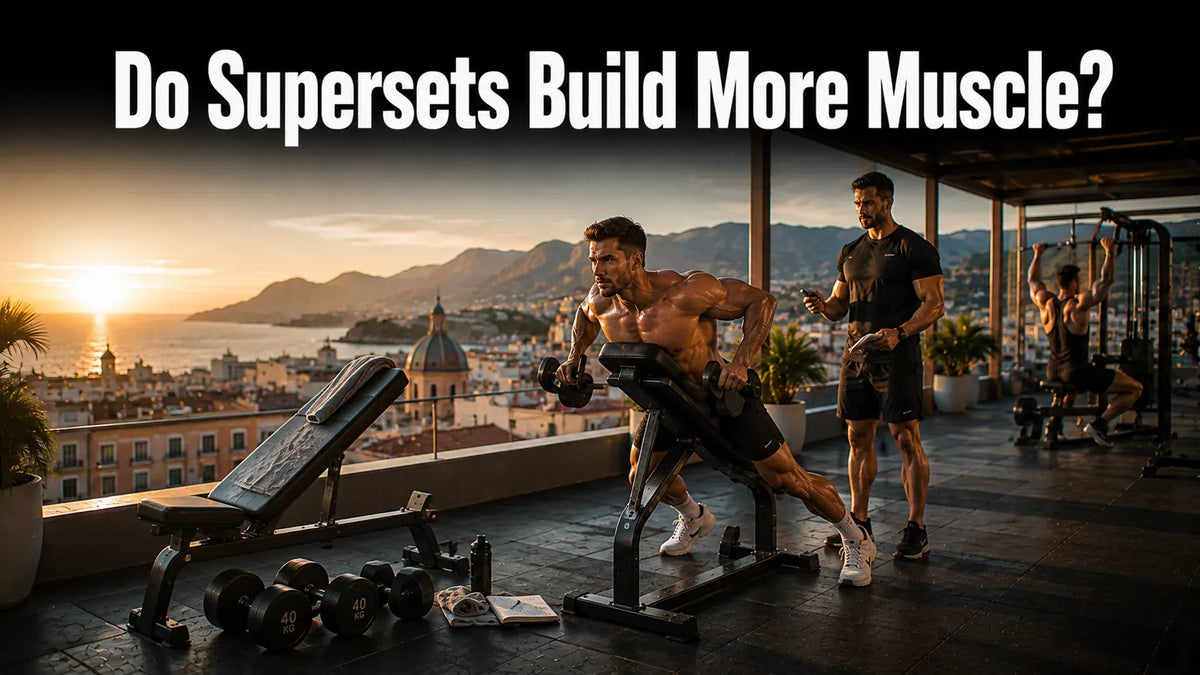
You finish a set of dumbbell bench presses.
Normally, you'd put the weights down, start your rest timer and spend the next two minutes recovering.
Instead, you immediately walk over to a cable station and start performing rows.
Chest.
Back.
Chest.
Back.
Two exercises have effectively been packed into a period that might normally contain one.
That's the appeal of supersets.
They're fast.
They're demanding.
They can produce an enormous pump.
And if you've ever completed several supersets in succession, you'll know they can make a relatively short workout feel considerably more intense.
But does that intensity actually mean more muscle growth?
Not necessarily.
Supersets can absolutely build muscle, and their ability to increase training density makes them particularly valuable when time is limited.
But shortening rest periods can also reduce performance.
And the way you pair exercises matters enormously.
Supersetting chest with back isn't necessarily the same as performing two chest exercises back-to-back. One pairing may allow you to train efficiently while preserving much of your performance; the other deliberately exhausts the same muscles twice in succession.
So the question isn't simply whether supersets work.
It's which type of supersets you use, what exercises you pair and whether the time you save comes at the expense of productive training performance.
1. What Are Supersets?
A superset involves performing two exercises consecutively with little or no conventional rest between them.
For example:
Exercise A: Dumbbell bench press
Immediately followed by:
Exercise B: Cable row
You then rest before repeating the pairing.
That creates one superset.
Compare that with traditional straight sets:
Bench press → rest → bench press → rest → bench press
With supersets, the second exercise occupies some or all of the period that would otherwise have been spent resting.
This increases training density—essentially allowing you to perform more work within a given amount of time.
But the term "superset" covers several different training methods.
You could pair opposing muscle groups.
You could train the same muscle twice.
You could combine a compound and isolation exercise.
Or you could pair exercises for completely unrelated areas of the body.
Those approaches can create very different levels of fatigue.
For example, pairing biceps curls with triceps extensions doesn't challenge exactly the same muscles.
Pairing dumbbell curls immediately with preacher curls does.
Both are supersets.
They aren't physiologically identical.
That's why saying "supersets are better" or "supersets are worse" without explaining the pairing doesn't tell us very much.

2. Do Supersets Actually Build More Muscle?
Supersets absolutely can build muscle.
Whether they inherently build more muscle than conventional training is another question.
Hypertrophy still depends on fundamentals such as:
- mechanical tension
- sufficiently challenging sets
- appropriate training volume
- progressive overload
- nutrition
- recovery
Supersets don't bypass those requirements.
What they change is how the work is organised.
Imagine you normally need an hour to complete a hypertrophy session.
Using carefully selected supersets might allow you to complete much of that training in 40–45 minutes.
If you're still performing enough productive work with appropriate effort, that's potentially extremely useful.
But suppose your supersets cause performance to collapse.
The weight falls dramatically.
Your repetitions decline.
Technique deteriorates.
And the second exercise in every pairing suffers because you're too fatigued to perform it properly.
You've certainly made the workout harder.
You haven't necessarily made it better.
This is the recurring problem with judging hypertrophy training according to discomfort.
A bigger pump doesn't automatically mean more growth.
More breathlessness doesn't mean more growth.
Finishing the workout faster doesn't automatically mean more growth either.
Supersets are best understood as a way of organising resistance training efficiently, rather than a special mechanism that suddenly makes muscles grow faster.
3. Are Supersets Better Than Straight Sets for Muscle Growth?
Neither method is universally better.
Straight sets have an important advantage:
recovery.
If you perform a challenging set and then rest for several minutes, you give yourself an opportunity to recover before repeating the exercise.
That can help preserve:
- repetitions
- load
- technique
- performance across sets
This is particularly valuable during heavy compound exercises.
If you're trying to progressively overload a barbell squat, immediately performing another demanding leg exercise before your next squat set probably won't improve your squat performance.
Supersets trade some of that conventional recovery time for greater training density.
Whether that's a good trade depends on the pairing.
Consider:
Bench press + cable fly
Both heavily involve the chest.
Your cable flyes will add additional fatigue to the same muscle you're expecting to use again during your next bench set.
Now consider:
Bench press + chest-supported row
While your chest performs the first exercise, your back becomes the primary target of the second.
That doesn't mean there's zero overlap or systemic fatigue, but the local muscular interference may be considerably different.
This is why well-designed supersets can save substantial time without simply turning every exercise into a worse version of itself.
Straight sets remain excellent.
Supersets are another programming option.
The best programme can easily contain both.
4. What Are the Different Types of Supersets?
This is where supersets become considerably more interesting.
Antagonist Supersets
These pair muscles that perform broadly opposing actions.
Common examples include:
Biceps + triceps
Chest + back
An example might be a cable curl immediately followed by a triceps pressdown.
These pairings can be particularly useful when your goal is increasing training density while limiting direct fatigue overlap between exercises.
Agonist Supersets
These pair two exercises targeting the same muscle group.
For example:
Dumbbell lateral raise + cable lateral raise
Your shoulders receive very little opportunity to recover between exercises.
This can create substantial local fatigue and a huge pump, but performance on the second movement will generally be affected more strongly.
Compound Supersets
The terminology varies, but these typically combine demanding multi-joint exercises.
For example:
Bench press + row
These can be extremely time-efficient, although combining two highly demanding exercises can also increase cardiovascular and systemic fatigue.
Pre-Exhaust Supersets
Here, an isolation exercise is performed immediately before a compound movement targeting the same muscle.
For example:
Cable fly → chest press
The idea is to fatigue the chest before moving onto the press.
That certainly makes the press feel harder.
But deliberately reducing your performance on the compound movement isn't automatically superior for hypertrophy.
Post-Exhaust Supersets
This reverses the sequence.
You perform the compound exercise first and then immediately move to an isolation exercise.
For example:
Chest press → cable fly
This allows you to perform the demanding compound movement while relatively fresh before extending the work with a more targeted exercise.
Different supersets solve different problems.
Don't choose one simply because it produces the most painful pump.
Choose the pairing according to what you're trying to achieve.

5. Can Supersets Save Time Without Sacrificing Muscle Growth?
This is probably the strongest argument for using supersets.
A surprising proportion of a conventional resistance-training session consists of not lifting weights.
You perform a set lasting perhaps 30 seconds.
Then rest for two minutes.
Another 30-second set.
Another two-minute rest.
Those recovery periods can be valuable—but they also make workouts longer.
Supersets allow you to use some of that time productively.
Instead of:
Chest → rest → chest
you could perform:
Chest → back → rest
While one muscle group is no longer performing the primary work, another is being trained.
That can dramatically reduce the total duration of a session.
For someone with 40 minutes available rather than 90, this can make the difference between completing a proper workout and constantly cutting sessions short.
However, exercise pairing becomes crucial.
If your superset creates so much fatigue that your repetitions and loads collapse, you're no longer simply saving time.
You're changing the training stimulus.
This is why antagonist or non-competing supersets can be particularly attractive when workout efficiency is the priority.
You might pair:
Chest + back
Biceps + triceps
Upper body + calves
rather than repeatedly exhausting exactly the same muscle.
Hydration remains relevant during dense training sessions too, particularly if you're sweating heavily. BetterYou Magnesium Water – Energy / Focus / Hydrate can fit within someone's wider hydration routine where appropriate, but it doesn't make poorly designed supersets productive.


The training structure is what saves the time.
And that's the real appeal.
Supersets don't need to build dramatically more muscle to be valuable.
If they allow you to achieve a productive hypertrophy session in significantly less time, that's already a substantial advantage.
Intermission
So far, we've established that supersets can absolutely build muscle, but their biggest advantage isn't necessarily superior hypertrophy.
It's training density.
By performing two exercises consecutively, you can dramatically reduce the amount of time spent simply waiting between sets. But the effectiveness of that strategy depends heavily on exercise pairing. Antagonist or non-competing supersets may preserve performance considerably better than repeatedly training the same muscle with little recovery.
In Part 2, we'll look at which exercises work best together, which supplements can support performance and recovery during dense training, whether supersets should be taken to failure, the mistakes that can turn a time-efficient workout into an unnecessarily exhausting one and the best way to programme supersets for muscle growth.
Part 2
6. Which Exercises Work Best in Supersets?
The best supersets aren't necessarily the combinations that feel the most brutal.
They're the combinations that allow you to save time while still performing both exercises properly.
That's why exercise pairing matters so much.
For antagonist supersets, classic combinations include:
- chest press + row
- cable fly + pulldown
- biceps curl + triceps extension
- leg extension + leg curl
These pairings allow one primary muscle group to work while its opposing muscle group isn't performing the same action.
You can also use non-competing supersets.
For example:
Lateral raise + calf raise
Your shoulders aren't directly limiting your calves, and your calves aren't directly limiting your shoulders.
This can be an extremely simple way to shorten a workout without deliberately exhausting either muscle before its next set.
Same-muscle supersets are different.
Pairing:
Incline dumbbell press + cable fly
can create considerable chest fatigue.
That's not inherently bad.
But you should expect your performance on the second exercise—and potentially subsequent sets—to decline.
Exercise setup matters too.
A technically perfect superset becomes considerably less useful if you spend two minutes walking across a packed gym trying to find the second machine.
Choose movements that are practical to perform consecutively.
And don't monopolise half the gym during peak hours just because your programme contains four supersets.

7. Which Supplements Support Performance and Recovery During Supersets?
Supersets can make a resistance-training session feel considerably more demanding because you're performing more work within a shorter period.
But they don't require a special supplement strategy.
For people who use pre-workout, ABE All Black Everything – PUMP Pre Workout 500g can fit into a wider pre-training routine where appropriate.


Another established option for resistance-trained individuals is creatine.
Applied Nutrition Creatine 3000 – 120 Caps provides a convenient creatine format that can support repeated high-intensity exercise performance when used consistently.

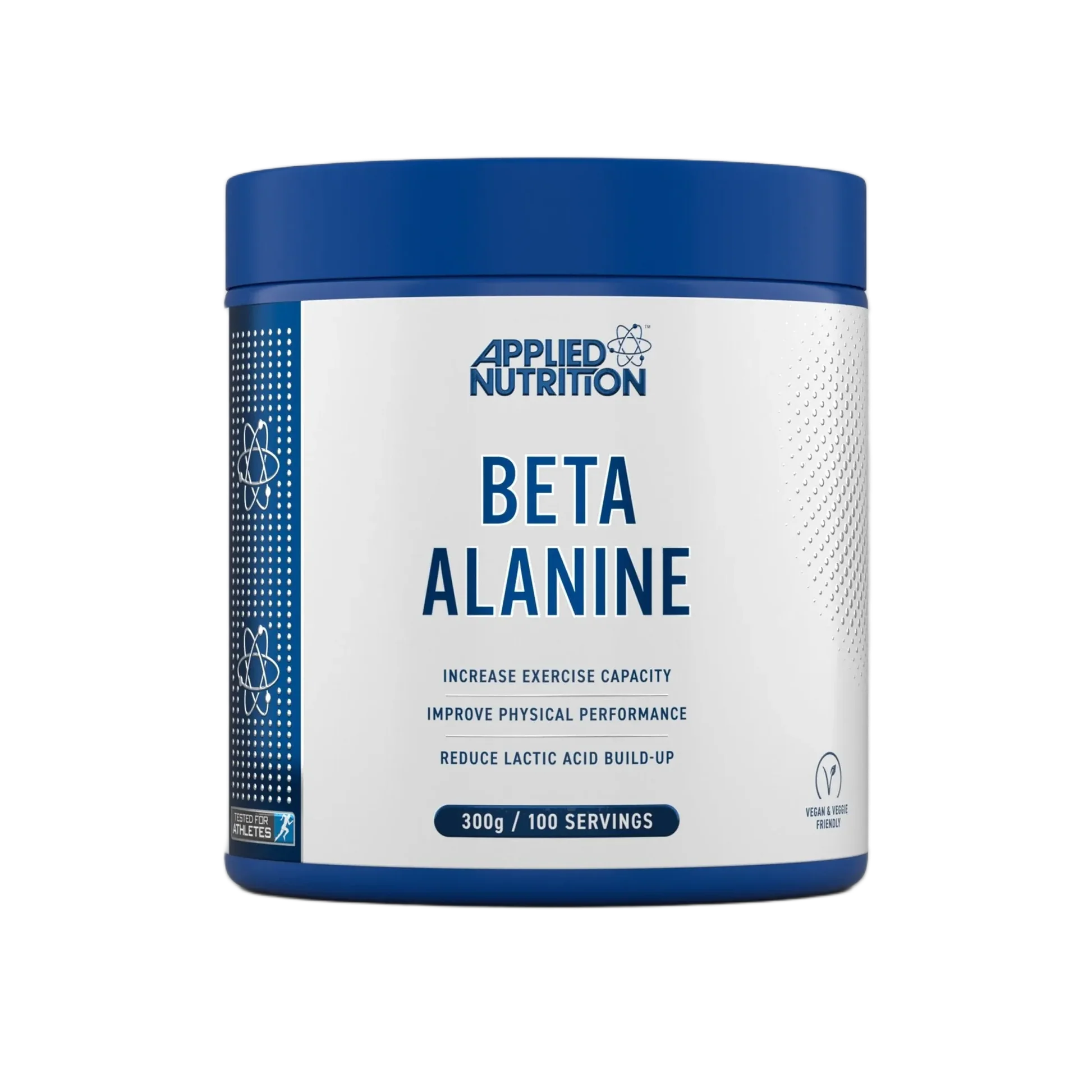
Applied Nutrition Beta-Alanine – 300g may also be relevant to repeated high-intensity exercise, particularly where demanding efforts accumulate, although it shouldn't be presented as something that specifically makes supersets build more muscle.
Then there's recovery.
Your muscles don't care whether their training stimulus came from straight sets or supersets when it comes to the basic requirement for adequate nutrition.
Daily protein intake remains important.
Per4m Plant Protein – 2kg provides a plant-based option for increasing dietary protein intake alongside normal meals.


But supplements remain exactly that:
supporting tools.
If your superset programme creates so much fatigue that performance collapses across the workout, adding more supplements isn't the solution.
Fix the programme first.
8. Should You Take Supersets to Failure?
You can.
That doesn't mean both exercises in every superset need to reach absolute failure.
Consider an antagonist pairing:
Incline press → chest-supported row
If you take the incline press to complete failure and immediately move onto rows, you're beginning the second exercise under greater overall fatigue.
Repeat that for several rounds and the effect accumulates.
Now imagine a same-muscle superset:
Dumbbell curl → preacher curl
Taking the first exercise to absolute failure means the biceps are already extremely fatigued before the second movement begins.
That may be precisely what you intended.
But don't confuse difficulty with necessity.
For hypertrophy, training sufficiently close to failure can provide a strong stimulus without requiring every working set to reach the point where another repetition is physically impossible.
One practical strategy is to leave a small number of reps in reserve on earlier rounds and allow the final superset to become more demanding.
This can help maintain performance across the workout.
The appropriate effort also depends on the exercise.
Taking a cable curl close to failure is very different from repeatedly taking a heavy free-weight compound exercise to failure before immediately beginning another demanding movement.
Supersets already increase training density.
You don't necessarily need to maximise every other intensity variable simultaneously.
9. What Mistakes Do People Make With Supersets?
Supersets are easy to programme badly because almost any two exercises can technically be paired together.
That doesn't mean they should be.
Pairing Two Exercises That Interfere Too Much
Imagine:
Heavy barbell row → heavy deadlift
Both movements create substantial overlapping fatigue.
You might save time, but your performance on the second exercise could suffer considerably.
A clever-looking pairing isn't useful if it makes both exercises worse.
Turning Every Exercise Into a Superset
You don't need to superset your entire workout.
Traditional straight sets can remain particularly valuable for exercises where strength, technique and progressive overload are priorities.
Supersets can then be introduced later in the session.
Using No Rest at All
A superset doesn't necessarily mean:
Exercise A → Exercise B → Exercise A → Exercise B forever.
You can perform both exercises and then take an appropriate rest before repeating the pairing.
That recovery can substantially improve subsequent performance.
Choosing Exercises Too Far Apart
Your beautifully designed programme isn't particularly time-efficient if one exercise is upstairs and the other is on the opposite side of the gym.
Practicality matters.
Chasing the Pump
Same-muscle supersets can produce enormous pumps.
That doesn't automatically make them superior for hypertrophy.
The pump is an acute response to training—not a direct measurement of future muscle growth.
Forgetting Progressive Overload
Supersets can become so focused on speed and intensity that progression gets forgotten.
You should still be able to answer:
Am I actually improving?
That might mean more repetitions, greater resistance, better execution or increased productive training volume over time.
If you've performed exactly the same superset with exactly the same performance for six months, making it feel exhausting isn't enough.

10. What's the Best Way to Use Supersets for Muscle Growth?
For most people, the best approach is to use supersets where they provide a clear advantage rather than forcing them into every part of the workout.
You might begin with conventional straight sets for your primary compound exercises.
For example:
Barbell bench press
Three conventional working sets with appropriate rest.
Then later:
Cable row + cable fly
followed by:
Biceps curl + triceps pressdown
This preserves plenty of recovery around the exercise where performance is particularly important while making the remainder of the session considerably more time-efficient.
Another excellent option is using antagonist supersets throughout parts of the workout.
A chest-and-back session could include:
Incline dumbbell press + chest-supported row
Cable fly + pulldown
Because the exercises target broadly opposing muscle groups, you may be able to increase training density without creating the same local muscular fatigue as two consecutive chest exercises.
Same-muscle supersets can still have a place.
Just recognise what you're doing.
A chest press followed immediately by a cable fly isn't primarily about preserving performance.
You're deliberately extending the work performed by an already-fatigued muscle.
That can be useful selectively.
It doesn't need to become the structure of every set.
The goal is to find the balance between:
performance
stimulus
fatigue
time
That's where supersets become genuinely useful.
Not as a way of making your workout as painful as possible.
But as a way of making it more efficient without unnecessarily compromising the work that actually drives progress.
Conclusion
So, do supersets build more muscle?
They can absolutely build muscle.
But there's no good reason to assume that simply pairing exercises together automatically produces more hypertrophy than well-programmed straight sets.
Their strongest advantage is efficiency.
Supersets allow you to perform more training within a shorter period by replacing some traditional rest time with another exercise.
And when exercises are intelligently paired, you may be able to achieve that without dramatically compromising performance.
Antagonist and non-competing supersets are particularly useful when preserving performance matters.
Same-muscle supersets can create enormous local fatigue and provide another way of extending demanding muscular work.
Neither approach is universally superior.
Use straight sets where recovery and performance are priorities.
Use supersets where increasing training density makes sense.
Keep progressing.
Manage fatigue.
And don't mistake a faster, sweatier workout for an automatically better muscle-building workout.
The best supersets aren't simply hard.
They're well designed.
FAQ
1. Do supersets build muscle?
Yes. Supersets can provide an effective hypertrophy stimulus when they contain sufficiently challenging resistance training and appropriate overall volume.
2. Do supersets build more muscle than normal sets?
Not necessarily. Supersets can produce effective muscle growth, but their major advantage is often completing productive training in less time.
3. Are supersets better than straight sets for hypertrophy?
Neither is universally better. Straight sets provide more conventional recovery, while supersets increase training density and can significantly shorten workouts.
4. What is an antagonist superset?
An antagonist superset pairs broadly opposing muscle groups, such as biceps with triceps or chest with back.
5. Can supersets save time in the gym?
Yes. This is one of their biggest advantages because one exercise can be performed during time that might otherwise have been spent completely resting.
6. What exercises are good to superset?
Chest and back, biceps and triceps, leg extensions and leg curls, or other non-competing exercises can work particularly well.
7. Should you take supersets to failure?
You can take some supersets very close to or occasionally to failure, but taking every exercise in every pairing to absolute failure can create unnecessary fatigue.
8. How many supersets should you do per workout?
There's no universal number. You could use only one or two pairings or structure much of a workout around supersets depending on your goals, exercise selection and recovery.
9. Are same-muscle supersets good for hypertrophy?
They can be. Pairing two exercises for the same muscle creates substantial local fatigue, although that doesn't automatically make it superior to other hypertrophy methods.
10. What's the best way to use supersets for muscle growth?
Keep performance-focused exercises conventional where appropriate, then use intelligently selected antagonist, non-competing or same-muscle supersets to increase training density without allowing fatigue to overwhelm the workout.


