


Lowering a heavy dumbbell slowly after a curl feels different from simply letting it fall.
Your biceps remain under tension.
The weight feels increasingly difficult to control.
And even when you're no longer capable of curling the dumbbell upwards, you may still be able to resist it on the way down.
That's the eccentric, or negative, portion of the repetition.
Because muscles can generally handle greater forces eccentrically than concentrically, negative reps have developed an almost legendary reputation in bodybuilding.
You'll hear claims that negatives create more muscle damage.
That slowing every repetition dramatically increases time under tension.
That assisted negatives allow you to continue growing after you've reached failure.
And, inevitably, that the eccentric phase is the real secret to muscle growth.
There's some truth buried inside the hype.
Eccentric training can absolutely build muscle, and deliberately overloading the lowering phase can provide a powerful training stimulus.
But that doesn't mean spending ten seconds lowering every repetition will automatically build more muscle.
Nor does it mean you should perform assisted negatives after every working set.
Negative training can also produce considerable fatigue and muscle soreness—particularly when it's unfamiliar or heavily overloaded.
So the real question isn't whether negative reps work.
It's whether they build more muscle than normal repetitions, how slowly you should actually lower the weight and when eccentric-focused training becomes worth the additional fatigue.
1. What Are Negative Reps?
Every conventional resistance-training repetition can usually be divided into different phases.
The concentric phase occurs when the target muscle produces force while shortening.
The eccentric phase occurs when the muscle produces force while lengthening under load.
Take a biceps curl.
Curling the dumbbell upwards is the concentric portion.
Lowering it back towards the starting position is the eccentric—or negative—portion.
So technically, you're already performing negatives during ordinary resistance training.
But when lifters talk about negative reps, they usually mean deliberately emphasising that eccentric portion.
That might involve:
- lowering the weight more deliberately
- using a heavier load eccentrically than you could lift concentrically
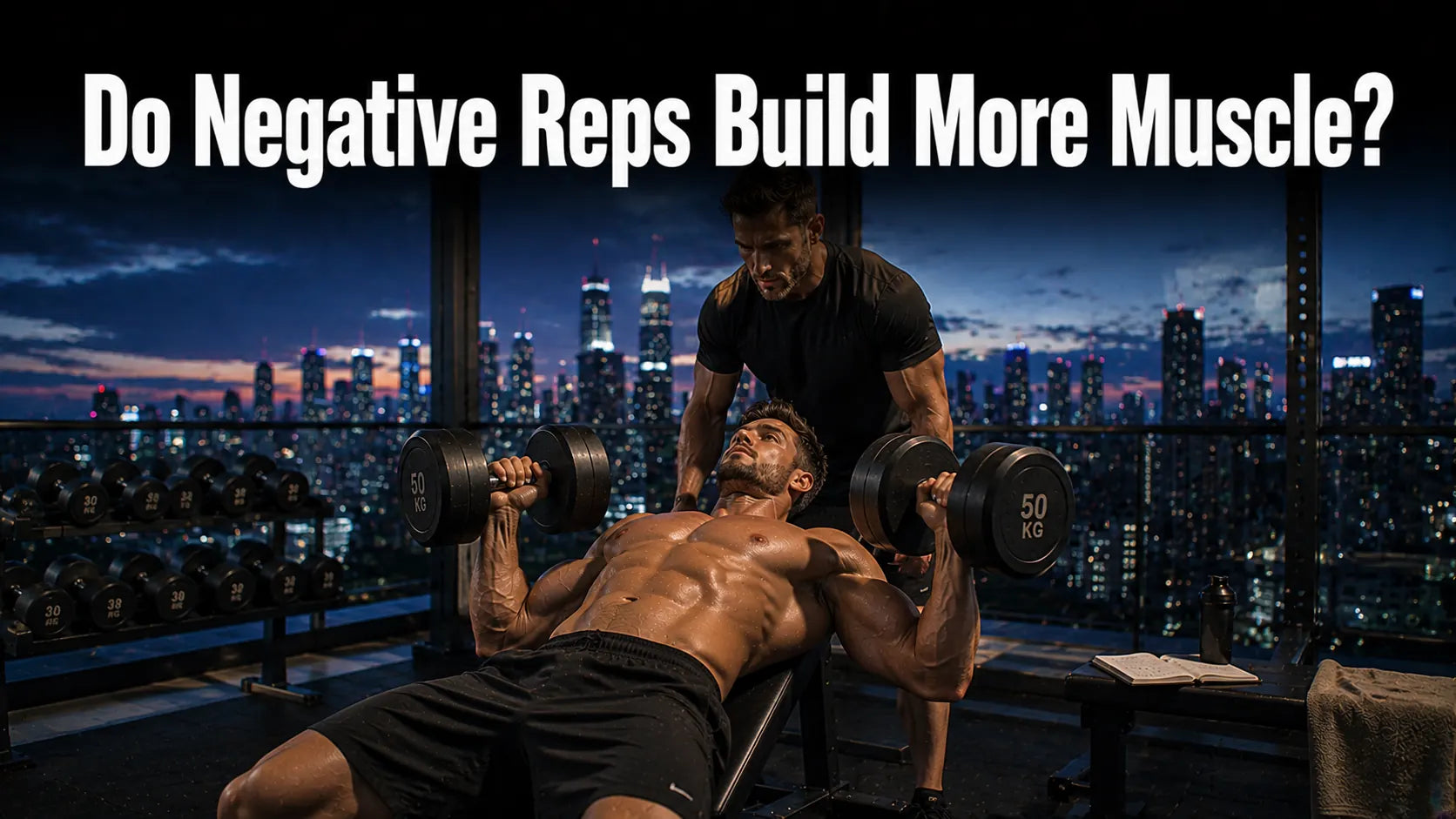
- having a training partner help with the concentric phase
- continuing with assisted negatives after concentric failure
Imagine you can no longer perform another pull-up.
A training partner helps you reach the top position.
You then lower yourself slowly and under control.
That's an assisted negative.
Or perhaps you're performing a machine exercise where someone helps you move the weight through the concentric phase before you resist a heavier load during the eccentric.
That's closer to eccentric overload.
This distinction matters.
Simply controlling the lowering phase of your normal repetitions isn't necessarily an advanced negative-rep technique.
It's just good resistance training.

2. Do Negative Reps Actually Build More Muscle?
Negative reps can certainly build muscle.
Whether they consistently build more muscle than well-performed conventional repetitions is a more complicated question.
Eccentric contractions can produce high levels of force and mechanical tension—both highly relevant to hypertrophy.
This makes eccentric-focused training a legitimate way to stimulate muscle growth.
But conventional repetitions already contain an eccentric phase.
If you're performing a controlled bench press, squat, curl or row, you're not somehow missing eccentric training simply because you aren't deliberately extending the lowering phase.
That's important because negative reps are sometimes presented as though ordinary repetitions only train half the muscle.
They don't.
A normal repetition combines concentric and eccentric muscle actions.
Dedicated negative training changes the emphasis.
That can be useful when you deliberately want to overload the eccentric phase or continue producing force after concentric failure.
But more eccentric stress doesn't automatically equal proportionally more muscle growth.
It can also mean:
more fatigue.
more soreness.
more recovery demand.
The best hypertrophy programme isn't necessarily the one that creates the greatest possible stress from every individual set.
It's the one that provides enough stimulus to grow while still allowing you to recover and perform productive training consistently.
3. Why Are You Stronger During the Eccentric Phase of a Lift?
This is what makes negative training possible in the first place.
Your muscles can generally resist more force while lengthening than they can produce while shortening.
Think about a pull-up.
Eventually, you may reach the point where you're incapable of pulling yourself from the bottom to the top.
Your concentric strength has failed.
But if someone helps you into the top position, you may still be able to lower yourself slowly.
You couldn't lift yourself up.
Yet you can still control yourself down.
The same principle applies to many resistance exercises.
This creates an interesting opportunity.
If you're capable of handling more force eccentrically, then specialised techniques can expose your muscles to loads during the negative phase that would be impossible to lift conventionally.
That's eccentric overload.
But practical implementation isn't always straightforward.
You need a safe method of getting the weight into position.
You may require a training partner.
Some exercises are much better suited to the technique than others.
And simply because your muscles can tolerate a heavier eccentric load doesn't mean your entire programme should revolve around exploiting that ability.
Eccentric strength is a useful characteristic.
It isn't an invitation to make every repetition brutally difficult.
4. Are Negative Reps Better Than Normal Reps for Muscle Growth?
Not automatically.
This is where the bodybuilding mythology around negatives can get ahead of the practical reality.
A normal controlled repetition gives you both:
a concentric phase
and
an eccentric phase.
You therefore don't have to choose between "normal reps" and "eccentric training" as though conventional resistance training contains no negative component.
The more relevant comparison is between ordinary controlled repetitions and deliberately eccentric-emphasised training.
There can be advantages to emphasising the negative.
You may be able to expose the muscle to greater eccentric forces.
You can continue producing force when concentric repetitions are no longer possible.
And eccentric-focused work can provide a novel stimulus.
But it also comes with potential disadvantages.
Heavy or unfamiliar eccentric training can create substantial muscle soreness and fatigue.
Assisted negatives can require a competent training partner.
And extending sets with negatives after failure can make recovery considerably more demanding.
For most people interested in hypertrophy, normal controlled repetitions should therefore remain the foundation.
Eccentric-focused techniques can then be layered on strategically where they're useful.
Think of negatives as a tool.
Not a replacement for ordinary resistance training.

5. How Slowly Should You Lower the Weight During Negative Reps?
This is where people often take a useful idea to an unnecessary extreme.
If controlling the eccentric is good, surely lowering the weight even more slowly must be better.
Three seconds becomes five.
Five becomes eight.
Eventually, someone is spending half a minute completing one repetition.
That's not automatically superior hypertrophy training.
For normal resistance training, the main priority is generally to control the eccentric rather than deliberately resist it for as long as physically possible.
You shouldn't simply allow gravity to drop the weight.
But you also don't need to transform every repetition into slow motion.
A controlled eccentric lasting roughly two to four seconds can be perfectly reasonable when deliberately emphasising the negative, although there's no universal magic tempo that must be used on every exercise.
True eccentric-overload training is slightly different.
If you're using a load heavier than you could lift concentrically, you need enough control to resist the weight safely throughout the intended range.
The correct tempo therefore depends partly on:
- the exercise
- the load
- your training objective
- whether you're using normal reps or eccentric overload
- your level of experience
Extremely slow repetitions also have a trade-off.
The slower each repetition becomes, the less weight or fewer repetitions you may be capable of performing.
So while time under tension increases, other aspects of the training stimulus change simultaneously.
More seconds don't automatically mean more hypertrophy.
If your normal repetitions already include a controlled lowering phase, you don't need to panic because you're not counting "one Mississippi, two Mississippi, three Mississippi" on every rep.
Control the weight.
Maintain your technique.
And use deliberately slower negatives when they actually serve a purpose.
Intermission
So far, we've established that negative reps are simply an intentional emphasis on the eccentric—or lowering—phase of resistance exercise.
Eccentric contractions can produce high forces, and your muscles can generally handle greater loads while lengthening than while shortening. That makes eccentric overload and assisted negatives legitimate training techniques with the potential to provide a powerful hypertrophy stimulus.
But conventional repetitions already contain an eccentric phase, and deliberately making that phase slower or heavier doesn't automatically guarantee additional muscle growth. More eccentric stress can also create more fatigue, soreness and recovery demand.
In Part 2, we'll look at which exercises are best suited to negative reps, which supplements can support training performance and recovery, why eccentric training can leave you unusually sore, the biggest mistakes people make with negatives and the best way to incorporate eccentric-focused work without allowing it to overwhelm the rest of your muscle-building programme.
Part 2
6. Which Exercises Work Best With Negative Reps?
Some exercises are much better suited to negative reps than others.
The ideal movement allows you to emphasise the eccentric phase safely without turning the exercise into an awkward two-person operation.
Pull-ups are a classic example.
If you can no longer pull yourself to the bar, you can use a platform or assistance from a training partner to reach the top position before lowering yourself under control.
Certain machine exercises can work well too because the fixed movement path makes the load easier to control.
Other useful candidates can include:
- pull-ups
- chin-ups
- machine chest presses
- machine rows
- leg curls
- biceps curls
- triceps extensions
- calf raises
Free-weight exercises require more caution.
Consider a bench press.
Using a weight heavier than you can actually press and relying on someone else to repeatedly lift it back into position creates obvious practical and safety problems.
The same applies to heavy squats.
There are considerably easier ways to stimulate your muscles than deliberately putting yourself underneath a load you cannot lift concentrically.
Negative training doesn't have to mean extreme eccentric overload either.
You can simply emphasise a controlled lowering phase during conventional exercises.
For example, you might perform a biceps curl normally on the way up before deliberately controlling the descent.
This is far easier to implement than attempting maximal assisted negatives.
If you're using demanding eccentric techniques, arriving at the session adequately fuelled also matters. Applied Nutrition Body Fuel Energy Shot – 12 × 60ml can provide a convenient pre-training option where appropriate, although no energy product makes an unsuitable eccentric exercise safer.


Choose movements that let you control the negative.
Not movements where losing control creates unnecessary risk.

7. Which Supplements Support Performance and Muscle Recovery?
Negative reps don't require specialised supplements.
They require the same fundamentals that support productive resistance training generally:
adequate nutrition, sufficient protein, good hydration and appropriate recovery.
Protein is particularly relevant because resistance training increases the requirement for muscle repair and remodelling.
Per4m Whey Hydrate – 1.8kg can provide a convenient source of dietary protein alongside normal meals, helping you work towards an appropriate daily protein intake.


Creatine is another useful option for resistance-trained individuals.
Applied Nutrition Creatine 3000 – 120 Caps can support repeated high-intensity exercise performance when used consistently alongside training.

And for people who prefer additional pre-training support, Optimum Nutrition Platinum Pre-Workout – 420g can fit into a wider performance-focused routine.


But there's an important point here.
Supplements don't cancel fatigue.
If you perform excessive eccentric training and create more muscle soreness than you can recover from, another scoop of something isn't going to magically repair your programme.
The hierarchy still matters:
Train appropriately.
Eat enough.
Consume sufficient protein.
Sleep.
Recover.
Then use supplements where they genuinely make your routine easier or support performance.
8. Do Negative Reps Cause More Muscle Soreness and Fatigue?
They certainly can.
Eccentric exercise is particularly associated with delayed onset muscle soreness (DOMS) when the stimulus is unfamiliar or substantially more demanding than what you're accustomed to.
This is one reason your first exposure to eccentric-focused training can feel brutal.
You might perform what appears to be a relatively small amount of work and then wake up the following day considerably more sore than expected.
Soreness can also peak later rather than immediately after training.
But here's the crucial distinction:
More soreness doesn't automatically mean more muscle growth.
Muscle damage can accompany resistance training, but creating as much damage as possible shouldn't be the objective of a hypertrophy programme.
If your eccentric session leaves you so sore that you cannot train the muscle productively again for a week, the additional recovery cost may outweigh whatever benefit you gained from making that individual workout more demanding.
Repeated exposure also matters.
As your body becomes accustomed to a particular eccentric stimulus, the same training generally produces less severe soreness.
So don't judge the effectiveness of negative training by how difficult it makes walking downstairs two days later.
Judge it by whether you can:
- recover appropriately
- maintain good technique
- progressively improve performance
- train consistently
- accumulate productive work over time
Applied Nutrition Multi-Vitamin Complex – 90 Capsules can complement an otherwise balanced diet where appropriate, but it shouldn't be treated as a treatment for DOMS or a shortcut to recovering from excessive eccentric training.
If negative reps continually destroy your ability to train, the first thing to adjust is the training.
Not the supplement cupboard.
9. What Mistakes Do People Make With Negative Reps?
Negative reps sound simple.
Lower the weight slowly.
But there are several ways to turn them into an unnecessarily exhausting training technique.
Making Every Rep Extremely Slow
Controlled doesn't mean glacial.
Taking ten seconds to lower every repetition isn't automatically better than taking three.
Extremely slow negatives can substantially reduce the load and repetitions you're able to perform without guaranteeing superior hypertrophy.
Using Too Much Weight
Yes, you're stronger eccentrically.
That doesn't mean you should load the bar with as much weight as possible and hope your muscles can stop gravity winning.
Eccentric overload needs to remain controlled.
Performing Negatives After Every Set
Assisted negatives after concentric failure can dramatically extend a set.
That's precisely why they can also generate substantial fatigue.
Using them occasionally is very different from adding them to every exercise in your programme.
Confusing Pain With Effectiveness
A brutally sore muscle isn't necessarily a rapidly growing muscle.
Soreness tells you that the training created a response.
It doesn't provide a direct measurement of hypertrophy.
Letting Your Training Partner Do Everything
Assisted negatives require competent assistance.
Your partner should help you reach the starting position while allowing you to control the eccentric.
If they're essentially performing an upright row every time you attempt another bench press repetition, the technique has probably stopped being useful for both of you.
Ignoring Progressive Overload
Negative reps still need some form of measurable progression.
That might involve:
- greater eccentric load
- additional controlled repetitions
- improved control
- progression within the wider exercise
Don't use negatives simply to make training feel harder.
Use them because they provide a specific stimulus you can manage and progress.

10. What's the Best Way to Use Negative Reps for Muscle Growth?
For most lifters, negative training works best as an addition to conventional resistance training rather than its replacement.
Start with the simplest approach.
Control Your Normal Eccentrics
Before worrying about assisted negatives or eccentric overload, make sure you actually control the lowering phase of ordinary repetitions.
If you're curling the dumbbell upwards and then allowing gravity to drop it back down, there's an obvious improvement available without introducing an advanced technique.
Use Deliberately Slower Negatives Selectively
You can occasionally emphasise the eccentric with a controlled two-to-four-second lowering phase.
There's no need to do this on every exercise or every repetition.
Use Assisted Negatives Sparingly
A more advanced approach is to perform your conventional repetitions and then add a small number of assisted negatives once another concentric repetition is impossible.
Pull-ups can work particularly well.
Complete your normal repetitions.
When you can no longer pull yourself up, use assistance to reach the top.
Then lower yourself under control.
That extends the set without pretending you're still capable of complete repetitions.
Experiment With Eccentric Overload Carefully
Experienced lifters may experiment with loads that exceed their concentric capabilities when the exercise and equipment allow this to be done safely.
But this isn't a prerequisite for building muscle.
You can develop an impressive physique without ever performing a dedicated supramaximal eccentric set.
Manage the Recovery Cost
This may be the most important rule.
If introducing negatives causes your soreness and fatigue to explode while your subsequent training quality collapses, you've probably added too much too quickly.
Start conservatively.
Allow your body to adapt.
Then decide whether the technique is actually improving your programme.
Because the goal isn't to become exceptionally good at surviving painful negatives.
It's to build muscle.
Conclusion
So, do negative reps build more muscle?
They can be a highly effective hypertrophy tool, but that doesn't mean eccentric-focused training automatically beats normal controlled repetitions.
Every conventional repetition already contains an eccentric phase.
Controlling that phase is a fundamental part of good resistance training.
Dedicated negative techniques take things further.
You can deliberately slow the eccentric.
You can continue performing negatives after concentric failure.
And with appropriate equipment or assistance, you can expose muscles to eccentric loads greater than you could lift concentrically.
Those techniques can provide substantial mechanical tension.
They can also produce substantial fatigue.
That's the trade-off.
If you respond to every interesting hypertrophy technique by adding it to every exercise, you eventually create a programme that's exceptionally difficult to recover from.
Use negative reps strategically instead.
Control your normal repetitions.
Introduce eccentric emphasis where it makes sense.
Keep the technique safe.
Progress over time.
And remember that the best muscle-building technique isn't necessarily the one that makes you the sorest.
It's the one that provides a productive stimulus you can recover from and repeat.
FAQ
1. Do negative reps build muscle?
Yes. Negative reps emphasise the eccentric phase of resistance exercise and can provide a strong hypertrophy stimulus.
2. Do negative reps build more muscle?
Potentially in some circumstances, particularly when eccentric overload provides a novel stimulus. However, negative reps aren't universally superior to well-programmed conventional repetitions.
3. What is the eccentric phase of a lift?
The eccentric phase occurs when a muscle produces force while lengthening, such as lowering a dumbbell during a biceps curl.
4. Are you stronger during negative reps?
Generally, muscles can handle greater forces eccentrically than concentrically, which is why you may still be able to lower a weight after you're unable to lift it.
5. How slow should negative reps be?
There's no universal perfect tempo. A controlled lowering phase of roughly two to four seconds can be useful when deliberately emphasising the eccentric, without assuming slower is always better.
6. Are slow negatives better for hypertrophy?
Not automatically. Extremely slow negatives increase repetition duration but can reduce the load or number of repetitions you can perform. More time under tension doesn't inherently mean more muscle growth.
7. What exercises are best for negative reps?
Pull-ups, chin-ups and certain machine or isolation exercises can work particularly well because the eccentric can be controlled relatively easily. Exercise safety should always determine whether heavier assisted negatives are appropriate.
8. Do negative reps cause more muscle soreness?
They can, particularly when eccentric-focused exercise is unfamiliar or heavily overloaded. However, greater DOMS shouldn't be interpreted as proof of greater muscle growth.
9. Should you do negative reps after failure?
Advanced lifters can occasionally use assisted negatives after concentric failure to extend a set, but the additional fatigue means they don't need to be used routinely.
10. How often should you use negative reps?
There's no mandatory frequency. Most lifters can use controlled eccentrics during normal training and introduce more demanding negative techniques selectively according to their recovery and programme.


