


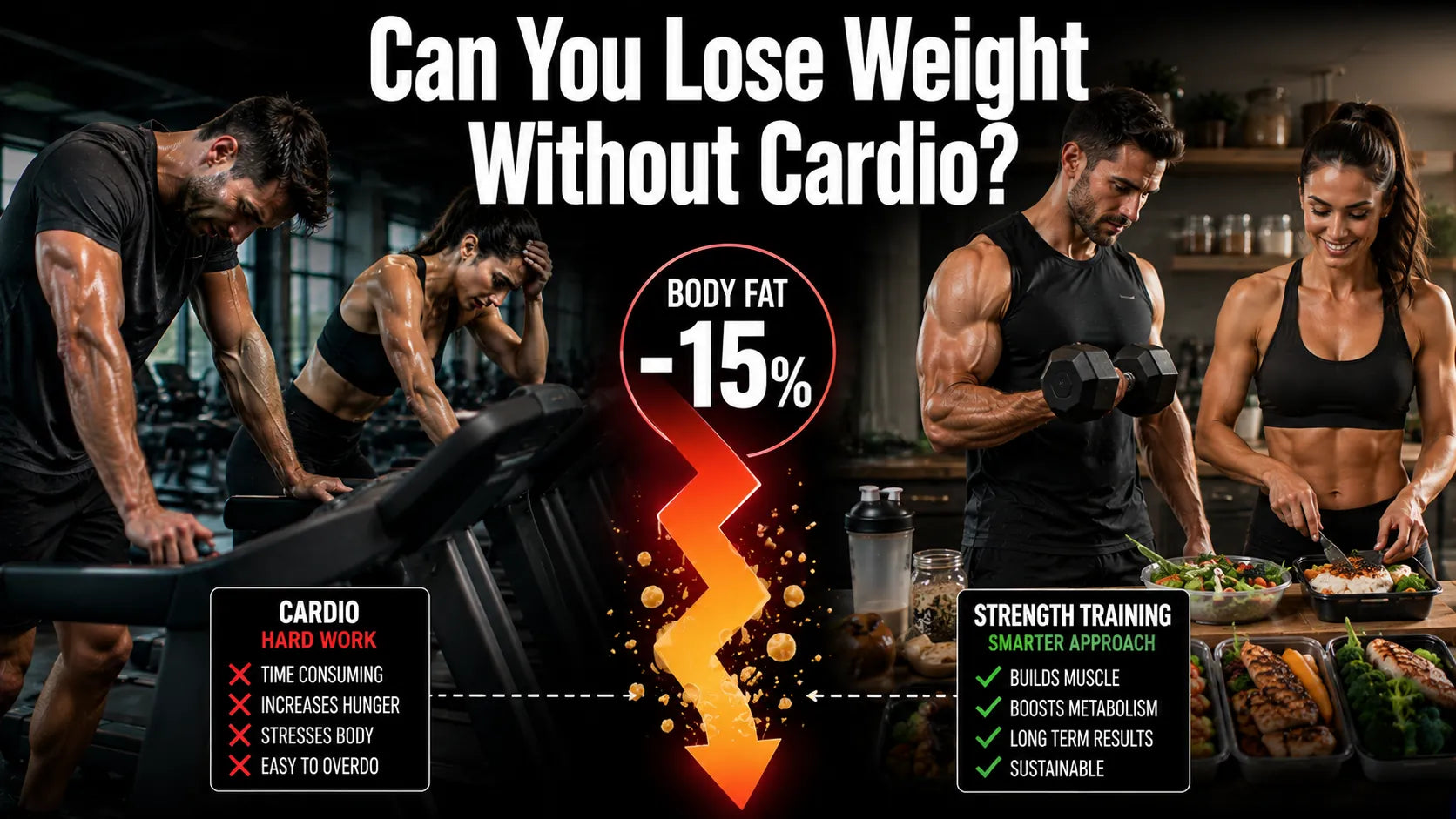
For decades, weight loss advice has sounded remarkably similar.
Eat less.
Move more.
Do more cardio.
Run.
Cycle.
Use the treadmill.
Burn as many calories as possible.
The message became so common that many people now assume cardio is mandatory for fat loss.
In fact, one of the most frequent questions people ask is:
"Can I lose weight without doing cardio?"
The answer often surprises them.
Because despite what many people believe, cardio is not the thing that causes weight loss.
Cardio can help.
It can be useful.
It can make creating a calorie deficit easier.
But cardio itself is not a requirement.
There are countless examples of people losing substantial amounts of body fat while doing very little traditional cardio.
Some focus primarily on:
- nutrition
- strength training
- daily activity
Others simply become more consistent with their eating habits.
The key is understanding what actually drives fat loss in the first place.
Once you understand that, the entire conversation changes.
1. Do you actually need cardio to lose weight?
No.
This is perhaps the biggest misconception in the fitness industry.
Weight loss is not caused by cardio.
Weight loss is caused by an energy deficit.
In simple terms:
You must consistently use more energy than you consume.
That's what drives fat loss.
Cardio is merely one tool that can help create that deficit.
But it's far from the only tool.
People can create an energy deficit through:
- nutrition
- strength training
- increased daily movement
- cardio
- a combination of all four
The body doesn't care whether the deficit came from running, walking, lifting weights, or eating slightly fewer calories.
It simply responds to the overall energy balance.
This is why some people successfully lose weight despite never stepping on a treadmill.

2. Why is a calorie deficit more important than cardio for fat loss?
Because the calorie deficit is the actual driver of fat loss.
Cardio is simply one way to influence it.
Imagine two people.
Person A runs for 45 minutes every day but consistently overeats afterwards.
Person B never performs traditional cardio but maintains a moderate calorie deficit through nutrition.
Who loses weight?
Usually Person B.
That's because cardio cannot override an ongoing calorie surplus.
Many people dramatically overestimate how many calories exercise burns.
At the same time, they underestimate how easy it is to consume those calories again.
This is why successful fat-loss journeys almost always involve some degree of nutritional awareness.
The most effective fat-loss tool isn't necessarily the one that burns the most calories.
It's often the one that makes maintaining a calorie deficit easiest.
3. Can strength training be enough to lose body fat?
Absolutely.
In fact, strength training offers several advantages during a fat-loss phase.
When dieting, the goal shouldn't simply be losing weight.
The goal should be improving body composition.
There's a difference.
You want to lose body fat while preserving as much muscle as possible.
Strength training helps support that process.
It provides the body with a reason to hold onto muscle tissue even while calories are reduced.
This is one reason products such as Naughty Boy Prime Creatine 450g remain popular during fat-loss phases. Creatine can help support training performance and strength levels while dieting, which may help lifters continue training effectively.
The scales don't tell the whole story.
A leaner, stronger body often looks dramatically different from a lighter body that has lost both fat and muscle.
That's why strength training is often considered one of the most valuable tools for long-term fat loss.
4. Why do some people lose weight successfully without doing any cardio?
Because they focus on the factors that matter most.
Many successful fat-loss transformations share several common characteristics:
- consistent nutrition
- adequate protein intake
- realistic calorie targets
- regular activity
- patience
Notice that cardio isn't automatically on the list.
That's not because cardio is ineffective.
It's because fat loss can occur without it.
People often imagine that successful weight loss requires suffering through endless exercise.
In reality, sustainable weight loss usually comes from habits that are repeatable.
The best fat-loss plan isn't necessarily the hardest.
It's the one someone can continue following for months.
And for many people, that means focusing heavily on nutrition rather than trying to out-exercise poor dietary habits.

5. How much does daily movement outside the gym affect weight loss?
Far more than most people realise.
This is one reason some people lose weight despite doing very little structured exercise.
Their overall daily activity is simply much higher.
Activities such as:
- walking
- housework
- gardening
- taking stairs
- standing more often
can collectively have a surprisingly large impact.
This is why two people following the same diet can experience different results.
One person may spend most of the day sitting.
The other may stay active from morning until night.
The difference accumulates.
Hydration and overall lifestyle habits matter too.
Products such as EHP Labs Hydreau are often used by people increasing daily activity levels because maintaining hydration can help support energy and consistency throughout the day.
Likewise, Applied Nutrition Critical Greens – 250g can fit naturally into a broader effort to improve overall nutritional habits during a fat-loss phase.

The lesson is simple:
Exercise matters.
But what you do during the other 23 hours of the day often matters just as much.
Intermission
So far we've explored whether cardio is actually required for weight loss, why calorie deficits matter more than exercise alone, how strength training can support fat loss, why many people lose weight successfully without cardio, and the surprisingly large role daily movement plays in long-term results.
In Part 2, we'll look at whether walking can replace traditional cardio, the nutrition habits that have the biggest impact on fat loss, whether supplements can help, the biggest mistakes people make when avoiding cardio, and what you can realistically expect when focusing on diet and strength training instead.
Part 2
6. Can walking replace traditional cardio for fat loss?
For many people, yes.
This is where walking becomes incredibly valuable.
The problem with traditional cardio isn't that it doesn't work.
The problem is that many people struggle to stick with it.
Running several times per week can be effective.
Cycling can be effective.
HIIT workouts can be effective.
But effectiveness means very little if the routine only lasts three weeks.
Walking has a major advantage:
It's sustainable.
Most people can:
- recover from it easily
- fit it into their day
- repeat it consistently
That's why walking often outperforms more intense forms of cardio over the long term.
Not because it burns more calories per minute.
Because people actually keep doing it.
For fat loss, consistency almost always beats intensity.

7. Which nutrition habits have the biggest impact on losing weight?
If fat loss had a hierarchy, nutrition would sit near the top.
Many people search for the perfect workout plan while completely overlooking the habits that drive results.
Some of the most important include:
- eating enough protein
- controlling calorie intake
- prioritising whole foods
- maintaining consistency
- managing hunger effectively
Protein deserves special attention.
It helps support muscle retention during a calorie deficit and is often more filling than other nutrients.
This is one reason Per4m Advanced Whey Protein – 2.01kg can be useful during fat-loss phases. It provides a convenient way to increase protein intake without dramatically increasing calories.
The biggest nutrition breakthrough for most people isn't discovering a secret food.
It's becoming consistent with the basics.
8. Can supplements support fat loss if you're not doing cardio?
They can support the process.
But support is the key word.
No supplement can override:
- excessive calorie intake
- poor consistency
- unrealistic expectations
The foundation still comes from nutrition and lifestyle habits.
However, some supplements can help support those habits.
For example:
Per4m Advanced Whey Protein – 2.01kg can help improve protein intake.
Naughty Boy Prime Creatine 450g can support training performance and help preserve strength while dieting.
Applied Nutrition Critical Greens – 250g can fit into a broader effort to improve nutritional consistency.
The important thing is viewing supplements as assistants rather than solutions.
The real work still comes from behaviour.
9. What are the biggest mistakes people make when trying to lose weight without cardio?
One of the biggest mistakes is assuming that avoiding cardio means activity no longer matters.
Some people hear:
"You don't need cardio to lose weight."
And interpret that as:
"I don't need to move."
Those are very different things.
Common mistakes include:
- ignoring daily activity
- eating too many calories
- underestimating portion sizes
- not eating enough protein
- expecting rapid results
- abandoning strength training
Another common mistake is neglecting recovery.
Poor sleep can make hunger harder to manage and consistency harder to maintain.
This is where products such as Per4m Advanced Magnesium can fit naturally into a routine focused on recovery and sleep quality.

The goal isn't to eliminate effort.
The goal is to apply effort where it matters most.

10. What can you realistically expect if you focus on diet and strength training instead of cardio?
Quite a lot.
In fact, many people achieve excellent body-composition results using exactly that approach.
With a sensible calorie deficit and consistent strength training, many people can expect:
- body-fat reduction
- improved muscle definition
- increased strength
- better body composition
- improved confidence
In many cases, the results look better than weight loss achieved through cardio alone.
Why?
Because strength training helps encourage muscle retention.
The result is often a leaner, more athletic appearance rather than simply a lower number on the scales.
The key is patience.
Body recomposition takes time.
But when people consistently combine:
- good nutrition
- strength training
- daily movement
- recovery
the results can be extremely impressive.
The body doesn't require endless cardio sessions to change.
It requires consistent habits.
Conclusion
Can you lose weight without cardio?
Absolutely.
Cardio can be a useful tool.
But it is not a requirement.
The true driver of fat loss remains a calorie deficit.
Strength training helps preserve muscle.
Daily movement supports energy expenditure.
Nutrition determines whether the plan succeeds or fails.
For many people, this approach is actually more sustainable than relying heavily on cardio.
Because the best fat-loss strategy isn't necessarily the one that burns the most calories.
It's the one you can follow consistently.
And when consistency is combined with smart nutrition and regular strength training, impressive results can happen without ever becoming best friends with a treadmill.
FAQ
1. Can you lose weight without doing cardio?
Yes. Fat loss occurs when you maintain a calorie deficit, regardless of whether cardio is included.
2. Do you need cardio to lose belly fat?
No. Fat loss is determined by overall energy balance rather than a specific exercise type.
3. Can strength training replace cardio for weight loss?
For many people, strength training combined with good nutrition can be highly effective for fat loss.
4. Is a calorie deficit enough to lose weight?
A calorie deficit is the primary driver of weight loss.
5. Can walking help you lose weight without cardio?
Walking increases daily activity and can support fat loss while being easier to sustain than many traditional cardio programmes.
6. Does lifting weights burn fat?
Strength training supports fat loss indirectly by helping maintain muscle and increasing overall energy expenditure.
7. Are supplements necessary for fat loss?
No, but some supplements can support nutrition, recovery, and training performance.
8. What is the best way to lose weight without cardio?
Most people achieve the best results through a combination of a calorie deficit, strength training, daily activity, and consistency.


