


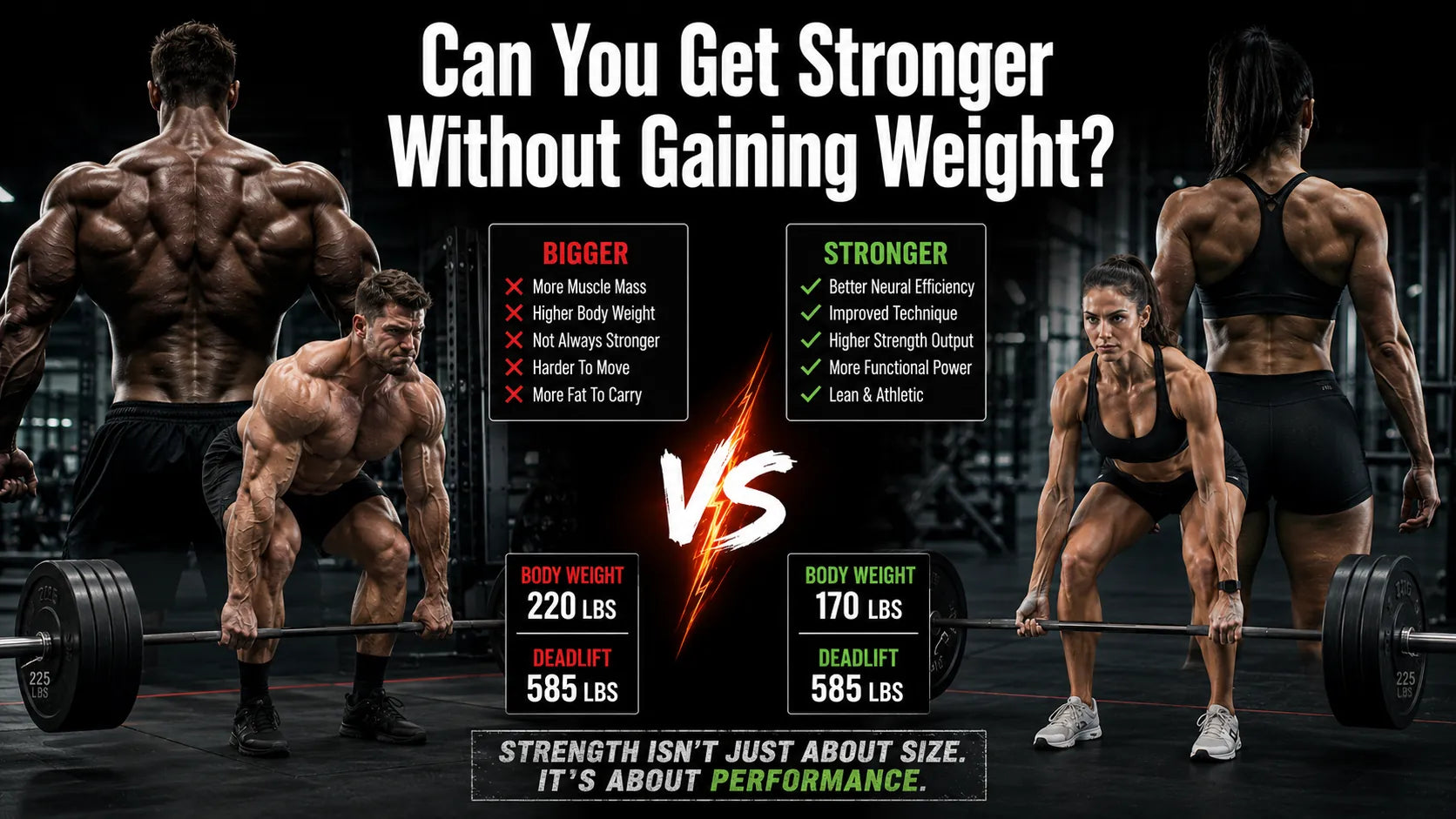
For many people, strength and body weight seem inseparable.
If you want to get stronger, you need to get bigger.
If you want to lift more weight, you need more muscle.
If the scales aren't moving up, progress must be limited.
At least, that's what most people assume.
But if that were true, sports such as:
- boxing
- MMA
- wrestling
- rowing
- gymnastics
- climbing
would look very different.
Athletes in these sports are often obsessed with one thing:
Strength-to-weight ratio.
In other words, how strong they can become without carrying unnecessary body weight.
Because in many situations, gaining strength while staying relatively lean is actually more useful than simply becoming heavier.
The good news is that strength and muscle growth are not exactly the same thing.
They're related.
But they're not identical.
And understanding the difference can completely change how you approach training.
Let's look at what's really happening when people get stronger.
1. Is it actually possible to get stronger without gaining body weight?
Yes.
In fact, it happens all the time.
Many people assume strength gains automatically require large increases in muscle mass.
But the body has several ways to improve strength.
Muscle growth is one.
The nervous system is another.
When you begin strength training, the brain becomes better at:
- recruiting muscle fibres
- coordinating movement
- producing force
- improving technique
The result?
You can often lift significantly more weight before adding much muscle at all.
This is especially common during the early stages of training.
The body essentially learns how to use the muscle it already has more effectively.
That's why the scales don't always tell the full story.
Someone can become considerably stronger while remaining at a very similar body weight.

2. Why do strength gains often happen before muscle growth?
Because strength and muscle growth operate on slightly different timelines.
Muscle growth is a physical change.
It takes time.
The body must:
- repair tissue
- build new tissue
- adapt structurally
Strength improvements often happen faster because many of the early adaptations occur within the nervous system.
Think of it like upgrading software before upgrading hardware.
The muscles may not look dramatically different.
But they can perform dramatically better.
This is one reason beginners frequently experience rapid increases in strength during their first few months of training.
The body is learning.
Movement patterns improve.
Efficiency improves.
Confidence improves.
All of these factors contribute to greater strength without necessarily creating visible muscle growth immediately.
3. Can beginners build significant strength without getting bigger?
Absolutely.
In fact, beginners are often the best example of this phenomenon.
Someone who has never followed a structured strength programme before can experience dramatic improvements in performance while remaining at roughly the same body weight.
This happens because nearly everything is new.
The body responds quickly.
Technique improves.
Coordination improves.
Confidence improves.
The nervous system becomes more efficient.
The result can be surprisingly impressive.
A beginner may increase the amount they lift by a substantial margin while seeing only modest changes on the scales.
This is one reason strength progress and physique progress should always be viewed separately.
They're related.
But they don't always move at the same speed.
4. Which types of training are best for increasing strength without adding size?
This is where training style becomes important.
Traditional bodybuilding training often focuses heavily on maximising muscle growth.
Strength-focused training tends to prioritise force production.
Common characteristics of strength-oriented programmes include:
- lower repetition ranges
- heavier loads
- longer rest periods
- greater emphasis on compound movements
Exercises such as:
- squats
- deadlifts
- presses
- rows
often form the foundation.
The goal isn't necessarily creating the biggest muscles possible.
The goal is teaching the body to produce more force.
This is why athletes concerned with strength-to-weight ratio often train differently from bodybuilders.
Both groups become stronger.
But their priorities are not identical.

5. Why do powerlifters, fighters, and athletes often focus on strength-to-weight ratio?
Because excess body weight isn't always helpful.
For many athletes, performance matters more than appearance.
A fighter moving up a weight class unnecessarily may face larger opponents.
A climber carrying extra body weight may find movements more difficult.
A rugby player may need power, but also speed and mobility.
In these situations, strength-to-weight ratio becomes extremely valuable.
The objective is simple:
Become stronger without gaining unnecessary mass.
This is why many performance-focused athletes spend far more time tracking performance metrics than body weight.
They're interested in:
- force production
- speed
- power
- athletic output
rather than simply increasing scale weight.
Products such as Naughty Boy Prime Creatine 450g are popular in these environments because creatine has consistently demonstrated benefits for strength and power performance without requiring a traditional bulking phase.
The goal isn't becoming heavier.
The goal is becoming more capable.
Intermission
So far we've explored whether strength can increase without weight gain, why strength gains often appear before muscle growth, why beginners can become dramatically stronger without getting much bigger, which training styles prioritise strength, and why athletes often focus heavily on strength-to-weight ratio.
In Part 2, we'll look at protein intake, supplements that support strength development, common mistakes that accidentally lead to weight gain, realistic strength timelines, and what you can actually expect when your goal is getting stronger rather than bigger.
Part 2
6. How important is protein intake when trying to gain strength but not mass?
Protein still matters.
A lot.
One misconception is that protein only matters when the goal is building muscle.
In reality, protein supports:
- recovery
- muscle maintenance
- training adaptation
- performance
The difference is that someone pursuing strength without significant size gains doesn't necessarily need to eat in a large calorie surplus.
This is where many people get confused.
You can support strength development without aggressively increasing calorie intake.
Products such as Per4m Advanced Whey Protein – 2.01kg can be useful because they help lifters consistently hit protein targets without relying on excessive food intake.
The goal isn't to eat everything in sight.
The goal is to provide the body with the resources needed to recover and perform.

7. Which supplements can support strength gains without encouraging unnecessary weight gain?
The first thing to understand is that supplements don't automatically cause weight gain.
Calories cause weight gain.
Supplements simply support specific aspects of performance and recovery.
For strength-focused athletes, a few products fit naturally into this goal.
Naughty Boy Prime Creatine 450g remains one of the most researched performance supplements available and is widely used to support strength and power output.
Applied Nutrition Creatine Caps also fits this goal well because it supports strength-focused training in a simple capsule format, without needing to frame the routine around bulking or gaining extra body weight.

For training intensity, products such as Applied Nutrition Body Fuel Energy Shot 12 × 60ml are often used before demanding sessions where performance is the priority.


Hydration also plays a bigger role in strength than many people realise.
Optimum Nutrition Electrolyte 264g


and BetterYou Magnesium Water – Hydrate


can support hydration habits that help maintain training quality and performance.
The important point is that none of these products are designed to force body weight upward.
They're designed to support performance.
8. What mistakes make people gain weight when their goal is simply to get stronger?
This is where many lifters accidentally drift into a bulking phase.
The most common mistake is assuming that strength gains require huge calorie surpluses.
So they start eating:
- larger portions
- extra snacks
- unnecessary shakes
- excessive calories
without any clear plan.
Over time, body weight rises.
Sometimes muscle increases too.
But often body fat increases faster than expected.
Other common mistakes include:
- chasing scale weight
- copying bodybuilding diets
- assuming heavier always means stronger
- neglecting activity levels
- ignoring nutrition quality
The irony is that many athletes achieve their best strength-to-weight ratios when they focus on performance rather than body weight itself.
Strength should be the target.
Weight gain should only occur when it's genuinely beneficial.
9. How long does it take to notice meaningful strength improvements?
Usually much sooner than people expect.
One of the most rewarding aspects of strength training is that progress often appears before visual changes.
Many beginners notice:
- increased confidence
- better lifting technique
- improved stability
- higher training loads
within weeks.
This is one reason strength training feels so motivating.
The feedback is immediate.
You can often measure improvement session by session.
The exact timeline varies depending on:
- training history
- programme quality
- recovery
- consistency
But meaningful strength improvements frequently appear long before dramatic physical changes.
The body becomes more capable before it becomes noticeably bigger.

10. What can you realistically expect if you focus on strength rather than muscle size?
Quite a lot.
In fact, many people are surprised by how much stronger they become without major changes in body weight.
When strength becomes the primary goal, people often experience:
- better athletic performance
- increased power output
- improved movement quality
- greater confidence
- higher training capacity
The scales may move very little.
Yet performance can improve dramatically.
This is why strength-focused athletes often pay more attention to:
- lifting numbers
- performance metrics
- recovery quality
than body weight.
A stronger squat.
A stronger deadlift.
A stronger press.
These improvements often matter more than a few pounds on the scales.
The reality is that strength and size are connected, but they're not identical.
You do not need to become dramatically bigger to become significantly stronger.
Conclusion
Can you get stronger without gaining weight?
Absolutely.
In fact, many athletes actively pursue exactly that goal.
Strength isn't determined solely by muscle size.
The nervous system, technique, coordination, and training quality all play major roles.
This is why beginners often become dramatically stronger before they become noticeably bigger.
It's also why fighters, climbers, gymnasts, and many athletes place such a strong emphasis on strength-to-weight ratio.
The key is focusing on:
- intelligent training
- adequate protein
- recovery
- consistency
rather than blindly chasing body weight.
Because while gaining muscle can certainly help strength, it's far from the only path to becoming stronger.
FAQ
1. Can you get stronger without gaining body weight?
Yes. Strength improvements can occur through neural adaptations, improved technique, and better force production without major weight gain.
2. Why am I getting stronger but not bigger?
Early strength gains are often driven by improvements in the nervous system rather than muscle growth.
3. Can beginners gain strength without gaining weight?
Absolutely. Beginners often experience rapid strength increases before significant muscle growth occurs.
4. What training style is best for strength without size?
Programmes focused on heavy loads, lower repetitions, and progressive overload are commonly used.
5. Do you need a calorie surplus to get stronger?
Not necessarily. Many people improve strength while maintaining body weight.
6. Does protein still matter if I don't want to bulk?
Yes. Protein remains important for recovery, muscle maintenance, and performance.
7. Can creatine help strength without bulking?
Creatine supports strength and power performance and is widely used by strength-focused athletes.
8. How long does it take to gain strength?
Many people notice measurable improvements within the first few weeks of consistent training.


