


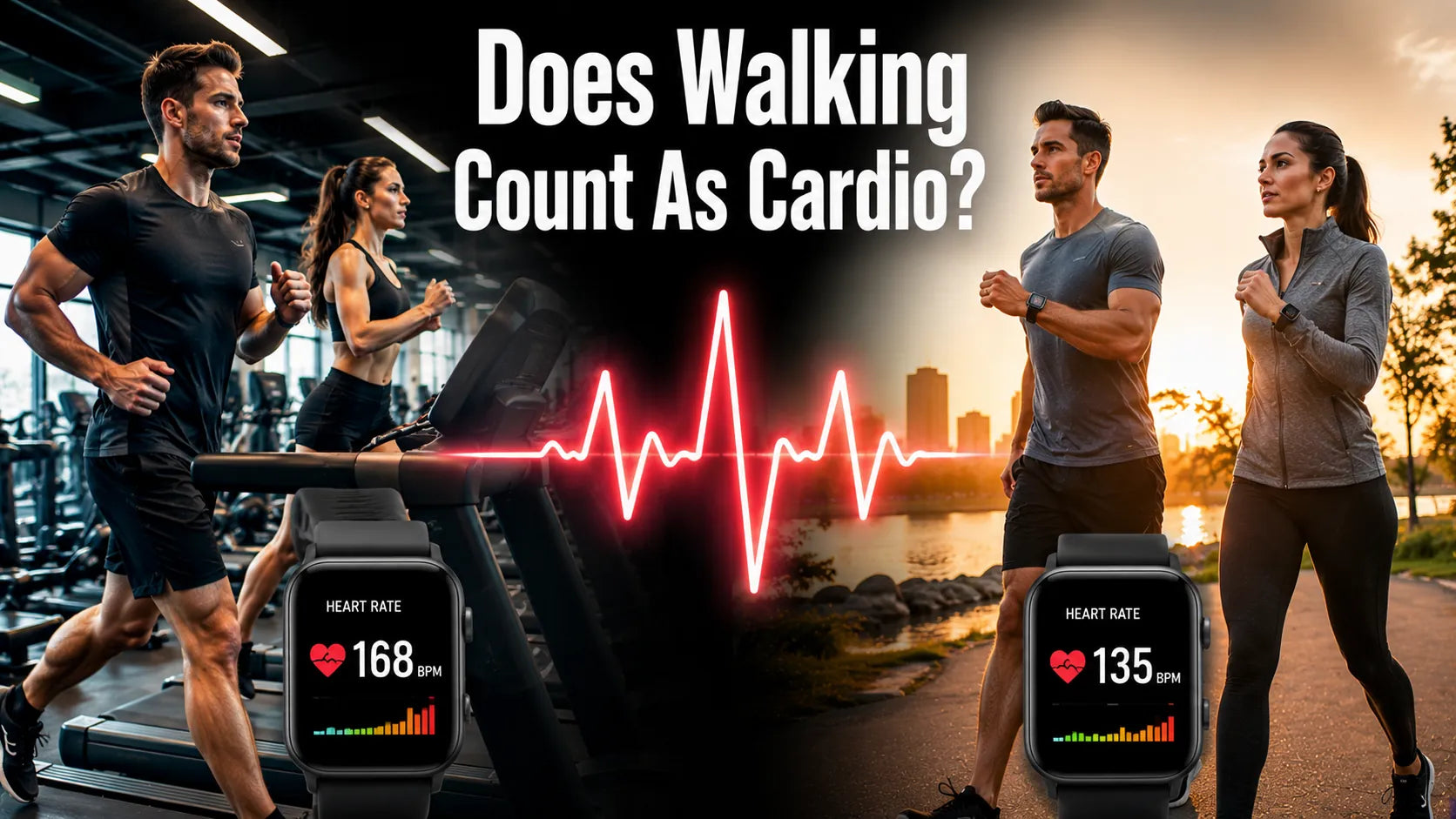
Ask ten people to name a cardio exercise and you'll probably hear the same answers.
Running.
Cycling.
Rowing.
Swimming.
HIIT workouts.
Walking rarely gets mentioned.
In fact, many people assume walking is somehow separate from cardio.
It's often viewed as:
- too easy
- too slow
- too gentle
to count as "real" cardiovascular exercise.
That's one of the biggest misconceptions in fitness.
Because the truth is that cardio isn't defined by how exhausted you feel afterwards.
It's defined by what happens inside your body during the activity.
And by that definition, walking absolutely deserves a place in the conversation.
The challenge is that many people compare walking to elite-level endurance training.
When they do that, walking naturally looks unimpressive.
But that's the wrong comparison.
The real question isn't:
"Is walking as intense as running?"
The real question is:
"Can walking improve cardiovascular fitness and overall health?"
The answer is far more interesting.
And for many people, far more encouraging.
1. What actually qualifies as cardiovascular exercise?
The word "cardio" comes from cardiovascular.
In simple terms, it refers to activities that challenge the heart, lungs, and circulatory system.
That means cardiovascular exercise isn't defined by suffering.
It's defined by increased demand on the body's ability to deliver oxygen.
When you perform cardio:
- heart rate increases
- breathing rate increases
- blood flow increases
- oxygen demand increases
Walking does all of those things.
The intensity may be lower than running.
But intensity isn't the deciding factor.
If an activity elevates heart rate and challenges the cardiovascular system, it can qualify as cardiovascular exercise.
That's why walking sits firmly within the cardio category.
The difference is simply where it sits on the intensity spectrum.

2. Does walking improve heart health in the same way as traditional cardio?
To a surprisingly large degree, yes.
Many people assume heart health improvements only come from intense exercise.
The evidence suggests otherwise.
The cardiovascular system responds remarkably well to regular movement.
Walking encourages:
- improved circulation
- increased daily activity
- greater cardiovascular efficiency
- better endurance
For someone currently inactive, daily walking can represent a significant improvement in heart-health behaviours.
This is one reason walking is so frequently recommended as a starting point for improving overall fitness.
You don't need to become a runner overnight.
You don't need to spend hours on cardio machines.
You simply need to move more consistently.
Long-term consistency often matters more than short-term intensity.
3. How fast do you need to walk for it to count as cardio?
This is where things become interesting.
Technically, even a gentle walk increases physical activity.
But for most people, walking starts functioning more like traditional cardio when the pace becomes purposeful.
A useful guideline is whether you can:
- talk comfortably
- but not sing comfortably
while walking.
At that point, the cardiovascular system is generally being challenged enough to create meaningful fitness benefits.
The exact speed varies from person to person.
Factors such as:
- age
- fitness level
- body weight
- walking terrain
all influence how demanding a walk feels.
This is why comparing pace between individuals isn't particularly useful.
The body only cares about how hard it is working.
Not what somebody else's smartwatch says.
4. Is walking enough to improve fitness and endurance?
For many people, absolutely.
Especially beginners.
One of the biggest mistakes in fitness is assuming that every improvement requires maximum intensity.
The body doesn't work that way.
The body adapts to challenge.
And for someone who currently spends most of the day sitting, walking provides a meaningful challenge.
This is why many people notice:
- improved stamina
- less breathlessness
- better energy levels
- improved recovery
after introducing regular walking.
The improvements may not be dramatic overnight.
But over weeks and months they become increasingly noticeable.
Fitness isn't built through occasional heroic efforts.
It's built through repeated exposure to manageable challenges.
Walking excels at that.

5. Why do some people get impressive results from walking alone?
Because walking is rarely the only thing that's changing.
When someone starts walking every day, other habits often improve too.
They become more active.
They spend less time sitting.
They start paying more attention to health.
They often begin improving:
- sleep
- nutrition
- hydration
- stress management
This creates a compounding effect.
The walking acts as a catalyst.
For example, products such as Applied Nutrition Critical Greens – 250g are often used by people trying to improve their overall health habits alongside increasing daily activity. The supplement itself isn't responsible for the transformation, but it often becomes part of a broader commitment to healthier behaviours.

Likewise, Applied Nutrition Multi-Vitamin Complex can fit naturally into a routine focused on improving overall wellbeing.
The people getting the best results from walking are rarely relying on walking alone.
They're building a healthier lifestyle around it.
Intermission
So far we've explored what qualifies as cardiovascular exercise, whether walking improves heart health, how fast you need to walk for it to count as cardio, whether walking can improve fitness and endurance, and why some people achieve surprisingly impressive results from walking alone.
In Part 2, we'll look at fat loss, whether walking can replace traditional cardio, how nutrition and hydration support a walking routine, the biggest mistakes people make when using walking for fitness, and what you can realistically expect after 30, 60, and 90 days of consistent walking.
Part 2
6. Does walking burn enough calories to support fat loss?
Yes.
But it's important to understand why.
Walking isn't a magic fat-loss tool.
Fat loss still depends primarily on overall calorie balance.
What walking does exceptionally well is increase daily energy expenditure in a sustainable way.
Unlike intense cardio sessions, walking is generally:
- easier to recover from
- easier to repeat
- easier to fit into daily life
This is why many people successfully use walking as part of a long-term fat-loss strategy.
A 30-minute walk may not seem particularly impressive.
But repeated every day for months, those small efforts accumulate significantly.
The biggest advantage of walking isn't the calories burned during one session.
It's the fact that most people can keep doing it consistently.
And consistency is where fat loss actually happens.

7. Can walking replace running, cycling, or gym cardio sessions?
For some people, yes.
For others, not entirely.
It depends on the goal.
If the goal is:
- improving health
- increasing activity levels
- supporting fat loss
- improving cardiovascular fitness
walking can be incredibly effective.
However, if someone is training specifically for:
- athletic performance
- endurance competition
- high-level conditioning
they may eventually benefit from higher-intensity forms of cardio.
The important thing is understanding that walking isn't inferior.
It's simply different.
Many people dismiss walking because it feels easy.
But easy activities often become powerful when performed consistently.
A walking programme that gets followed for years will almost always outperform an intense cardio programme that gets abandoned after three weeks.
8. How can nutrition and hydration support a daily walking routine?
Walking may be simple, but the body still benefits from good nutritional support.
Many people focus entirely on activity while ignoring everything else.
Then they wonder why progress stalls.
Good nutrition supports:
- energy levels
- recovery
- overall health
- long-term consistency
Hydration matters too.
Even relatively low-intensity activity can become harder when hydration is poor.
This is where products such as EHP Labs Hydreau can fit naturally into an active lifestyle, particularly for people walking regularly in warmer conditions or covering longer distances.
Recovery matters as well.
Products such as Per4m Advanced Magnesium are often used by active individuals looking to support sleep quality and recovery habits.

The goal isn't perfection.
The goal is making healthy habits easier to maintain.
9. What are the biggest mistakes people make when using walking for fitness?
The most common mistake is expecting walking to create instant results.
Walking works best as a long-term strategy.
Unfortunately, many people approach it with short-term expectations.
Common mistakes include:
- walking inconsistently
- doing too much too soon
- ignoring nutrition
- focusing only on body weight
- quitting before results appear
Another mistake is underestimating the value of daily movement.
People often assume that because walking feels easy, it can't be effective.
In reality, many successful fitness transformations begin with something as simple as walking every day.
The challenge is that the benefits often arrive gradually.
Patience becomes essential.

10. What can you realistically expect from walking consistently for 30, 60, and 90 days?
This is where walking becomes surprisingly impressive.
After 30 Days
Many people notice:
- increased energy
- better mood
- improved stamina
- more daily movement
Walking often starts feeling easier and more natural.
After 60 Days
Fitness improvements usually become more noticeable.
Many people report:
- improved endurance
- easier daily activities
- better cardiovascular fitness
- improved consistency with other healthy habits
The routine begins feeling automatic.
After 90 Days
This is where many people start seeing the compound effect.
Depending on nutrition and overall lifestyle, they may notice:
- improved body composition
- better fitness levels
- increased confidence
- improved cardiovascular endurance
- healthier daily routines
This is also where broader health habits often begin reinforcing each other. Products such as Per4m Advanced Omega 3 can fit naturally into this stage because long-term fitness success is usually built around maintaining healthy habits rather than chasing quick fixes.

The biggest surprise for many people is that walking often changes more than just fitness.
It changes behaviour.
And behaviour changes tend to create the most lasting results.
Conclusion
So, does walking count as cardio?
Without question.
Walking elevates heart rate, challenges the cardiovascular system, improves endurance, and supports long-term fitness.
It may not look as intense as running or cycling.
But intensity isn't the only path to progress.
Walking succeeds because it is:
- accessible
- sustainable
- effective
- easy to maintain
For many people, that's exactly what makes it so powerful.
The best exercise isn't necessarily the hardest.
It's the one you'll continue doing.
And when walking becomes a daily habit, the results can be surprisingly significant.
FAQ
1. Does walking count as cardio exercise?
Yes. Walking elevates heart rate and challenges the cardiovascular system, making it a form of cardio.
2. Is walking enough cardio for good health?
For many people, regular walking provides significant cardiovascular and health benefits.
3. How fast do you need to walk for cardio?
A brisk pace where conversation is possible but singing would be difficult is often a useful guideline.
4. Can walking improve cardiovascular fitness?
Yes. Consistent walking can improve endurance, circulation, and overall cardiovascular health.
5. Can walking replace running?
For general fitness and health goals, walking can be highly effective. Athletic goals may require additional training methods.
6. Does walking help with fat loss?
Walking can support fat loss by increasing daily energy expenditure and encouraging a more active lifestyle.
7. How long does it take to see results from walking?
Many people notice energy and fitness improvements within weeks, while physical changes often take longer.
8. What can I expect after 90 days of walking?
Many people experience better fitness, improved endurance, healthier habits, and noticeable improvements in overall wellbeing.


