


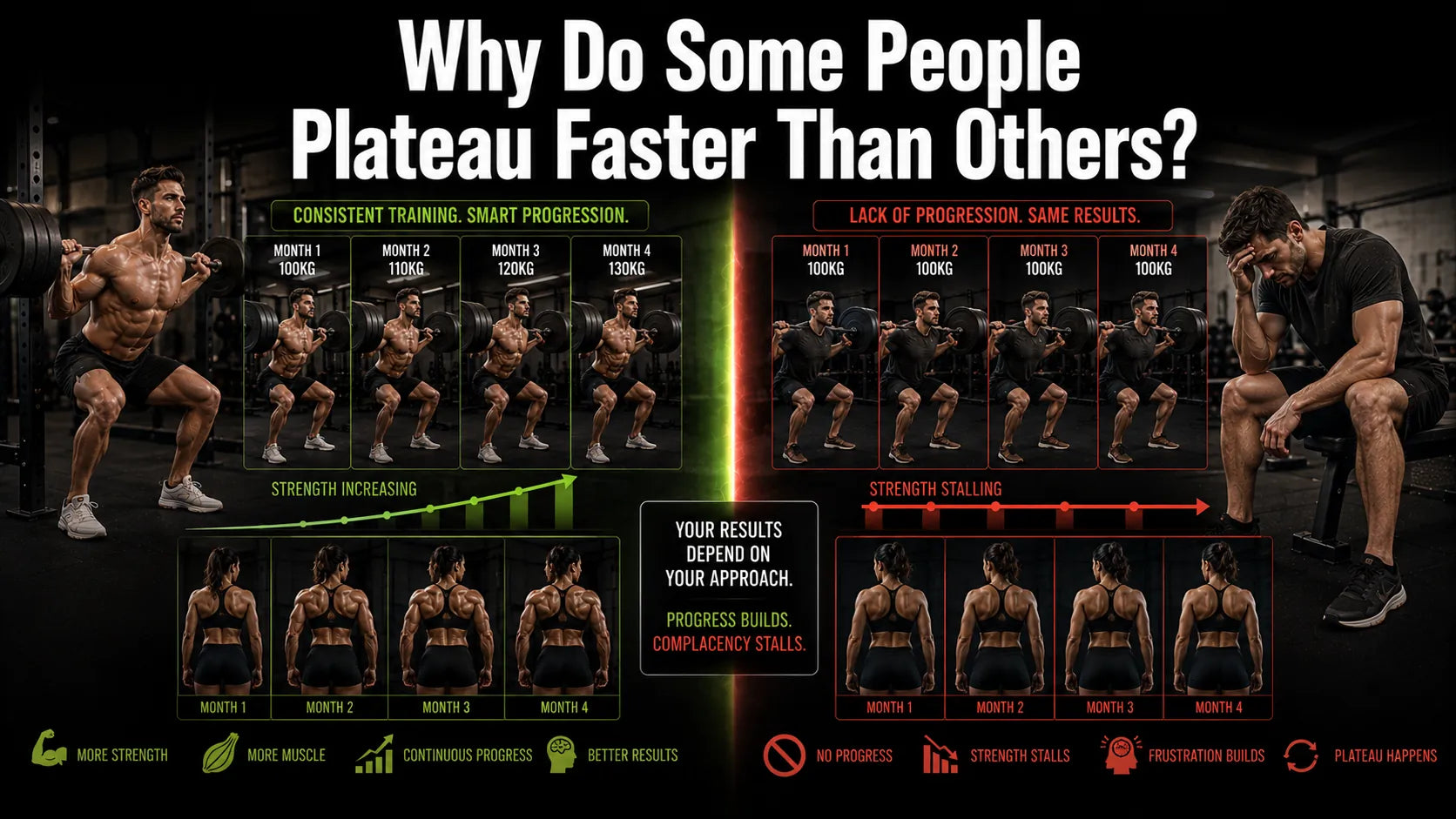
Few things are more frustrating than putting in the work and seeing the results suddenly stop.
One month you're adding weight to the bar almost every session.
The next, nothing seems to change.
Your lifts stall.
Your muscles stop growing.
Motivation begins to fade.
This is known as a training plateau, and almost everyone who trains consistently will experience one at some point.
The important thing to remember is that plateaus are normal.
They're not a sign that your body has reached its limit.
More often, they're a sign that something in your training or recovery needs adjusting.
The good news is that most plateaus can be overcome.
By understanding why progress slows, you can make small changes that help your body continue adapting and building strength.
Let's look at the most common reasons some people hit plateaus much sooner than others.
1. What Causes a Training Plateau?
A plateau happens when your body no longer has a strong enough reason to adapt.
When you first begin training, almost everything is new.
Your muscles, nervous system and movement patterns all improve rapidly.
Over time, however, your body becomes more efficient.
The same workout that once challenged you eventually becomes routine.
Without introducing a greater challenge, progress naturally slows.
Common causes of a plateau include:
- repeating the same weights for too long
- inconsistent training
- inadequate recovery
- poor nutrition
- insufficient sleep
- lack of progressive overload
Plateaus aren't failures.
They're simply feedback that your current routine is no longer providing enough stimulus.

2. Why Do Some People Plateau Earlier?
Not everyone progresses at the same speed.
Some people continue improving for months before reaching a plateau.
Others notice their progress slowing much sooner.
Several factors influence this, including:
- previous training experience
- genetics
- recovery ability
- nutrition
- training quality
- stress levels
Beginners often enjoy rapid improvements because almost any structured resistance training is new.
As experience increases, gains naturally become slower.
That's completely normal.
Advanced lifters don't necessarily work less hard.
They simply need more carefully planned training to continue making progress.
Comparing your progress with someone else's rarely tells the full story.
3. Does Recovery Affect Progress?
Absolutely.
Recovery is where adaptation actually takes place.
Training provides the stimulus.
Recovery allows your body to rebuild stronger than before.
If recovery is poor, fatigue gradually accumulates.
That often leads to:
- declining strength
- persistent soreness
- lower energy
- reduced motivation
- slower muscle growth
Many people respond by training even harder.
Unfortunately, that often makes the situation worse.
Improving recovery is frequently the quickest way to restart progress.
The strongest athletes aren't simply those who train the hardest.
They're often the ones who recover the smartest.
4. Could Nutrition Be Holding You Back?
Very easily.
Your body can't build new muscle without enough energy and nutrients.
Even the best training programme struggles to produce results if nutrition isn't supporting recovery.
Many people unknowingly:
- eat too little
- consume insufficient protein
- skip meals
- underfuel demanding workouts
Training quality also suffers when energy availability is low.
Applied Nutrition Body Fuel Energy Shot 12 × 60ml can naturally fit into a structured training routine where maintaining energy and focus during demanding sessions is a priority.


Good nutrition doesn't guarantee progress.
Poor nutrition almost guarantees slower progress.

5. Does Sleep Influence Plateaus?
Without question.
Sleep is one of the most powerful recovery tools available.
During quality sleep your body works to:
- repair muscle tissue
- restore energy stores
- support hormone production
- prepare your nervous system for the next workout
Consistently poor sleep often causes:
- slower recovery
- reduced strength
- poorer concentration
- lower motivation
- increased fatigue
Chaos Crew ZMA – 30 Capsules can naturally become part of an evening routine focused on quality sleep and recovery, reinforcing one of the key habits that supports long-term progress in the gym.

Many plateaus don't begin in the gym.
They begin the night before.
Intermission
So far we've explored what causes training plateaus, why some people reach them sooner than others, the critical role recovery plays, how nutrition can quietly limit your progress, and why consistent, high-quality sleep is essential for continued strength and muscle growth.
In Part 2, we'll cover how progressive overload helps you move beyond a plateau, which supplements naturally support long-term progress, the mistakes that keep many people stuck, practical ways to break through a plateau, and how to keep improving year after year.
Part 2
6. Are You Progressively Overloading Enough?
Progressive overload is one of the biggest factors separating people who keep progressing from those who plateau.
Many lifters continue training consistently but unknowingly stop asking their muscles to do anything new.
If you're lifting the same weight, performing the same repetitions and following the same routine month after month, your body has very little reason to continue adapting.
Progressive overload doesn't always mean adding more weight.
It can also involve:
- performing an extra repetition
- improving technique
- increasing training volume
- improving range of motion
- slowing the lowering phase
- reducing unnecessary momentum
Naughty Boy Prime Creatine 450g can naturally support a structured strength programme by helping maintain high-intensity performance while you gradually increase your training demands over time.
Small improvements made consistently usually produce far greater long-term results than dramatic changes made occasionally.

7. Which Supplements Support Continued Progress?
Supplements don't eliminate plateaus.
Training, recovery and nutrition always remain the biggest factors.
However, once those foundations are in place, certain supplements can help support consistent progress.
Per4m Plant Protein – 2kg provides a convenient way to increase your daily protein intake, making it easier to meet the nutritional requirements needed for muscle repair and growth after resistance training.


Supporting your nutrition consistently is often far more effective than constantly searching for a new training programme.
Muscle growth rewards good habits repeated over time.
8. How Can You Break Through a Plateau?
Breaking a plateau usually requires identifying the real problem rather than randomly changing everything.
Start by asking yourself:
- Have my lifts actually stopped improving?
- Am I recovering well enough?
- Am I eating enough?
- Am I sleeping properly?
- Am I training with enough effort?
Often, only one or two small adjustments are needed.
You might benefit from:
- increasing training intensity
- improving exercise technique
- adding recovery days
- eating slightly more
- following a structured deload week
The goal isn't to completely reinvent your programme.
It's to restore your body's reason to adapt.
9. What Mistakes Keep People Stuck?
Many plateaus aren't caused by poor genetics.
They're caused by repeating the same mistakes.
Some of the biggest include:
- skipping workouts
- constantly changing programmes
- avoiding progressive overload
- under-eating
- neglecting recovery
- expecting rapid progress every week
Another common mistake is comparing yourself with other people.
Everyone progresses at a different rate.
Your training age, recovery ability and lifestyle all influence how quickly you improve.
The most successful lifters stay focused on improving their own performance—not somebody else's.

10. How Can You Keep Improving Long-Term?
Long-term progress isn't built through perfect workouts.
It's built through consistent habits.
Focus on:
- progressive overload
- quality nutrition
- good recovery
- structured training
- patience
Optimum Nutrition Opti-Men can naturally complement a balanced diet by helping support your daily micronutrient intake, reinforcing the importance of consistent nutrition alongside effective training and recovery habits.


Remember that plateaus are part of the process.
Every experienced lifter encounters them.
Those who continue improving aren't the ones who avoid plateaus altogether.
They're the ones who respond to them intelligently.
Conclusion
Training plateaus are a normal part of getting stronger.
They don't mean you've reached your genetic limit or that your programme has stopped working.
More often, they signal that something needs attention.
Whether that's:
- recovery
- nutrition
- sleep
- progressive overload
- training quality
small improvements can often restart progress surprisingly quickly.
Stay patient.
Focus on the fundamentals.
Keep improving little by little.
Long-term muscle growth isn't about avoiding plateaus.
It's about learning how to move beyond them.
FAQ
1. Why do some people plateau faster than others?
Factors such as recovery, nutrition, training experience, genetics and progressive overload all influence how quickly someone reaches a plateau.
2. What causes a training plateau?
A plateau usually occurs when your body is no longer being challenged enough to continue adapting.
3. Can poor recovery stop muscle growth?
Yes. Without adequate recovery, fatigue accumulates and performance often begins to decline.
4. Does nutrition affect gym plateaus?
Absolutely. Inadequate calories or protein can significantly limit muscle growth and recovery.
5. How do you break through a strength plateau?
Review your training, recovery, sleep and nutrition, then gradually increase the challenge through progressive overload.
6. Which supplements support continued progress?
Protein supplements and creatine can complement a structured training programme and balanced nutrition.
7. Can poor sleep cause a plateau?
Yes. Poor sleep reduces recovery, affects strength and limits your ability to perform consistently.
8. How do you keep improving in the gym long-term?
Prioritise progressive overload, good nutrition, quality recovery, consistent training and patience.


