


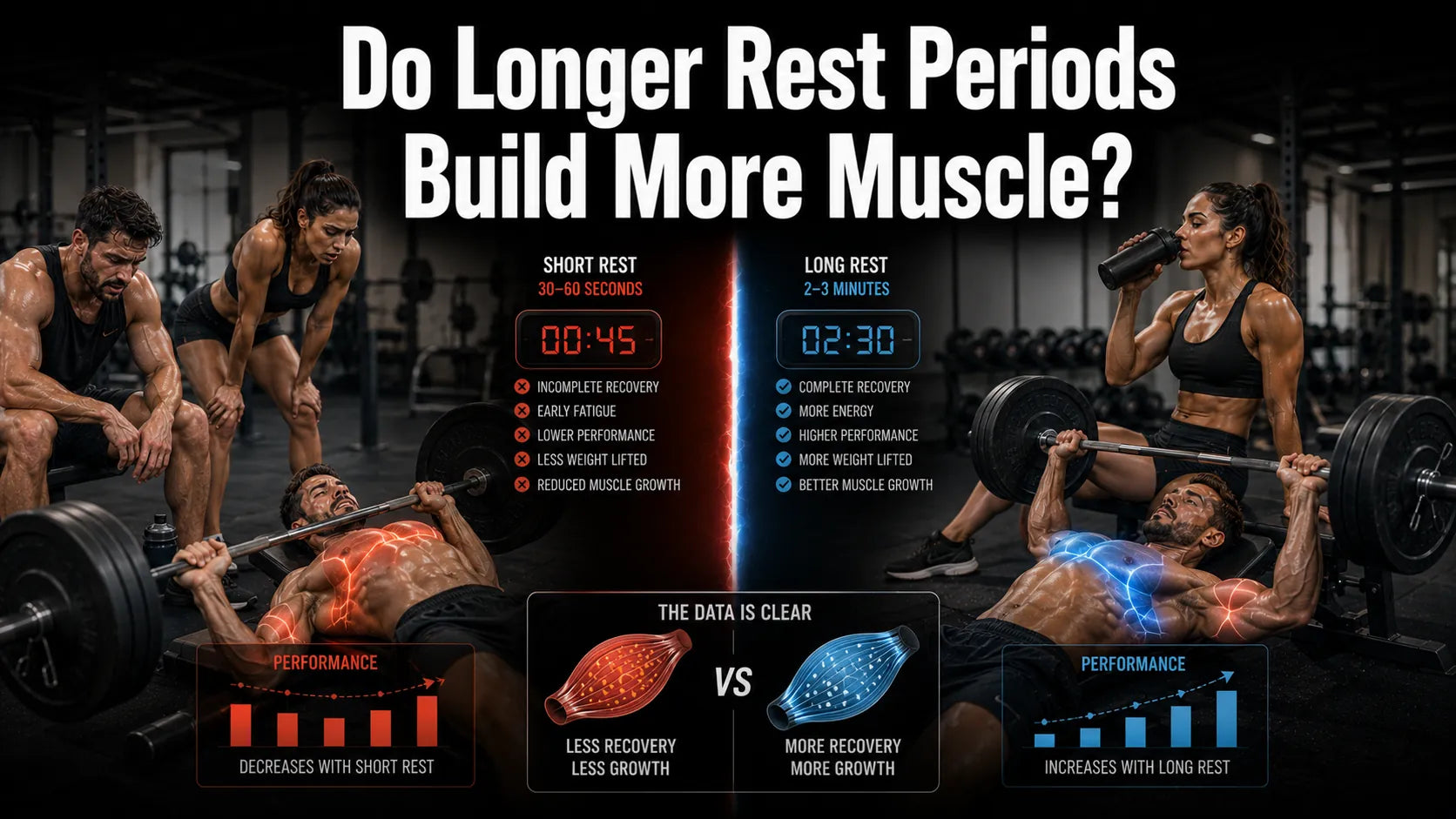
Walk into almost any gym and you'll notice one thing immediately.
Everyone rests differently.
Some people jump straight into their next set after 30 seconds.
Others sit quietly for three or four minutes before touching another weight.
So who's right?
The answer isn't as simple as "shorter is better" or "longer is better."
Rest periods are one of the most overlooked variables in resistance training, yet they directly influence how much weight you can lift, how many quality repetitions you complete and, ultimately, how much muscle you can build.
The truth is that your muscles don't grow while you're lifting.
They grow because you repeatedly expose them to enough training stimulus over weeks and months.
How long you recover between sets affects the quality of that stimulus.
Choosing the right rest period can help you:
- lift heavier weights
- perform more quality repetitions
- maintain better technique
- complete more productive training volume
- recover more effectively between sets
Let's look at what the evidence actually says.
1. Why Do Rest Periods Matter?
Every challenging set places stress on your muscles and nervous system.
As you perform repetitions, your body rapidly uses stored energy to power muscular contractions.
At the same time, fatigue begins to build.
If you start your next set before recovering sufficiently, you're unlikely to perform as well.
You may notice:
- fewer repetitions
- lighter weights
- poorer technique
- reduced power output
Giving your body enough time to recover allows you to approach the next set with much higher quality.
Over an entire workout, those small improvements add up.
More productive sets usually mean a greater overall training stimulus.
Rest isn't wasted time.
It's preparation for the next effort.

2. Do Longer Rests Increase Muscle Growth?
In many situations, yes.
For years, shorter rest periods were often recommended because they created a greater "muscle burn" and produced an impressive pump.
While that feeling can be satisfying, recent research suggests that resting slightly longer often allows people to complete more total training volume.
That matters because training volume is one of the key drivers of muscle growth.
Longer rests usually allow you to:
- lift heavier weights
- complete more repetitions
- maintain better technique
- train closer to your planned intensity
Animal Creatine – 300 Capsules can naturally support repeated high-intensity efforts during resistance training, making it easier to maintain performance across multiple demanding sets as part of a progressive overload programme.

That doesn't mean every exercise requires several minutes of rest.
But for heavy compound lifts, longer recovery is often beneficial.
3. How Long Should You Rest?
The ideal answer depends on your goal.
As a general guide:
- Heavy compound lifts often benefit from around two to three minutes of rest.
- Moderate hypertrophy work may only require around one to two minutes.
- Smaller isolation exercises can often be performed with shorter breaks.
The important point is that you should begin your next set feeling ready to perform well—not simply because the clock says it's time.
Many people rush through workouts in an effort to finish faster.
Ironically, they often reduce the overall quality of their training by doing so.
Better sets usually produce better results.
4. Does Exercise Choice Change Rest Times?
Absolutely.
Not every exercise creates the same level of fatigue.
Large compound movements place much greater demands on the body than smaller isolation exercises.
For example:
- squats
- deadlifts
- bench press
- overhead press
- bent-over rows
typically require longer recovery than exercises such as:
- biceps curls
- lateral raises
- triceps extensions
- calf raises
Trying to perform another heavy set of squats after only thirty seconds rarely produces your best performance.
Giving yourself enough recovery allows you to maintain both strength and technique throughout the session.

5. Can Rest Improve Strength Too?
Definitely.
Strength performance depends on producing as much force as possible.
That becomes difficult if fatigue from the previous set hasn't been cleared.
Longer rest periods allow your muscles and nervous system to recover more completely, helping you produce higher-quality efforts during your next lift.
This is particularly important when training with heavier weights where every repetition demands maximum focus and power.
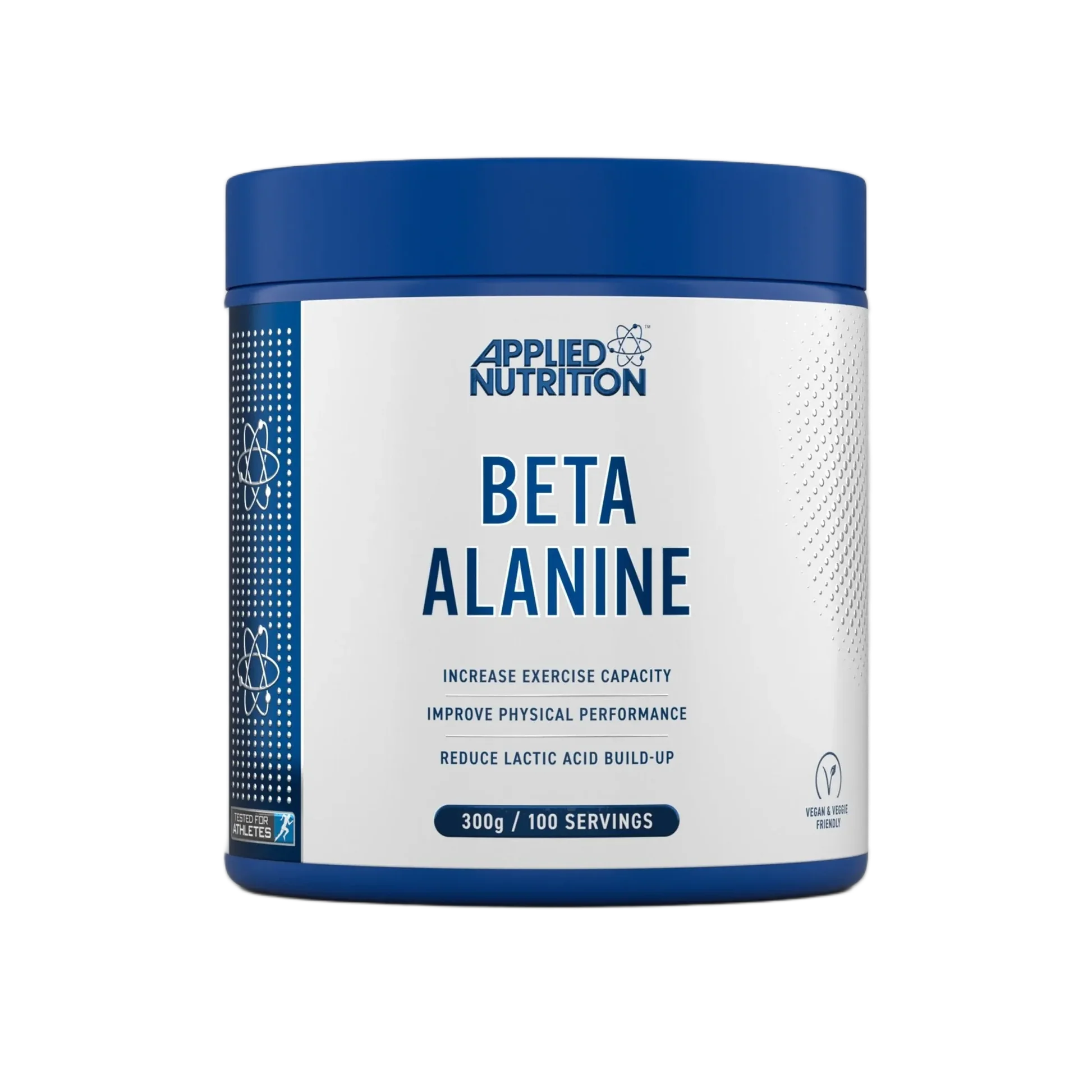
Applied Nutrition Beta-Alanine 300g can naturally support demanding training sessions involving repeated high-intensity efforts, helping you maintain quality across challenging sets as part of a structured strength programme.
If your goal is becoming stronger while building muscle, don't be afraid to rest long enough to give every set your full effort.
Intermission
So far we've explored why rest periods are such an important part of muscle growth, looked at the evidence supporting longer rests for many exercises, discussed ideal recovery times, explained why different exercises require different amounts of rest, and examined how longer recovery can improve strength as well as hypertrophy.
In Part 2, we'll cover what happens when you rush your sets, which supplements naturally support recovery, whether beginners should rest differently, what the latest research says about rest intervals, and how to build the best rest strategy for long-term muscle growth.
Part 2
6. What Happens If You Rush Sets?
It's tempting to shorten your rest periods so you can finish your workout more quickly.
The problem is that rushing between sets often reduces the quality of the work you're actually doing.
If your muscles and cardiovascular system haven't recovered enough, you'll often notice:
- fewer repetitions
- lighter weights
- poorer technique
- reduced power
- earlier fatigue
Over an entire workout, those small drops in performance can significantly reduce your total training volume.
Rather than thinking about how quickly you can finish your session, focus on how well you perform each set.
High-quality repetitions almost always produce better long-term results than simply moving from exercise to exercise as fast as possible.

7. Which Supplements Support Better Recovery?
Rest between sets is only one part of recovery.
What you do after your workout is just as important.
A balanced diet, adequate hydration and enough protein provide the foundation for muscle repair.
Once those habits are established, supplements can help support your recovery routine.
Per4m Advanced Whey Protein – 2.01kg provides a convenient source of high-quality protein, making it easier to meet your daily protein requirements and support muscle recovery after resistance training.
Later in the day, recovery continues while you sleep.
Applied Nutrition Sleep – 300g can naturally become part of an evening routine focused on quality sleep, helping reinforce one of the most important aspects of muscle recovery.


Supplements don't replace recovery.
They simply help support it.
8. Should Beginners Rest Differently?
Generally speaking, yes.
Beginners often benefit from slightly longer rest periods than they expect.
Learning exercises correctly requires concentration and good technique.
If you're still breathing heavily from your previous set, your next one may suffer.
Longer rests allow beginners to:
- regain good technique
- build confidence
- produce higher-quality repetitions
- reduce unnecessary fatigue
As experience increases, you'll naturally learn how much recovery you personally need for different exercises.
There isn't one perfect rest period.
The goal is simply to perform every working set with as much quality as possible.
9. What Does the Research Say?
Modern research generally suggests that longer rest periods are often beneficial when your goal is maximising muscle growth and strength.
The reason is relatively straightforward.
Resting longer usually allows you to maintain:
- heavier loads
- more repetitions
- higher training quality
- greater overall volume
All of these contribute to an effective hypertrophy programme.
It's also important to remember that rest periods are only one piece of the puzzle.
Progressive overload, nutrition, recovery and consistency remain far more influential over months and years.
Optimum Nutrition Opti-Men can naturally complement a balanced diet by helping support your daily micronutrient intake, reinforcing the importance of overall nutrition alongside effective training and recovery habits.


The best programme isn't built around one variable.
It's built around getting many variables consistently right.

10. What's the Best Rest Strategy?
For most people trying to build muscle, the simplest strategy is also the most effective.
Use longer rests for demanding compound exercises.
Use shorter rests for smaller isolation movements.
A practical approach might look like:
- Squats: 2–3 minutes
- Deadlifts: 2–4 minutes
- Bench Press: 2–3 minutes
- Rows: 2–3 minutes
- Shoulder Press: 2 minutes
- Biceps Curls: 60–90 seconds
- Triceps Extensions: 60–90 seconds
- Lateral Raises: 45–90 seconds
Most importantly, don't rush simply because you think longer rests are "less productive."
Your goal is to maximise the quality of every working set.
If resting another 30–60 seconds allows you to perform more repetitions with better technique, that extra time is usually well spent.
Conclusion
Longer rest periods aren't a shortcut to muscle growth.
They're a tool that allows you to perform more productive training.
For heavy compound lifts especially, taking enough time to recover often leads to:
- better technique
- heavier weights
- more quality repetitions
- greater overall training volume
Combined with progressive overload, good nutrition and consistent recovery, these factors create the environment needed for long-term muscle growth.
The next time you're tempted to rush into another set, remember that recovering properly between efforts may actually help you grow more muscle—not less.
FAQ
1. Do longer rest periods build more muscle?
They often can, particularly during heavy compound exercises where longer rests help maintain training quality and overall volume.
2. How long should I rest between sets for hypertrophy?
Around one to three minutes is suitable for most hypertrophy training, depending on the exercise and the weight being used.
3. Should I rest longer on squats and deadlifts?
Yes. Large compound lifts generally benefit from longer recovery because they create more overall fatigue.
4. Are short rest periods bad for muscle growth?
Not necessarily. They're useful for many isolation exercises but can reduce performance if used during heavy compound lifts.
5. Do beginners need longer rest periods?
Often yes. Extra recovery helps beginners maintain good technique and produce better-quality sets.
6. Which supplements support recovery?
Protein supplements and products that support quality sleep can complement a balanced diet and structured recovery routine.
7. Does resting longer improve strength?
Yes. Longer rest periods generally allow greater force production and better performance on subsequent sets.
8. What's the best rest strategy for building muscle?
Use longer rests for demanding compound lifts and shorter rests for smaller isolation exercises while prioritising high-quality training.


