


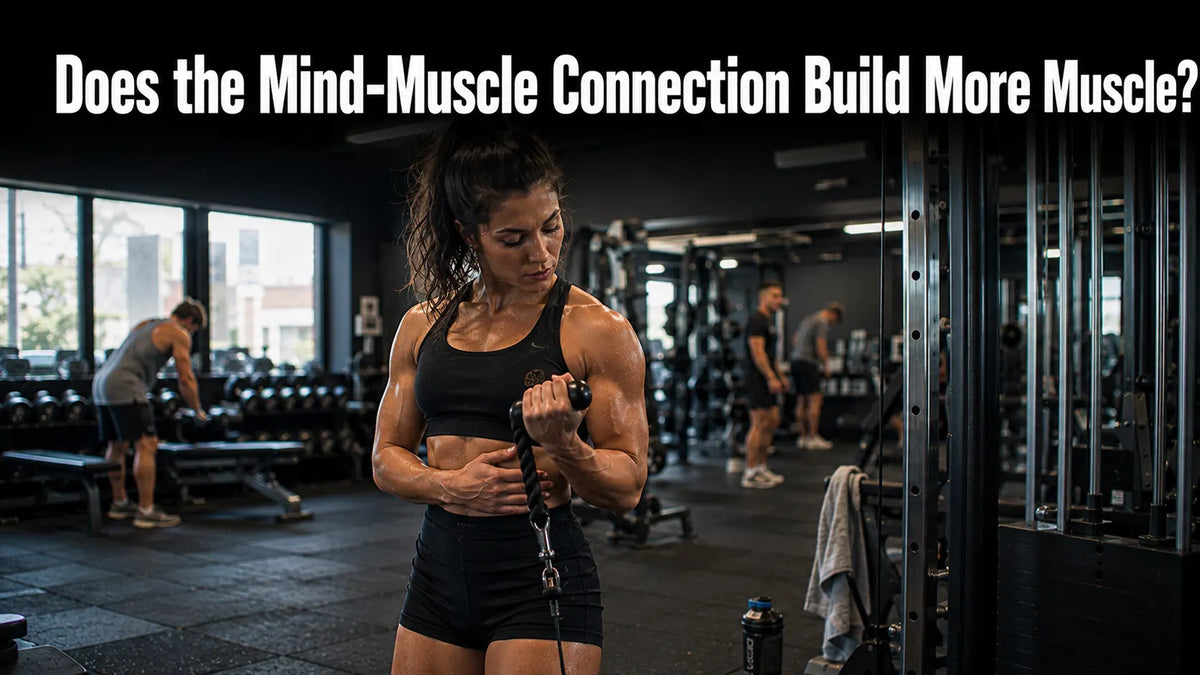
You’re halfway through a set of cable curls.
Your technique looks controlled. The weight is moving. Your biceps are doing the work.
But you can barely feel them.
So you lower the weight, slow everything down and concentrate intensely on squeezing your biceps through every repetition.
Suddenly, they’re burning.
The pump is better.
You can feel every contraction.
Was the second set automatically better for muscle growth?
Not necessarily.
The mind-muscle connection has become one of bodybuilding’s most familiar pieces of advice. Instead of simply moving a weight from A to B, you deliberately focus your attention on the muscle you’re trying to train.
There is a genuine idea behind it.
Where you direct your attention can influence how you perform an exercise, and consciously focusing on a particular muscle may alter its activation during certain movements.
But bodybuilding culture often takes that concept considerably further:
If you can't feel the muscle, it isn't working.
Or:
The stronger the mind-muscle connection, the more muscle you'll build.
Those claims are much harder to defend.
You can build muscle without experiencing an enormous contraction, burn or pump during every set. And becoming so obsessed with "feeling" a muscle that you dramatically reduce performance isn't necessarily an improvement either.
The mind-muscle connection is best understood as another training tool.
Sometimes extremely useful.
Sometimes largely unnecessary.
And occasionally something lifters focus on far too much.
1. What Is the Mind-Muscle Connection?
The mind-muscle connection describes deliberately directing your attention towards a muscle while performing an exercise.
In exercise science, this is generally discussed as an internal attentional focus.
Imagine performing a cable curl.
An internal cue might be:
"Concentrate on contracting your biceps."
Rather than thinking primarily about moving the handle, you're consciously directing attention towards what the target muscle is doing.
Compare that with an external focus, where your attention is directed towards the outcome of the movement.
For example:
"Drive the floor away."
"Push the bar upwards."
"Move the handle towards you."
Neither approach means you're literally controlling individual muscle fibres with your thoughts.
Your nervous system is already coordinating the muscular contractions required to perform the exercise.
The mind-muscle connection is about where you consciously direct your attention while that movement occurs.
This can be particularly intuitive during bodybuilding exercises.
Think about:
- cable curls
- triceps extensions
- lateral raises
- leg extensions
- pec deck flyes
These exercises have relatively clear target muscles, making it easier to consciously concentrate on the contraction.
It becomes more complicated during large compound movements.
A squat involves your quadriceps, glutes, adductors, trunk musculature and numerous other structures working together.
Trying to consciously isolate one tiny part of that system isn't always useful.
So the mind-muscle connection isn't one universal technique that needs applying identically to every exercise.

2. Does the Mind-Muscle Connection Actually Build More Muscle?
Potentially, in some circumstances.
But the evidence is nowhere near strong enough to say that consciously thinking about a muscle automatically makes it grow more.
There has been research investigating whether an internal attentional focus can influence muscular adaptations.
The idea is plausible.
If consciously focusing on a target muscle changes how you perform an exercise or how force is distributed between participating muscles, that could potentially influence the training stimulus.
But hypertrophy is considerably more complicated than simply:
Think about muscle → activate muscle more → grow more muscle.
Muscle growth still depends on repeatedly providing an appropriate training stimulus over time.
That means factors such as:
- mechanical tension
- sufficiently challenging resistance training
- appropriate training volume
- progressive overload
- exercise selection
- adequate nutrition
- recovery
The mind-muscle connection doesn't replace any of those.
Suppose focusing intensely on your chest helps you perform a cable fly with better control and prevents your shoulders from dominating the movement.
Useful.
Now suppose you become so focused on squeezing your chest that you cut the resistance in half, shorten your range of motion and stop progressing the exercise because you're terrified of losing the sensation.
That's much less convincing.
The mind-muscle connection can potentially improve how you direct an exercise.
It shouldn't become the objective of the exercise itself.
3. Do You Need to Feel a Muscle Working for It to Grow?
No.
This is probably the most important misconception to clear up.
A muscle doesn't need to produce a dramatic burning sensation for it to be working.
And you don't need an enormous pump to prove you've stimulated hypertrophy.
Take Romanian deadlifts.
Some lifters experience an extremely obvious sensation through their hamstrings.
Others don't feel much of a burn at all.
Provided the hamstrings are producing force and being appropriately loaded during the movement, the absence of an intense subjective sensation doesn't somehow switch them off.
The same applies to compound pressing.
You might finish a heavy set of bench presses and primarily notice general fatigue rather than an enormous chest contraction.
That doesn't mean your pectorals took the afternoon off.
This is where three different concepts often get mixed together:
Muscular involvement
Whether the muscle is actually contributing to the movement.
Muscular sensation
How strongly you consciously feel the muscle during the exercise.
Muscle growth
The longer-term adaptation resulting from repeated training.
They're related.
They aren't interchangeable.
If you consistently feel an exercise almost entirely in an unintended area, that's worth investigating.
Your technique, setup, exercise selection or anatomy may make another variation more suitable.
But don't judge the quality of every exercise purely by how much it burns.
4. Does the Mind-Muscle Connection Increase Muscle Activation?
It can influence measured muscle activation during certain exercises and conditions.
This is one reason the mind-muscle connection isn't simply bodybuilding folklore.
When someone is instructed to consciously focus on contracting a particular muscle, researchers can sometimes observe changes in electrical activity measured using electromyography, or EMG.
That's interesting.
But this is where interpretation becomes important.
Higher EMG activity during one exercise condition doesn't automatically prove that condition will produce greater long-term hypertrophy.
EMG can provide information about neuromuscular activity.
It isn't a direct muscle-growth meter.
The ability to deliberately alter muscle activation may also depend on factors such as:
- the exercise
- the load
- training experience
- the muscle being targeted
- the attentional cue being used
At moderate loads, you may have plenty of opportunity to consciously concentrate on a particular muscle.
As loads become very heavy and the task becomes increasingly demanding, simply completing the movement can require more of your attention.
That's one reason the mind-muscle connection often feels more natural during controlled bodybuilding movements than near-maximal strength work.
So yes, internal focus can influence muscle activation.
Just don't make the leap from an EMG reading to guaranteed additional muscle growth.

5. Is the Mind-Muscle Connection More Important With Isolation Exercises?
This is probably where it becomes most practically useful.
Isolation exercises usually have a relatively simple objective.
A lateral raise is primarily there to train the deltoids.
A cable curl is there to train the elbow flexors, particularly the biceps depending on the variation.
A leg extension is there to challenge the quadriceps.
Because the movement is stable and the target is clear, consciously focusing on that muscle can help some people maintain controlled technique and avoid turning the exercise into something else as fatigue increases.
Take a lateral raise.
You could:
Choose a manageable resistance.
Raise the arms under control.
Maintain a consistent movement.
Concentrate on the deltoids producing the movement.
That's a sensible use of the mind-muscle connection.
Alternatively, you could choose a much heavier dumbbell, aggressively swing it upwards with your entire body and barely recognise the movement by the final repetitions.
In that situation, reducing the resistance slightly and improving control may help you direct the exercise towards its intended purpose.
But don't take this too far.
An isolation exercise still needs to be progressively challenging.
The goal isn't to use the lightest possible resistance because it gives you the most intense sensation.
If you can maintain good technique, an appropriate range of motion and target-muscle involvement while gradually becoming stronger, you've got a much better long-term strategy.
For isolation work, think of the mind-muscle connection as a useful execution cue.
Not a substitute for progression.
Intermission
The mind-muscle connection is real in the sense that where you direct your attention can influence exercise execution and, under certain conditions, measured muscle activation.
But that doesn't mean you need to feel an enormous contraction for a muscle to grow.
Sensation isn't the same thing as stimulus.
And higher measured activation during an exercise shouldn't automatically be interpreted as greater long-term hypertrophy.
The mind-muscle connection appears most practically useful when you're performing controlled bodybuilding and isolation exercises where directing effort towards a particular muscle is actually part of the objective.
In Part 2, we'll look at whether lifting too heavy can interfere with the mind-muscle connection, which supplements can support focus and training performance, whether beginners should actively concentrate on individual muscles, when too much internal focus can actually hurt performance and practical ways to improve your mind-muscle connection without sacrificing progressive overload.
Part 2
6. Does Lifting Too Heavy Make It Harder to Feel the Target Muscle?
It can.
As resistance gets heavier, the objective of the exercise can gradually shift from deliberately controlling a target muscle towards simply completing the repetition.
Imagine performing cable curls with a weight you can control for 10–12 challenging repetitions.
You can keep your upper arms relatively stable, control the eccentric and concentrate on your biceps producing the movement.
Now dramatically increase the resistance.
Your shoulders begin moving.
Your torso starts rocking.
You accelerate the handle through the hardest part of the repetition.
You might technically move more weight, but you've also changed how you're performing the exercise.
This doesn't mean heavy weights are bad for hypertrophy.
Nor does losing some sensation in the target muscle automatically mean the exercise has stopped working.
The issue is choosing a load that suits the purpose of the exercise.
For a heavy compound movement, you might care considerably more about executing the overall movement effectively and progressively increasing performance.
For an isolation exercise, there's often less reason to sacrifice control simply to move a larger number on the weight stack.
There's another important distinction:
Progressive overload doesn't mean adding weight at every opportunity.
Progress can include performing more repetitions with the same resistance, improving technique, increasing resistance while maintaining execution or gradually increasing productive training volume.
If adding another 5kg turns a controlled lateral raise into something resembling a standing dumbbell clean, the additional load isn't necessarily useful progression.
What About Training Fuel?
Your ability to concentrate and perform well can also be affected by how prepared you are for the session.
Carbohydrates provide an important fuel source for demanding resistance training. Applied Nutrition Cream Of Rice – 1kg can provide a convenient carbohydrate option as part of a pre-training meal where appropriate.


But fuelling doesn't create a mind-muscle connection.
It simply supports the training session in which you're trying to apply it.

7. Which Supplements Can Support Focus and Training Performance?
No supplement can teach you to contract your lats properly.
The mind-muscle connection is fundamentally a training skill, not something you get from a scoop of powder.
However, certain supplements can support the wider environment around concentration and resistance-training performance.
Pre-Workout
Naughty Boy Menace V2 – 420g can fit into a pre-training routine for people who choose to use a pre-workout product.


The important distinction is that feeling more alert during training doesn't automatically improve exercise execution.
You still need to direct that attention productively.
More stimulation isn't always better, either. If a pre-workout leaves you excessively restless and rushing between sets, that may be the opposite of what you want when practising controlled movements.
Creatine
Applied Nutrition Creatine 3000 – 120 Caps provides a convenient creatine option for people wanting to include creatine within their daily supplementation routine.

Creatine is relevant to repeated high-intensity exercise and resistance-training performance.
It isn't a focus supplement, however, and shouldn't be presented as something that improves your ability to "feel" a muscle.
Hydration and Focus
BetterYou Magnesium Water – Focus can fit into a wider hydration routine where appropriate.

Again, the product should be considered supportive rather than transformative.
Good concentration during training still depends heavily on factors such as sleep, hydration, nutrition and arriving at the gym mentally prepared to train.
Protein
Then there's the part that actually matters considerably more for muscle growth than how impressive your mind-muscle connection feels:
adequate protein intake.
Applied Nutrition Clear Whey – 875g provides a convenient way to increase daily protein intake alongside normal food.


You can have an extraordinary mind-muscle connection during every curl you perform, but your overall nutrition and recovery still matter.
Supplements should support those fundamentals.
They don't replace them.
8. Is the Mind-Muscle Connection Important for Beginners?
It can be useful.
But beginners have something more important to learn first:
How to perform the exercise.
Imagine teaching someone to squat for the first time.
They're thinking about:
Foot position.
Balance.
Depth.
Breathing.
Controlling the weight.
Maintaining a stable torso.
Now tell them to simultaneously concentrate intensely on feeling one specific region of their quadriceps.
You've potentially made a relatively complicated learning task even more complicated.
For beginners, simple movement cues are often more useful.
Learn the exercise.
Develop consistent technique.
Understand what controlled resistance training feels like.
Then refine things.
The mind-muscle connection can become particularly useful when a beginner consistently struggles to understand the purpose of an isolation exercise.
Take a cable triceps pressdown.
If they're moving their entire upper body and turning every repetition into a strange combination of shoulder extension and momentum, asking them to concentrate on extending the elbow and contracting the triceps may help.
But beginners shouldn't become anxious because they can't "feel their lats" perfectly after three weeks of training.
Neuromuscular control and exercise skill improve with practice.
Give them time.
9. Can Focusing Too Much on the Mind-Muscle Connection Hurt Performance?
Potentially.
This is where the mind-muscle connection can go from useful bodybuilding cue to unnecessary distraction.
There are situations where an external focus may be more appropriate for performance.
Imagine attempting a demanding set of squats.
Thinking:
"Drive upwards."
may be more useful than trying to consciously monitor several individual muscles simultaneously.
Likewise, if you're performing a heavy row, becoming obsessed with achieving the perfect sensation in your lats can distract you from simply executing the movement strongly and consistently.
This becomes especially important as loads increase.
Your attention is limited.
You need to control your body, maintain technique and produce force.
Trying to micromanage every muscular contraction isn't always helpful.
There's also a hypertrophy-specific problem.
Some lifters become so addicted to feeling the muscle that sensation starts determining every training decision.
They constantly reduce loads.
Make repetitions excessively slow.
Avoid exercises that don't produce an immediate pump.
Add unnecessary squeezes.
Change exercises every week searching for something they can "feel" more.
Eventually, the pursuit of sensation starts interfering with measurable progression.
That's backwards.
The mind-muscle connection should improve your training.
Your training shouldn't exist to maximise the mind-muscle connection.

10. How Can You Improve Your Mind-Muscle Connection?
You don't need complicated neuromuscular drills.
Start by making the exercise easier to execute consistently.
Choose Stable Exercises
Stable exercises remove distractions.
It's generally easier to concentrate on your quadriceps during a leg extension than during a heavy barbell squat.
Likewise, a preacher curl provides considerably more external stability than a standing curl where your entire body can move.
Machines and cables can therefore be excellent tools for practising internal focus.
Use a Manageable Resistance
Don't deliberately train light forever.
Just choose a load you can actually control.
If the resistance immediately forces you to use momentum and alter your technique, you're making it harder to concentrate on what the target muscle is doing.
Control the Eccentric
Don't simply let gravity return the resistance.
Maintain control as the muscle lengthens.
This gives you another part of the repetition during which you can maintain awareness of the target muscle.
You don't need absurdly slow ten-second negatives.
Just avoid dropping the resistance between repetitions.
Adjust Your Setup
Sometimes a poor mind-muscle connection isn't really a concentration problem.
It's an exercise-selection or setup problem.
Changing seat height, grip, stance, bench angle or body position may make an exercise feel substantially better.
If you've spent six months desperately trying to feel your chest during one particular machine press, another machine may simply suit your structure better.
Practise
The mind-muscle connection is partly a skill.
Someone with ten years of resistance-training experience has performed thousands upon thousands of repetitions.
They've had enormous amounts of practice controlling movements and recognising muscular sensations.
Don't expect that awareness immediately.
Don't Chase Sensation at the Expense of Progress
This is the most important rule.
Use internal focus when it helps you perform an exercise better.
Then keep progressing.
If you're performing controlled cable curls with excellent biceps involvement, don't remain on the same weight indefinitely because increasing it slightly changes the sensation.
Your goal is still to become capable of producing more high-quality muscular work over time.
Conclusion
So, does the mind-muscle connection build more muscle?
It might help in certain circumstances.
Deliberately focusing on a target muscle can influence how an exercise is performed and may alter muscle activation, particularly during controlled movements where the load allows you to consciously direct your attention.
That makes the mind-muscle connection a potentially useful tool for bodybuilding.
Especially during stable isolation exercises.
But it isn't a requirement for hypertrophy.
You don't need to experience an enormous burn.
You don't need every muscle to feel intensely pumped.
And you certainly don't need to sacrifice progressive overload just to create a stronger sensation.
Free-weight compounds, heavy resistance training and exercises involving several muscle groups may sometimes benefit from a broader performance-focused approach rather than trying to consciously isolate one muscle.
The simplest rule is:
Use the mind-muscle connection when it improves the exercise.
If focusing on your deltoids helps you perform better lateral raises, use it.
If obsessing over your pecs makes your bench press weaker and less natural, stop forcing it.
Your muscles still need mechanical tension, challenging resistance training, progressive overload, appropriate nutrition and recovery.
The mind-muscle connection can help you direct that training.
It doesn't replace it.
FAQ
1. Does the mind-muscle connection build more muscle?
It may help in some circumstances by influencing exercise execution and how effort is directed towards a target muscle, but it isn't established as universally superior for hypertrophy.
2. Does the mind-muscle connection actually work?
Yes, in the sense that directing attention internally can influence muscle activation and exercise execution. That doesn't mean a stronger subjective connection automatically produces greater muscle growth.
3. Do you need to feel a muscle working for it to grow?
No. A muscle can be appropriately loaded without producing a strong burn, pump or conscious sensation.
4. Does the mind-muscle connection increase muscle activation?
Research suggests an internal focus can alter measured activation in certain muscles and exercises. However, higher EMG activity shouldn't automatically be interpreted as greater long-term hypertrophy.
5. Is the mind-muscle connection important for hypertrophy?
It can be useful, particularly for directing controlled isolation exercises towards the intended muscle. Mechanical tension, progression, training volume and recovery remain fundamental.
6. Is the mind-muscle connection better with isolation exercises?
It can be easier and more practically useful with stable isolation exercises because there are fewer movement demands competing for your attention.
7. Can you still build muscle if you don't feel it working?
Yes. Feeling a muscle strongly isn't required for hypertrophy, although consistently feeling an exercise somewhere completely unintended may justify reviewing your technique or exercise selection.
8. Is mind-muscle connection important for beginners?
It can help with certain exercises, but beginners should prioritise learning safe, repeatable exercise technique rather than trying to consciously micromanage every muscle.
9. Can lifting too heavy reduce mind-muscle connection?
Very heavy resistance can make consciously concentrating on an individual muscle more difficult. If excessive load also causes technique to deteriorate, using a more manageable resistance may be beneficial.
10. What's the best way to improve mind-muscle connection?
Use stable exercises, choose controllable resistance, maintain good technique, control both phases of the repetition, adjust your setup when necessary and practise consistently.


