


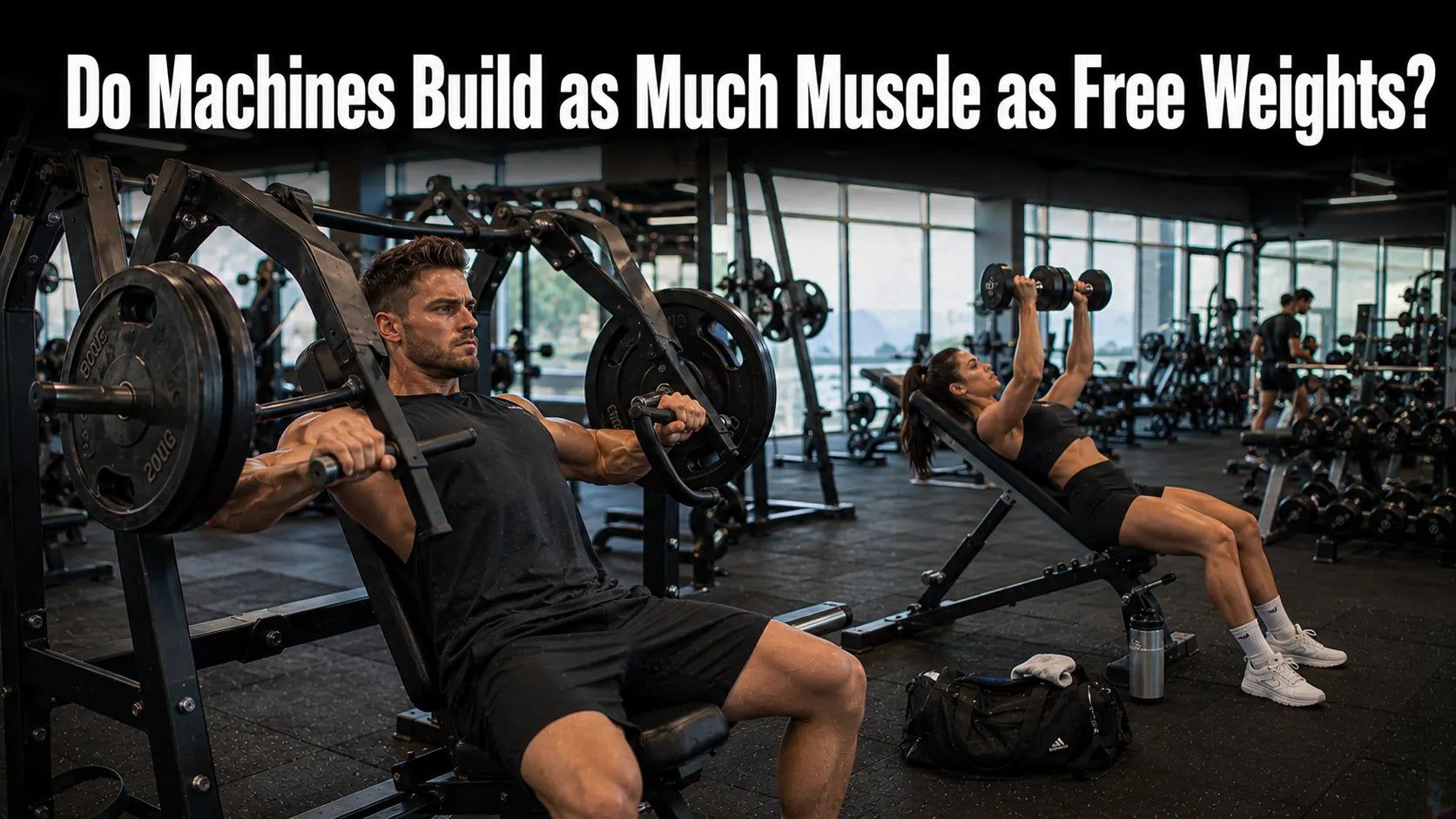
Walk into almost any serious gym and you'll see two very different approaches to building muscle.
One person is underneath a barbell, controlling a heavy bench press while their entire upper body works to keep the weight stable.
Ten metres away, someone else is using a plate-loaded chest press. Their torso is supported, the movement path is controlled and virtually all their attention can be directed towards pushing as hard as possible.
Which person is building more muscle?
For decades, free weights have carried a certain prestige.
Barbells and dumbbells are often treated as the "real" way to train, while machines are sometimes dismissed as something for beginners, rehabilitation or people unwilling to learn proper lifting technique.
But if your primary goal is muscle growth, that distinction doesn't hold up particularly well.
Machines can build muscle.
Free weights can build muscle.
And depending on the exercise, muscle and individual lifter, a machine can sometimes offer characteristics that are extremely useful for hypertrophy.
That doesn't make free weights obsolete.
It means the question is more interesting than:
"Which one is better?"
Instead, we need to look at stability, mechanical tension, range of motion, exercise technique, progression and what actually limits you when a set becomes difficult.
So, do machines build as much muscle as free weights?
They certainly can.
Here's why.
1. Do Machines Build as Much Muscle as Free Weights?
Yes. You can build substantial muscle using resistance machines.
Muscle growth isn't reserved for barbells and dumbbells.
When a muscle is repeatedly exposed to appropriate resistance training, sufficient mechanical tension and progressively challenging workloads, it can adapt by growing.
A chest press machine can challenge your pecs.
A leg press can challenge your quadriceps.
A pulldown can challenge your back.
A leg curl can challenge your hamstrings.
Those muscles don't reject the stimulus because the resistance happens to travel through a machine.
The more useful question is whether a particular exercise provides a good stimulus to the muscle you're trying to develop.
Take chest training.
You might choose:
Barbell bench press
or:
Plate-loaded chest press
Both involve pressing resistance away from the body and can heavily involve the pectorals, anterior deltoids and triceps.
But they don't feel identical.
The machine provides external stability and usually constrains the movement to a predetermined path.
The barbell requires you to control the path yourself.
Neither characteristic automatically determines hypertrophy.
What matters is whether the exercise allows you to train the target muscles effectively, progressively and consistently.

2. What's the Difference Between Machines and Free Weights?
The biggest difference is how the resistance is controlled.
Free weights include equipment such as:
- barbells
- dumbbells
- kettlebells
- weight plates used independently
When you perform a dumbbell press, you're responsible for controlling those dumbbells through space.
They can move forwards.
Backwards.
Sideways.
Rotate.
Your body therefore has to stabilise the resistance while the primary muscles produce the movement.
Machines provide more external constraint.
Sit in a chest press and the handles generally follow a path determined by the machine's design.
Your job is still to produce force against the resistance, but you don't have to stabilise it in exactly the same way.
This changes the demands of the exercise.
Free weights can provide greater freedom of movement, but that freedom also requires greater control.
Machines provide greater stability, but the fixed or semi-fixed movement path may not suit every person's anatomy equally well.
Then there are cable machines, which sit somewhere between these categories in practical terms.
A cable provides an externally guided source of resistance while still allowing considerably more movement freedom than many selectorised machines.
That's why "machines versus free weights" isn't always as clean a comparison as it initially appears.
Different equipment creates different exercises.
The goal is to choose the ones that work well for your body and your training objective.
3. Are Machines or Free Weights Better for Muscle Growth?
For hypertrophy, neither category automatically wins.
Instead, look at what each exercise allows you to accomplish.
A good muscle-building exercise generally needs to let you:
Challenge the target muscle effectively.
Use an appropriate range of motion.
Perform enough productive training volume.
Progress over time.
Train consistently without unnecessary discomfort.
You can find excellent machine exercises that satisfy all five.
You can find excellent free-weight exercises that satisfy all five.
You can also find terrible examples of both.
A beautifully designed chest press that fits your structure and allows your pecs to become the limiting factor may be an excellent hypertrophy exercise.
A poorly designed machine that forces your shoulders into an uncomfortable position may not be.
Likewise, dumbbell presses can be fantastic for chest development.
But if balance and setup consistently limit the amount of productive chest work you can perform, another exercise might suit you better.
This is why equipment loyalty makes little sense.
Your muscles don't award bonus points because the resistance came from a barbell.
Choose exercises based on the stimulus they provide, not how impressive the equipment looks.
4. Do Free Weights Activate More Muscles Than Machines?
Free-weight exercises often require greater stabilisation because you're responsible for controlling the resistance through space.
Consider:
Dumbbell shoulder press versus machine shoulder press.
The dumbbells have to be stabilised independently.
Your shoulders, arms and surrounding musculature all contribute to controlling their position.
The machine provides considerably more external stability.
That difference is real.
But there's an important leap people sometimes make:
More muscles involved = more muscle growth.
That doesn't necessarily follow.
If your objective is specifically growing your deltoids, having additional muscles working to stabilise a dumbbell isn't automatically advantageous.
Sometimes greater stability can allow you to direct more effort towards the muscles you're actually trying to train.
The same principle appears throughout bodybuilding.
A chest-supported row removes much of the need to stabilise your torso compared with a bent-over barbell row.
Does that make the chest-supported row inferior?
Not if your objective is training your back.
In fact, removing another potential limiting factor can be useful.
Free weights demanding greater stabilisation is therefore neither universally good nor bad.
It depends on what you're trying to achieve.
If you want to become better at controlling and producing force with free weights, that stabilisation requirement matters.
If you're trying to hypertrophy a particular muscle, additional stability can sometimes be exactly what you want.

5. Are Machines Better for Training Close to Failure?
This is one area where machines can have a very practical advantage.
Imagine you're performing a machine chest press.
The repetition slows.
You keep pushing.
Eventually, you can't complete another full repetition.
You return the handles to the starting position and finish the set.
Now imagine approaching the same level of fatigue during a heavy barbell bench press.
Failure has additional consequences.
If the bar stops moving on your chest, you need appropriate safeties, a competent spotter or another safe way of ending the set.
That doesn't mean barbell bench presses can't be trained hard.
They obviously can.
But stable resistance machines can make high-effort training more straightforward.
The same applies to exercises such as:
- leg extensions
- leg curls
- machine rows
- machine presses
- pulldowns
- cable curls
As fatigue increases, you aren't simultaneously trying to prevent a freely moving resistance from travelling somewhere you don't want it to go.
This can also help when performing intensity techniques or training alone.
But machine stability shouldn't become an excuse for reckless failure training.
You don't need to take every set to absolute failure to stimulate hypertrophy.
And even on a machine, technique can deteriorate as fatigue increases.
The advantage is simply that machines often allow you to approach your muscular limits while balance and stabilisation play a smaller role in ending the set.
For bodybuilding-style training, that's not a flaw.
It's one of the reasons machines can be so useful.
Intermission
So far, the supposed battle between machines vs free weights for muscle growth looks considerably less dramatic than gym culture sometimes makes it seem.
Both can build substantial muscle.
Free weights generally require you to control and stabilise the resistance to a greater degree, while machines provide more external stability and a more constrained movement path.
But more stabilisation doesn't automatically mean more hypertrophy.
In fact, when the objective is isolating and heavily challenging a particular muscle, greater exercise stability can sometimes be an advantage—especially when you're training close to failure.
In Part 2, we'll look at whether you can build an impressive physique using machines alone, which supplements can support strength and muscle growth, whether machines or free weights make more sense for beginners, why free-weight strength is a slightly different question from hypertrophy and whether the smartest approach is simply to use both.
Part 2
6. Can You Build a Muscular Physique Using Only Machines?
Yes.
You could build an impressively muscular physique without making barbells or dumbbells the centre of your training.
Think about the major muscle groups and the machines available in a well-equipped gym:
Chest
Machine chest press
Incline press
Pec deck
Cable fly
Back
Pulldown
Machine row
Cable row
Pullover machine
Shoulders
Machine shoulder press
Cable lateral raise
Machine lateral raise
Reverse pec deck
Legs
Leg press
Hack squat
Leg extension
Leg curl
Calf raise
Arms
Cable curl
Preacher curl machine
Triceps pressdown
Machine extension
There's no obvious muscle that becomes impossible to develop because you've removed free weights.
The important question is whether your exercise selection collectively provides appropriate resistance through useful ranges of motion and allows you to progressively challenge the muscles.
Machines can actually make certain aspects of bodybuilding easier.
Setup can be simpler.
Stability is often higher.
Training close to failure can be more practical.
Some machines also provide resistance profiles that would be difficult to reproduce with a dumbbell or barbell.
However, there is a limitation worth understanding.
If your goal isn't simply to look muscular, but also to become highly proficient and strong at free-weight movements, you need to practise those movements.
Someone can develop enormous quadriceps using hack squats and leg presses without becoming particularly skilled at barbell squatting.
Muscle development and movement-specific strength are related.
They aren't identical.

7. Which Supplements Can Support Strength and Muscle Growth?
Whether you're training with machines, dumbbells or barbells, supplements don't determine which equipment produces the better hypertrophy stimulus.
The nutritional foundations remain the same.
You need adequate overall nutrition, sufficient protein and enough recovery to support your training.
For people who choose to use pre-workout, ABE All Black Everything – Ultimate Pre-Workout can fit into a wider pre-training routine where appropriate.
Creatine is another relevant option for people performing resistance training.
Animal Creatine – 300 Capsules provides a convenient creatine format. Creatine can support performance during repeated high-intensity exercise and help support improvements in strength and training capacity when used consistently.

Protein intake also matters.
Per4m Whey Hydrate – 1.8kg can provide a convenient way to increase daily protein intake alongside normal food when required.


That's the important role of protein supplements:
convenience.
Your muscles don't suddenly respond differently to dietary protein because today's chest workout involved a machine rather than dumbbells.
Applied Nutrition Multi-Vitamin Complex – 90 Capsules can also complement someone's wider diet where appropriate, although a multivitamin shouldn't be treated as a direct muscle-building supplement.
Likewise, Applied Nutrition Body Fuel Energy Shot – 12 × 60ml can fit into some people's pre-training routines when appropriate, but it doesn't make a machine or free-weight exercise more anabolic.


Supplements support the wider training environment.
The actual muscle-building stimulus still comes from productive resistance training.
8. Are Machines or Free Weights Better for Beginners?
Both can be useful.
Machines have several characteristics that can make them particularly approachable when someone first enters a gym.
The movement is generally constrained.
Setup instructions are often straightforward.
There's less need to control a freely moving resistance.
And adjusting the load may be as simple as moving a pin.
That allows a beginner to concentrate on producing controlled repetitions and learning what hard resistance training actually feels like.
But that doesn't mean beginners should avoid free weights.
Basic dumbbell and barbell exercises can also be introduced from the beginning.
In fact, if someone eventually wants to become proficient at exercises such as:
- squats
- bench presses
- Romanian deadlifts
- dumbbell presses
- free-weight rows
there's value in learning those movement skills while they're a beginner.
The mistake is assuming beginners must earn the right to use free weights by starting on machines—or that machines are somehow beneath experienced lifters.
Neither is true.
An experienced bodybuilder may deliberately choose a machine because its stability makes it excellent for the muscle being targeted.
A beginner may learn a goblet squat because it's simple and suits their current ability.
Exercise selection should match the individual.
Not their perceived status in the gym hierarchy.
9. Do Free Weights Build More Strength Than Machines?
This depends on what you mean by strength.
Strength is highly specific to the task being performed.
If you want to become stronger at the barbell bench press, you need to practise the barbell bench press.
Becoming stronger on a chest press machine may contribute through increased muscular strength and development, but it doesn't reproduce every requirement of controlling a barbell.
The same applies in reverse.
If you've spent years barbell squatting and sit on an unfamiliar hack squat for the first time, you might not immediately be exceptionally strong at it.
The movement is different.
The resistance profile is different.
Your body position is different.
Your technique is different.
So when someone says:
"Free weights build more strength."
the obvious response should be:
Strength at what?
Free weights are particularly important if your goal involves free-weight performance.
Powerlifters need to squat, bench press and deadlift because those are the movements they compete in.
But if your primary objective is hypertrophy, you don't need every exercise to maximise transferable barbell strength.
A machine exercise can be incredibly valuable even if the strength developed is partly specific to that machine.
Progressive overload still matters.
If you're moving from 80kg to 120kg on a well-designed machine while maintaining controlled technique and an appropriate range of motion, that's not meaningless simply because there isn't a barbell in your hands.

10. Should You Use Both Machines and Free Weights for Muscle Growth?
For most people, this is probably the most practical answer.
Use both.
Not because you need an exact 50/50 split.
And not because every muscle requires one machine exercise and one free-weight exercise.
Use each where it provides an advantage.
You might prefer a barbell or dumbbells for certain compound movements.
Then use stable machines and cables to accumulate additional targeted work.
A chest workout could look like:
Incline dumbbell press
Machine chest press
Cable fly
A back workout could include:
Free-weight row
Machine row
Pulldown
A leg workout might contain:
Romanian deadlift
Hack squat
Leg extension
Leg curl
There's no contradiction there.
You're simply choosing different tools for different jobs.
You may even discover that a machine works significantly better for your anatomy than the free-weight exercise traditionally associated with that muscle.
Or the opposite.
Perhaps you love dumbbell pressing but dislike every chest press machine in your gym.
That's fine.
Exercise selection doesn't need to satisfy an ideological rule.
Judge movements according to:
How well can you target the intended muscles?
Can you perform them comfortably?
Can you use an appropriate range of motion?
Can you progressively overload them?
Can you train hard without another factor constantly ending the set first?
Can you recover from the amount of work you're performing?
Those questions are much more useful than whether the resistance comes from a weight stack or barbell.
Conclusion
So, do machines build as much muscle as free weights?
They certainly can.
Free weights aren't automatically superior for hypertrophy simply because they require more stabilisation.
And machines aren't inferior simply because they provide more support.
That stability can actually be extremely useful.
When balance and coordination are less limiting, you may be able to concentrate more heavily on the target muscle and approach muscular failure in a controlled environment.
Free weights offer different advantages.
They require you to control resistance through space, can develop movement-specific skills and are essential if getting stronger at particular free-weight exercises is one of your goals.
But bodybuilding doesn't require you to pick a side.
A barbell is a tool.
A dumbbell is a tool.
A cable is a tool.
A resistance machine is a tool.
The best exercise is the one that provides a productive stimulus for the muscle you're trying to develop and allows you to train consistently and progress over time.
Build your programme around that principle and the machines-versus-free-weights debate becomes much less important.
FAQ
1. Do machines build as much muscle as free weights?
They can. Both machines and free weights can provide an effective hypertrophy stimulus when exercises are performed with appropriate effort, volume and progression.
2. Are machines or free weights better for muscle growth?
Neither is universally better. The quality of the individual exercise and how well it suits your body and training goal matter more than simply categorising it as machine or free weight.
3. Can you build muscle using only machines?
Yes. A sufficiently equipped gym provides machine and cable exercises capable of effectively training all the major muscle groups.
4. Can you get big using only machines?
Yes. Significant muscular development is possible using resistance machines when training and nutrition are appropriate.
5. Do free weights activate more muscles?
Free weights generally require greater stabilisation because you must control the resistance through space. However, involving more stabilising muscles doesn't automatically mean greater hypertrophy in the muscle you're targeting.
6. Are machines better for training to failure?
They can make training very close to failure more practical because the resistance is externally stabilised and often easier to stop safely when you cannot complete another repetition.
7. Are machines better for beginners?
Machines can be approachable because they reduce some of the stability and coordination demands, but beginners can also learn appropriate free-weight exercises from the beginning.
8. Do free weights build more strength?
They'll generally be more useful when the goal is becoming stronger at specific free-weight movements. Strength improvements are partly specific to the exercises you practise.
9. Do machines count as resistance training?
Absolutely. Resistance machines provide external resistance that muscles must produce force against, making them a legitimate form of resistance training.
10. Should you use machines and free weights together?
For many lifters, yes. Combining them allows you to take advantage of the freedom and movement-specific demands of free weights alongside the stability and targeted training possibilities of machines.


