


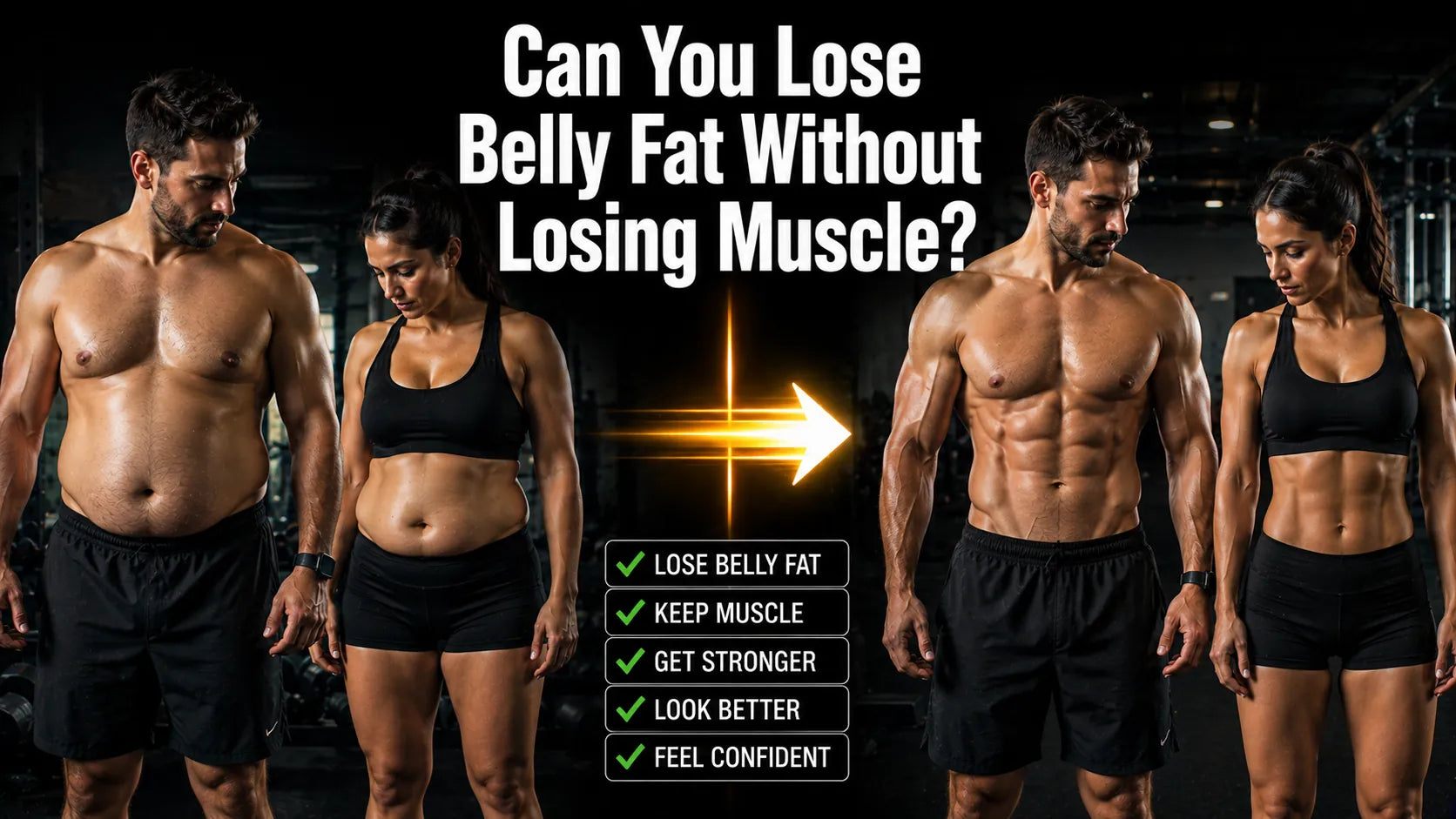
If you've ever tried to lose body fat, you've probably faced a frustrating dilemma.
On one hand, you want the scales to go down.
On the other, you don't want to lose the muscle you've spent months—or even years—building.
This is where many diets go wrong.
People become so focused on losing weight that they forget the real goal isn't simply to become lighter.
The goal is usually to improve body composition.
In other words:
- less body fat
- more muscle retention
- a leaner appearance
- better performance
Unfortunately, the body doesn't automatically know the difference between weight you want to lose and weight you want to keep.
Without the right approach, it's entirely possible to lose:
- body fat
- muscle mass
- strength
at the same time.
The good news is that muscle loss isn't inevitable.
With sensible nutrition, appropriate training, and realistic expectations, many people can significantly reduce body fat while holding on to the majority of their hard-earned muscle.
Let's look at how.
1. Can You Target Belly Fat Specifically?
This is one of the most common questions in fitness.
And unfortunately, the answer is no.
The body doesn't allow you to choose where fat comes from.
Despite countless products and gimmicks claiming otherwise, there is no proven way to specifically burn belly fat while leaving fat elsewhere untouched.
Fat loss occurs across the body as a whole.
The exact pattern depends largely on:
- genetics
- hormones
- body-fat levels
- individual physiology
For many people, belly fat is simply one of the last areas to disappear.
That can be frustrating.
But it doesn't mean progress isn't happening.
Often, people are successfully losing fat from:
- the face
- arms
- chest
- legs
before significant changes occur around the stomach.
The key is patience.
The body decides where fat comes from.
Your job is simply to create the conditions that allow fat loss to occur.

2. Why Muscle Loss Happens During Fat Loss
The body is incredibly efficient.
When calories drop, it begins looking for ways to reduce energy expenditure.
Unfortunately, muscle tissue is metabolically expensive.
Maintaining it requires resources.
If the body believes muscle is no longer necessary, it may begin breaking some of it down.
This is why poorly planned diets often produce disappointing results.
People lose weight.
But they also lose:
- strength
- muscle mass
- athletic performance
The result is often a smaller version of the same physique rather than a genuinely leaner one.
Muscle loss becomes more likely when:
- calorie deficits are too aggressive
- protein intake is too low
- strength training is absent
- recovery is poor
The goal of a good cutting phase isn't simply losing weight.
The goal is convincing the body to keep muscle while losing fat.
3. How Much Protein Do You Need While Dieting?
Protein becomes even more important during fat loss than it is during maintenance.
When calories are reduced, protein helps provide the body with a reason to retain muscle tissue.
It also offers other advantages.
Protein tends to be:
- filling
- satisfying
- helpful for recovery
- supportive of muscle maintenance
This is one reason high-protein diets consistently appear in successful fat-loss programmes.
For many people, consistently hitting protein targets is one of the biggest challenges of a cut.
Products such as Per4m Advanced Whey Protein – 2.01kg can be useful because they provide a convenient way to increase protein intake without dramatically increasing calories.
The goal isn't to consume endless amounts of protein.
The goal is ensuring the body has enough available to support recovery and muscle retention.
4. Why Strength Training Protects Muscle Mass
If protein provides the building blocks, strength training provides the reason to keep them.
The body adapts according to demand.
When muscles are regularly challenged through resistance training, the body receives a clear message:
This muscle is still needed.
That message becomes incredibly valuable during a calorie deficit.
Without strength training, the body has fewer reasons to prioritise muscle retention.
This is why many successful fat-loss programmes include resistance training even when the primary goal isn't building muscle.
The objective isn't necessarily gaining size.
It's preserving what you've already built.
This often leads to better:
- body composition
- performance
- strength levels
- appearance
than dieting alone.

5. Can You Lose Belly Fat Without Doing Cardio?
Absolutely.
This surprises many people.
Cardio can certainly help create a calorie deficit.
But cardio itself is not the mechanism responsible for fat loss.
Fat loss ultimately comes from an energy deficit.
That deficit can be created through:
- nutrition
- strength training
- increased daily activity
- cardio
- a combination of all four
Many people successfully lose body fat while performing little traditional cardio.
Instead, they focus on:
- diet quality
- calorie control
- resistance training
- daily movement
This is one reason walking has become so popular.
It's sustainable.
It's easy to recover from.
And it contributes meaningfully to overall energy expenditure.
Hydration also becomes increasingly important when activity levels increase.
Products such as Optimum Nutrition Electrolyte 264g can fit naturally into an active fat-loss routine by helping support hydration habits during training and daily activity.


Intermission
So far we've explored whether belly fat can be targeted directly, why muscle loss occurs during fat loss, the importance of protein intake, how strength training helps preserve muscle, and whether cardio is actually necessary for reducing belly fat.
In Part 2, we'll look at the ideal rate of fat loss, supplements that can support muscle retention, the mistakes that cause unnecessary muscle loss, realistic timelines for seeing belly-fat reductions, and what results you can expect from a properly structured cut.
Part 2
6. How Fast Should You Lose Weight to Keep Muscle?
One of the biggest mistakes people make during a fat-loss phase is trying to lose weight too quickly.
The logic seems sensible.
If losing a little weight is good, losing lots of weight must be better.
Unfortunately, the body doesn't always agree.
Aggressive calorie deficits often increase the risk of:
- muscle loss
- strength loss
- poor recovery
- reduced training performance
This is why slower, more controlled fat loss is often more successful.
A sustainable approach allows the body to continue:
- training effectively
- recovering properly
- preserving muscle tissue
while gradually reducing body fat.
Many successful cuts are surprisingly boring.
No crash diets.
No starvation.
No extreme restrictions.
Just consistent progress over time.
The people who keep the most muscle are often the people who show the most patience.

7. Which Supplements Help Preserve Muscle While Cutting?
No supplement can replace:
- adequate protein
- strength training
- a sensible calorie deficit
However, some products can support the process.
For example, Per4m Advanced Whey Protein – 2.01kg can help make protein targets easier to achieve when calories are lower.
Maintaining training quality matters too.
Many people find workouts become more challenging during a cut because energy intake is reduced.
Products such as Applied Nutrition Body Fuel Energy Shot 12 × 60ml are often used before demanding training sessions to help maintain workout intensity.


Reflex Nutrition Acetyl-L-Carnitine 90 Caps is also commonly used during cutting phases because L-carnitine is often associated with fat-loss support and energy metabolism. While it won't directly burn belly fat on its own, it fits naturally into a structured fat-loss plan focused on preserving performance while reducing body fat.

Overall dietary quality remains important.
This is where Applied Nutrition Critical Greens – 250g can fit naturally into a structured fat-loss plan focused on maintaining healthy habits.

The key is remembering that supplements support muscle retention indirectly.
The real drivers remain:
- nutrition
- training
- recovery
- consistency
8. What Mistakes Cause Muscle Loss During Fat Loss?
Most muscle loss occurs because people become too aggressive.
Common mistakes include:
- cutting calories too severely
- avoiding resistance training
- eating too little protein
- losing weight too quickly
- neglecting recovery
Another common mistake is chasing scale weight above all else.
People celebrate every pound lost without asking an important question:
What exactly did I lose?
Because weight loss and fat loss are not the same thing.
The goal should be preserving as much muscle as possible while reducing body fat.
That usually requires patience rather than panic.
The body responds far better to a measured approach than an extreme one.
9. How Long Does It Take to Notice Belly Fat Loss?
Usually longer than people would like.
This is partly because belly fat is often one of the last places people notice changes.
Many people start losing fat successfully but become discouraged because their stomach hasn't changed dramatically yet.
Meanwhile, improvements may already be occurring elsewhere:
- face
- shoulders
- arms
- chest
- waistline
The challenge is that belly fat often requires consistency over months rather than weeks.
This is why progress photos can be so valuable.
Day-to-day changes are difficult to notice.
Month-to-month changes are much easier to see.
The people who succeed are usually the people who stay patient long enough to allow the process to work.

10. What Results Can You Expect From a Proper Cut?
A successful cut should deliver far more than a lower number on the scales.
When done properly, many people can expect:
- reduced body fat
- improved muscle definition
- better body composition
- improved confidence
- maintained strength levels
This is where the concept of body recomposition becomes important.
The goal isn't simply becoming lighter.
The goal is creating a physique that looks and performs better.
Hydration and recovery also play a role throughout this process.
Products such as Optimum Nutrition Electrolyte 264g can support hydration habits, while maintaining a sensible recovery routine helps preserve training quality throughout the cut.
The best cuts are rarely the fastest.
They're the ones that allow fat loss to occur while keeping as much muscle as possible.
Conclusion
Can you lose belly fat without losing muscle?
Absolutely.
But it requires the right approach.
The body cannot specifically target belly fat, and aggressive dieting often increases the risk of muscle loss.
The most successful strategy combines:
- adequate protein
- strength training
- a sensible calorie deficit
- patience
- consistency
When those pieces come together, many people can significantly reduce body fat while maintaining the majority of their muscle mass.
The goal isn't simply losing weight.
The goal is improving body composition.
Because a leaner, stronger physique almost always looks and performs better than a lighter physique that has lost both fat and muscle.
FAQ
1. Can you lose belly fat without losing muscle?
Yes. With adequate protein, strength training, and a sensible calorie deficit, most people can minimise muscle loss while reducing body fat.
2. Can you target belly fat specifically?
No. The body decides where fat is lost from, and spot reduction is not supported by evidence.
3. How much protein do I need to preserve muscle while dieting?
Protein needs vary, but maintaining a high-protein intake is one of the most important factors for muscle retention.
4. Does strength training prevent muscle loss?
Strength training provides the body with a strong reason to maintain muscle during a calorie deficit.
5. Do you need cardio to lose belly fat?
No. Fat loss is driven primarily by a calorie deficit rather than cardio itself.
6. What causes muscle loss during fat loss?
The biggest causes are aggressive calorie deficits, inadequate protein intake, poor recovery, and a lack of resistance training.
7. How long does it take to notice belly fat loss?
Most people notice changes gradually over several weeks and months of consistent dieting.
8. What is the best way to lose fat without losing muscle?
Combine a moderate calorie deficit with high protein intake, strength training, recovery, and patience.


