


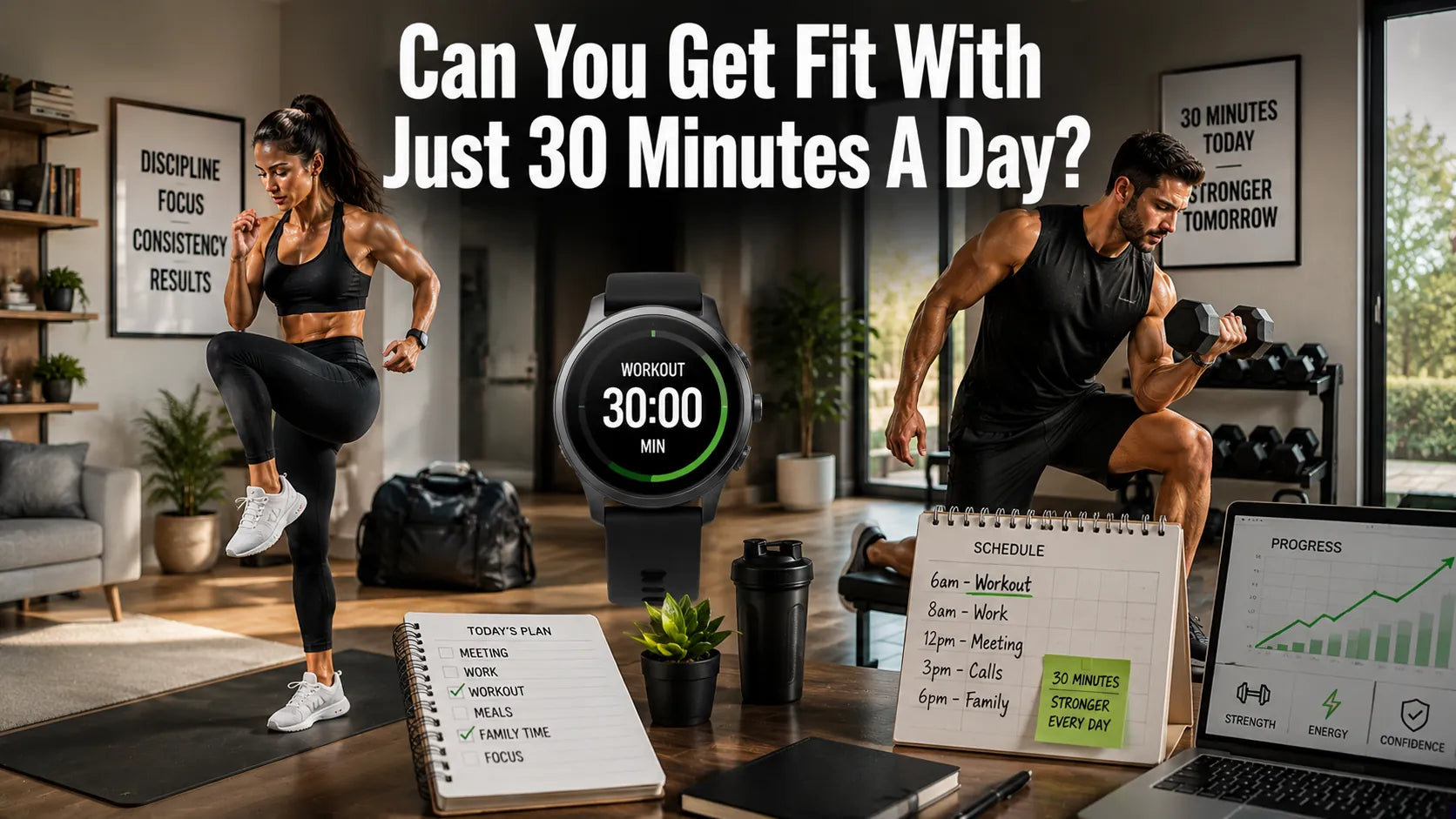
One of the biggest excuses people give for not exercising is a lack of time.
Work gets busy.
Family commitments pile up.
Life becomes hectic.
Before long, fitness gets pushed to the bottom of the priority list.
Many people imagine getting fit requires:
- two-hour gym sessions
- daily cardio
- complicated workout schedules
- huge amounts of free time
But does it really?
The truth is that some of the fittest people in the world aren't necessarily training for hours every day.
Instead, they're remarkably consistent.
And that's an important distinction.
Because when it comes to fitness, consistency often matters far more than duration.
This raises a simple but important question:
Can you actually get fit with just 30 minutes a day?
For many people, the answer is yes.
In fact, thirty focused minutes can produce significantly better results than two hours of inconsistent effort.
The key is understanding how to use those thirty minutes effectively.
Let's look at what matters most.
1. Is 30 Minutes a Day Really Enough?
For most people, yes.
The body doesn't reward time spent exercising.
It rewards effective training.
A focused thirty-minute session can improve:
- fitness
- strength
- endurance
- body composition
- overall health
The mistake many people make is assuming longer automatically means better.
In reality, workout quality often matters more than workout length.
A highly focused thirty-minute session frequently outperforms a distracted ninety-minute one.
This is especially true for people whose primary goals involve:
- getting fitter
- losing body fat
- building some muscle
- improving health
Thirty minutes may not sound impressive.
But repeated consistently over weeks and months, it becomes extremely powerful.

2. What Type of Exercise Delivers the Best Results?
The answer depends on your goal.
However, for general fitness, some combination of:
- resistance training
- cardiovascular exercise
- daily movement
usually works best.
Strength training helps:
- build muscle
- improve strength
- support body composition
Cardio helps:
- improve endurance
- support cardiovascular health
- increase activity levels
The best approach isn't necessarily choosing one over the other.
It's finding a balance you can maintain consistently.
Many people achieve excellent results by combining short strength sessions with regular walking and general activity.
The body responds remarkably well when movement becomes part of daily life.
3. Can You Build Muscle in 30 Minutes a Day?
Absolutely.
Muscle growth depends on:
- effort
- progression
- recovery
- consistency
not simply workout duration.
Many highly effective muscle-building workouts can be completed in thirty minutes.
Especially when they focus on:
- compound exercises
- progressive overload
- minimal wasted time
The idea that muscle growth requires endless gym sessions is largely a myth.
A well-designed thirty-minute workout can provide more than enough stimulus for growth.
Particularly for beginners and intermediate lifters.
The important thing is making those thirty minutes count.
4. Can You Lose Weight With Short Workouts?
Yes.
Although it's important to understand why.
Weight loss is primarily driven by energy balance.
Short workouts can help increase energy expenditure.
But the biggest influence usually remains nutrition.
This is actually good news.
Because it means people don't need to spend hours exercising to lose body fat.
Instead, many successful fat-loss journeys involve:
- sensible nutrition
- regular activity
- manageable workouts
- long-term consistency
Thirty minutes may not burn thousands of calories.
But thirty minutes performed regularly can contribute significantly over time.
Small actions repeated consistently often create surprisingly large results.

5. Why Consistency Matters More Than Workout Length
Imagine two people.
Person A trains for two hours every Saturday.
Person B trains for thirty minutes five days per week.
Who usually gets better results?
In most cases, Person B.
That's because adaptation occurs through repeated exposure.
The body responds to consistent training.
Not occasional heroic efforts.
This is why many successful fitness transformations are built on routines that seem almost boring.
The workouts aren't extreme.
They're repeatable.
And repeatability creates momentum.
When people remove barriers and make exercise easy to maintain, progress often accelerates.
The best workout programme isn't necessarily the most advanced.
It's the one you'll still be doing six months from now.
Intermission
So far we've explored whether thirty minutes per day is enough, the types of exercise that deliver the best results, whether muscle can be built in short sessions, how weight loss works with limited training time, and why consistency almost always beats workout length.
In Part 2, we'll look at the role of nutrition, supplements that fit a busy lifestyle, the mistakes that make short workouts less effective, realistic timelines for progress, and what results you can genuinely expect after 90 days of consistent effort.
Part 2
6. How Important Is Nutrition for Fast Progress?
Nutrition is arguably the most important factor outside of training itself.
Many people spend hours searching for the perfect workout plan while paying very little attention to what happens in the kitchen.
Unfortunately, fitness doesn't work that way.
Even the best training programme struggles when nutrition is poor.
Good nutrition supports:
- recovery
- muscle growth
- fat loss
- energy levels
- training performance
The encouraging news is that nutrition doesn't need to be perfect.
It simply needs to be consistently good.
For busy people, convenience often becomes a major factor.
This is where products such as Applied Nutrition Critical Greens – 250g can fit naturally into a routine focused on improving overall dietary quality when time is limited.

The goal isn't perfection.
The goal is building habits that can actually be maintained.

7. Which Supplements Support a Busy Lifestyle?
Supplements should never replace good habits.
But they can certainly support them.
For people balancing work, family, and training, convenience matters.
This is one reason products such as EHP Labs OxyShred Ultra Energy Drink 335ml have become popular among active individuals looking for a convenient option when fitting exercise into a busy day.
Recovery matters too.
BetterYou Magnesium Water – Hydrate can fit naturally into a routine focused on hydration and recovery between workouts.


Overall wellbeing also plays a role in consistency.
Products such as Applied Nutrition Probiotic Advanced Multi-Strain Formula are often included as part of broader health-focused routines.

Meanwhile, Reflex Nutrition Acetyl-L-Carnitine 90 Caps is frequently used by people pursuing active lifestyles and fat-loss goals.

The common theme is simple:
The easier healthy habits become, the easier consistency becomes.
And consistency drives results.
8. What Mistakes Reduce the Effectiveness of Short Workouts?
The biggest mistake is treating short workouts casually.
Many people assume that because a workout is only thirty minutes long, intensity no longer matters.
That's a mistake.
Short workouts work best when they remain:
- focused
- structured
- progressive
- intentional
Other common mistakes include:
- scrolling on phones between sets
- skipping warm-ups
- inconsistent scheduling
- poor nutrition
- lack of progression
Thirty minutes can be incredibly productive.
But only if those thirty minutes are used effectively.
Quality matters.
A lot.
9. How Long Until You Notice Results?
Usually sooner than people expect.
Many people notice improvements in:
- energy levels
- fitness
- endurance
- confidence
within the first few weeks.
Physical changes often take longer.
The exact timeline depends on:
- starting point
- consistency
- nutrition
- recovery
- training quality
The mistake many people make is expecting dramatic changes after a handful of workouts.
Fitness improvements accumulate gradually.
The people who succeed are often the people who continue showing up long enough for those small improvements to compound.

10. What Results Can You Expect After 90 Days?
Ninety days is where things become interesting.
Three months of consistent effort can create significant change.
Depending on starting point and goals, many people may notice:
- improved fitness
- increased strength
- reduced body fat
- better endurance
- improved confidence
- healthier daily habits
This is also where consistency starts producing visible results.
The body begins reflecting the habits you've been building.
And that's ultimately the real lesson of this article.
Most people don't need more time.
They need more consistency.
Thirty minutes per day may sound modest.
But ninety consecutive days of effort can produce results that genuinely surprise people.
Conclusion
Can you get fit with just 30 minutes a day?
Absolutely.
The idea that fitness requires endless hours in the gym is one of the biggest myths in the industry.
For most people, thirty focused minutes is more than enough to:
- improve fitness
- build strength
- support fat loss
- improve health
- increase energy levels
The key isn't training longer.
It's training consistently.
When good training is combined with sensible nutrition, recovery, and patience, remarkable progress can happen in surprisingly little time.
Because ultimately, fitness isn't built by occasional marathon sessions.
It's built by showing up regularly and doing the work.
FAQ
1. Is 30 minutes a day enough to get fit?
Yes. For most people, thirty minutes of focused exercise is enough to improve fitness, strength, and health.
2. Can you build muscle with 30-minute workouts?
Absolutely. Muscle growth depends on training quality, progression, recovery, and consistency rather than workout length alone.
3. Can you lose weight exercising 30 minutes a day?
Yes. Short workouts can contribute to fat loss when combined with appropriate nutrition.
4. What type of exercise is best for a 30-minute workout?
A combination of resistance training, cardio, and daily movement tends to work well for overall fitness.
5. How long does it take to see results?
Many people notice fitness improvements within weeks, while visible physical changes often take a few months.
6. Are short workouts effective?
Yes. Focused, structured workouts can be highly effective even when time is limited.
7. What mistakes make short workouts less effective?
Lack of intensity, poor progression, distractions, and inconsistent scheduling are common issues.
8. What can you expect after 90 days?
Many people experience improved fitness, strength, body composition, confidence, and overall health.


