


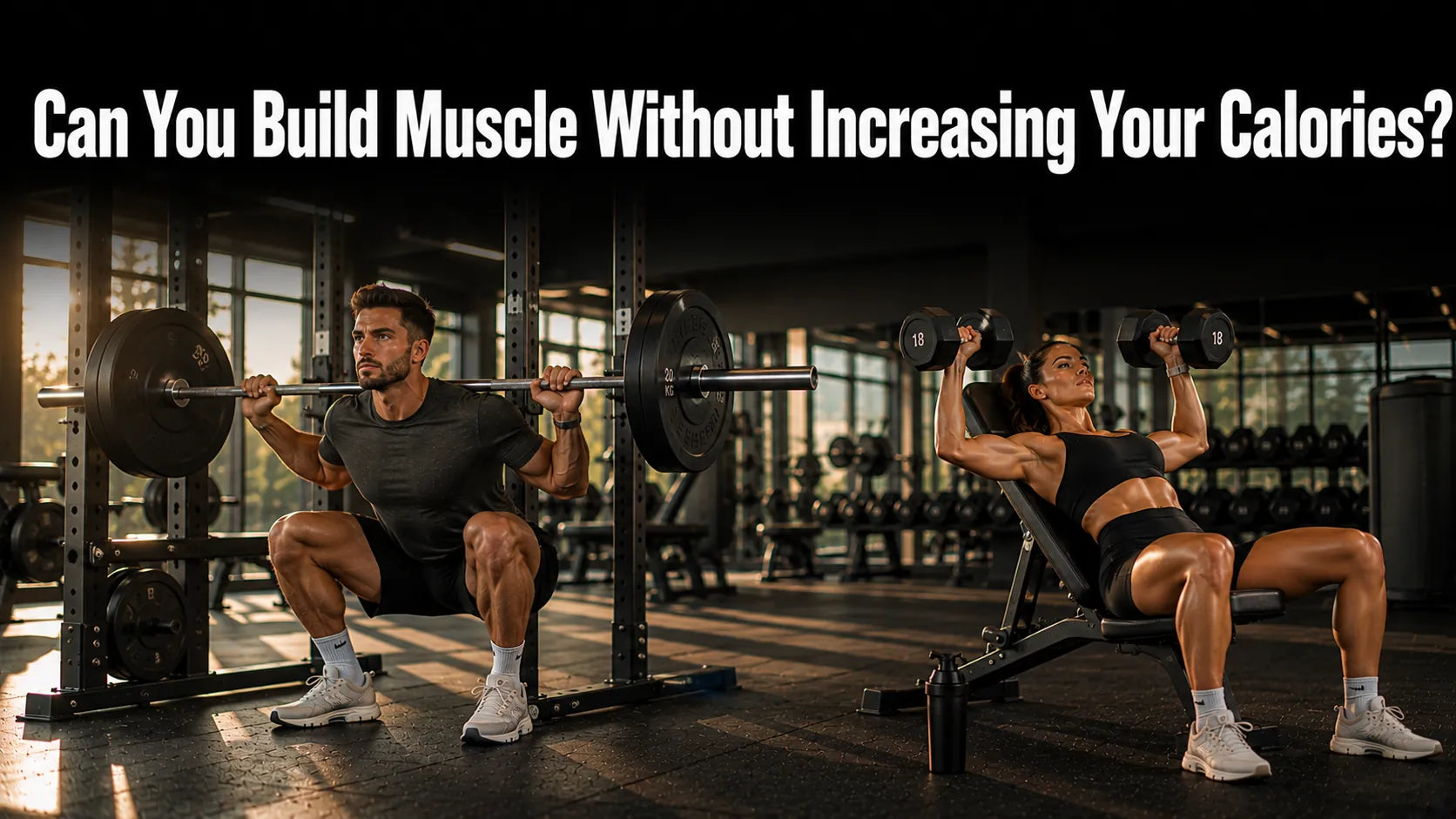
Building muscle has traditionally been linked to one simple rule: eat more.
Spend any time reading fitness forums or scrolling through social media and you'll quickly come across the same advice—if you want bigger muscles, you need to be in a calorie surplus. The logic seems straightforward. Muscle tissue requires energy to build, so eating more should naturally lead to greater muscle growth.
But what if increasing your calories isn't your goal?
Perhaps you're happy with your current body weight and don't want to gain unnecessary body fat. Maybe you're trying to improve your physique through body recomposition, replacing fat with muscle while staying roughly the same weight. Or perhaps you've simply reached a point where eating more food feels impractical.
So, can you actually build muscle while eating at maintenance calories?
The answer is yes—but there are important caveats.
Building muscle without increasing calories is absolutely possible under the right circumstances. However, your training, protein intake, recovery and consistency become even more important because you're asking your body to become more efficient with the energy it's already receiving.
Rather than relying on excess calories to maximise muscle growth, your body must carefully balance repairing damaged muscle tissue, supporting daily activity and maintaining countless other physiological processes.
For some people, this approach can produce impressive results.
For others, progress will naturally be slower.
Understanding why is the key to setting realistic expectations and creating a training plan that actually works.
1. Can You Really Build Muscle at Maintenance Calories?
Yes—but the amount of muscle you can build depends largely on your current training status, body composition and overall lifestyle.
Maintenance calories simply refer to eating roughly the same number of calories as your body uses each day. Your weight remains relatively stable because energy intake closely matches energy expenditure.
Contrary to popular belief, maintaining your weight doesn't automatically mean maintaining your physique.
Your body is constantly adapting.
If resistance training creates a sufficient stimulus and recovery is adequate, your body can gradually increase lean muscle tissue while simultaneously reducing body fat—a process commonly known as body recomposition.
This happens because the body isn't just looking at total calories.
It also considers:
- available amino acids
- stored body fat
- training stimulus
- hormonal environment
- recovery quality
- sleep
- overall health
Someone carrying moderate body fat while beginning resistance training often has enough stored energy to support muscle growth without intentionally increasing calorie intake.
This is one reason many beginners experience dramatic improvements during their first year of lifting.
They're building muscle while becoming leaner at the same time.
The process isn't magic.
It's simply an efficient redistribution of energy.
However, as you become leaner and more experienced, this becomes increasingly difficult.
Advanced lifters usually require much more precise nutrition and often benefit from periods of eating in a small calorie surplus to maximise muscle growth.
Maintenance calories don't prevent muscle gain.
They simply reduce the margin for error.
Every workout needs to count.
Every recovery session matters.

2. Who Can Build Muscle Without Eating More?
Not everyone responds to maintenance calories in exactly the same way.
Some people are in an ideal position to build muscle without increasing food intake.
Others will find progress considerably slower.
Generally, the people who see the greatest results include:
Beginners
New lifters experience rapid neurological and muscular adaptations.
Their bodies respond extremely well to resistance training because almost every exercise represents a completely new stimulus.
Even simple compound movements performed consistently can produce noticeable improvements in muscle size and strength.
People Returning After Time Off
Muscle memory is real.
Someone who previously built significant muscle before taking months—or even years—away from training often regains lost muscle much faster than someone building it for the first time.
Their muscles have already adapted once before.
The rebuilding process is surprisingly efficient.
Individuals Carrying Higher Body Fat
Stored body fat represents a substantial energy reserve.
When protein intake is sufficient and resistance training is appropriately challenging, some of that stored energy can indirectly support muscle-building processes.
This doesn't mean body fat turns into muscle.
Rather, stored energy helps cover part of the body's overall energy demands while dietary protein provides the building blocks required for muscle repair.
Experienced Lifters
Progress is still possible.
It's simply slower.
Experienced lifters have already adapted to years of resistance training.
Building additional muscle requires a much stronger stimulus, more precise recovery and significantly greater patience.
They often notice improvements measured in months rather than weeks.
The further you progress in your lifting journey, the harder every additional kilogram of muscle becomes to earn.
3. How Important Is Protein When Calories Stay the Same?
Protein becomes even more important when you're trying to build muscle without increasing your calorie intake.
Unlike carbohydrates and fats, protein supplies the amino acids your body requires to repair and build muscle tissue following resistance training.
If total calories remain stable but protein intake is too low, muscle protein synthesis can struggle to keep pace with muscle breakdown.
Over time, this limits progress.
For most active individuals aiming to maximise muscle growth while eating at maintenance calories, consuming sufficient high-quality protein across the day is one of the most effective nutritional strategies available.
Rather than eating the majority of your protein in one meal, spreading it throughout breakfast, lunch, dinner and snacks may help provide a more consistent supply of amino acids.
This also makes it easier to hit higher daily protein targets without feeling uncomfortably full.
One practical option is Applied Nutrition Clear Whey – 875g.


Unlike traditional milkshake-style protein powders, Clear Whey offers a lighter, juice-like drink that can make increasing protein intake feel less repetitive, particularly during warmer weather or after intense training sessions.
It isn't a substitute for a balanced diet.
But it can help bridge the gap on days when meeting your protein target through whole foods alone proves difficult.
Protein is often described as the building block of muscle.
When calories remain unchanged, those building blocks become even more valuable.
4. Does Progressive Overload Matter More Than a Calorie Surplus?
If there is one principle that determines whether muscle grows, it's progressive overload.
Eating more food alone doesn't force muscles to become larger.
Your body only builds additional muscle when it believes more muscle is necessary.
Resistance training provides that signal.
Progressive overload means gradually increasing the demands placed on your muscles over time.
That progression might involve:
- lifting heavier weights
- performing additional repetitions
- completing more total sets
- improving exercise technique
- increasing range of motion
- slowing the eccentric phase
- reducing reliance on momentum
Each improvement gives your muscles another reason to adapt.
Without progressive overload, extra calories are simply extra calories.
Likewise, without a meaningful training stimulus, muscle protein synthesis has little reason to remain elevated after exercise.
For someone eating at maintenance calories, training quality becomes even more important.
You don't have excess energy to compensate for inconsistent workouts.
Every session should have a clear purpose and measurable progression.
Animal Creatine – 300 Capsules naturally fits into this discussion because maintaining strength progression is often one of the biggest drivers of long-term muscle growth. By supporting repeated high-intensity efforts during resistance training, creatine can help you continue challenging your muscles as your programme becomes progressively more demanding.

Training creates the signal.
Nutrition supports the response.
Neither works particularly well without the other.

5. Which Training Style Works Best at Maintenance Calories?
When calories are limited, recovery resources become more valuable.
That doesn't necessarily mean training less.
It means training smarter.
Research consistently shows that hypertrophy is best supported by programmes built around effective resistance training, sufficient weekly training volume and progressive overload.
Compound exercises should form the foundation of most programmes because they recruit large amounts of muscle mass while allowing consistent progression.
Examples include:
- squats
- deadlifts
- bench presses
- overhead presses
- pull-ups
- rows
- Romanian deadlifts
- lunges
These movements can then be complemented by isolation exercises that target individual muscle groups.
Training close to muscular failure—while maintaining excellent technique—also appears to maximise muscle fibre recruitment without requiring unnecessarily excessive training volume.
The goal isn't simply to leave the gym exhausted.
It's to provide your muscles with a high-quality growth stimulus that you can recover from consistently week after week.
For people eating at maintenance calories, balancing intensity with recovery is often far more productive than constantly increasing training volume.
A well-designed programme performed consistently will almost always outperform random hard workouts.
Intermission
So far, we've explored why muscle growth at maintenance calories is possible, who is most likely to succeed with this approach, why protein intake becomes even more important, how progressive overload often matters more than simply eating extra calories, and which style of resistance training provides the strongest muscle-building stimulus.
In Part 2, we'll examine whether beginners and experienced lifters can expect the same results, which supplements can support muscle growth without increasing calories, the most common mistakes that prevent progress, how to tell whether you're building muscle without gaining weight, and the best long-term strategy for successful body recomposition.
Part 2
6. Can Beginners and Experienced Lifters Get the Same Results?
One of the biggest factors influencing muscle growth at maintenance calories isn't your diet—it's your training experience.
Beginners and experienced lifters respond very differently to the same programme.
For beginners, almost any well-structured resistance training programme provides a strong enough stimulus to encourage muscle growth. Their muscles and nervous system are adapting to unfamiliar demands, making body recomposition far more achievable.
In many cases, beginners can:
- gain lean muscle
- reduce body fat
- improve strength
- maintain a similar body weight
all at the same time.
This is often referred to as the "beginner advantage."
Experienced lifters, however, face a different challenge.
After years of consistent training, the body has already adapted to many training stimuli. Building additional muscle requires increasingly precise programming, careful recovery and patience.
The improvements become smaller because the body is already much closer to its genetic potential.
That doesn't mean experienced lifters can't build muscle at maintenance calories.
It simply means progress tends to be slower and less dramatic.
An advanced trainee may spend several months gaining only a small amount of lean muscle while maintaining body weight.
Although this can feel frustrating, those small improvements accumulate significantly over the years.
The key is comparing yourself to your previous performance—not someone else's.

7. Which Supplements Support Muscle Growth Without Extra Calories?
Supplements cannot replace effective training or good nutrition.
However, they can make it easier to consistently support muscle growth while keeping calories under control.
One supplement that fits particularly well into this approach is Applied Nutrition Critical Greens – 250g.

When reducing or maintaining calorie intake, some people unintentionally eat fewer fruits and vegetables. Critical Greens provides a convenient way to support micronutrient intake alongside a varied diet, helping maintain overall nutritional quality while focusing on body recomposition.
It isn't designed to directly build muscle.
Instead, it supports the nutritional foundation that allows hard training, recovery and consistent progress.
Other fundamentals remain equally important:
- consuming sufficient protein
- training consistently
- prioritising sleep
- staying hydrated
- progressively overloading your exercises
The supplements simply support those habits—they don't replace them.
8. What Mistakes Stop Muscle Growth at Maintenance Calories?
Building muscle without increasing calories leaves much less room for error.
Several common mistakes can prevent progress, even when someone trains regularly.
Not Eating Enough Protein
Protein provides the amino acids required for muscle repair.
Without sufficient intake, muscle protein synthesis is limited regardless of how hard you train.
Avoiding Progressive Overload
Repeating exactly the same workout each week gives your body no reason to continue adapting.
Muscle grows in response to increasing demands.
Expecting Weekly Physical Changes
Body recomposition is slower than traditional bulking.
Visible changes often take several months rather than several weeks.
Patience is essential.
Poor Recovery
Many people underestimate the importance of sleep.
Most muscle repair occurs after training—not during it.
Chronically poor sleep limits recovery, hormone regulation and training performance.
Maintaining hydration also contributes to recovery quality.
BetterYou Magnesium Water – Focus can naturally complement an active lifestyle by supporting hydration while fitting easily into a maintenance-calorie nutrition plan.

Eating Too Little
Ironically, some people trying to stay at maintenance accidentally drift into a calorie deficit.
While a modest deficit may reduce body fat, a larger one can make building muscle increasingly difficult.
Maintenance calories require consistency—not constant restriction.
9. How Can You Tell If You're Building Muscle Without Gaining Weight?
Because the scales may barely move, measuring progress requires a different mindset.
Instead of focusing solely on body weight, consider several indicators together.
Your Strength Is Increasing
Consistently lifting heavier weights or completing more repetitions is one of the strongest signs that your training is working.
Your Measurements Change
Your waist may become slightly smaller while your chest, shoulders, arms or thighs gradually increase.
This often indicates body recomposition.
Clothes Fit Differently
Many people notice shirts becoming tighter across the shoulders while trousers fit more loosely around the waist.
Progress Photos Improve
Weekly photographs taken under similar lighting often reveal changes that daily mirror checks miss.
Body Weight Stays Stable
Perhaps the most surprising sign is that your weight barely changes at all.
Losing a small amount of body fat while gaining a similar amount of muscle can result in almost identical scale readings despite noticeable improvements in physique.
The scales only measure total weight.
They don't distinguish between muscle and fat.

10. What's the Best Strategy for Building Muscle Without Increasing Calories?
If your goal is to maximise muscle growth while maintaining your current body weight, focus on building the strongest possible foundation.
Prioritise:
- resistance training three to five times per week
- progressive overload
- compound exercises
- sufficient daily protein
- consistent sleep
- quality recovery
- patience
Support your nutrition by ensuring you're meeting your micronutrient needs as well.
Applied Nutrition Multi-Vitamin Complex – 90 Capsules can naturally complement a balanced diet by helping maintain overall vitamin and mineral intake during periods of calorie maintenance.
Perhaps most importantly, stop expecting dramatic weekly transformations.
Building muscle while maintaining calories is often a slower process than traditional bulking.
But it's also one of the most sustainable approaches for people who want to improve their physique without unnecessary fat gain.
Small improvements repeated consistently over months often produce better long-term results than aggressive bulking followed by prolonged dieting.
Conclusion
So, can you build muscle without increasing your calories?
Yes—but success depends on creating the right environment for muscle growth.
A well-designed resistance-training programme, progressive overload, adequate protein, quality recovery and consistency can all support muscle gain while eating at maintenance calories. This is especially true for beginners, people returning after a break and those aiming for body recomposition.
More experienced lifters may see slower progress, but meaningful improvements are still possible with realistic expectations and disciplined training.
Ultimately, building muscle isn't determined solely by how much you eat.
It's determined by how effectively you train, recover and support your body over time.
If you stay consistent, maintenance calories don't have to mean maintaining the same physique forever.
FAQ
1. Can you build muscle without increasing your calories?
Yes. Many people can build muscle at maintenance calories, particularly beginners, those returning after a break and individuals with higher body fat levels.
2. Can you gain muscle while eating maintenance calories?
Yes. This is commonly known as body recomposition, where lean muscle increases while body fat decreases without significant changes in body weight.
3. Is a calorie surplus necessary for muscle growth?
Not always. While a calorie surplus can maximise muscle growth, it isn't essential for everyone, especially beginners or those aiming to improve body composition.
4. How much protein do you need at maintenance calories?
Most active individuals benefit from consuming sufficient protein throughout the day to support muscle protein synthesis and recovery alongside regular resistance training.
5. Can experienced lifters build muscle without eating more?
Yes, although progress is generally slower than it is for beginners because experienced lifters are already closer to their genetic potential.
6. How can you tell if you're gaining muscle without gaining weight?
Look for improvements in strength, body measurements, progress photos, clothing fit and overall body composition rather than relying solely on the scales.
7. Does progressive overload matter more than eating extra calories?
Progressive overload provides the training stimulus that tells your body to build muscle. Without it, increasing calorie intake alone is unlikely to maximise muscle growth.
8. What's the best strategy for building muscle at maintenance calories?
Combine progressive resistance training, adequate protein intake, consistent recovery, quality sleep and patience while tracking strength and body composition over time.


