


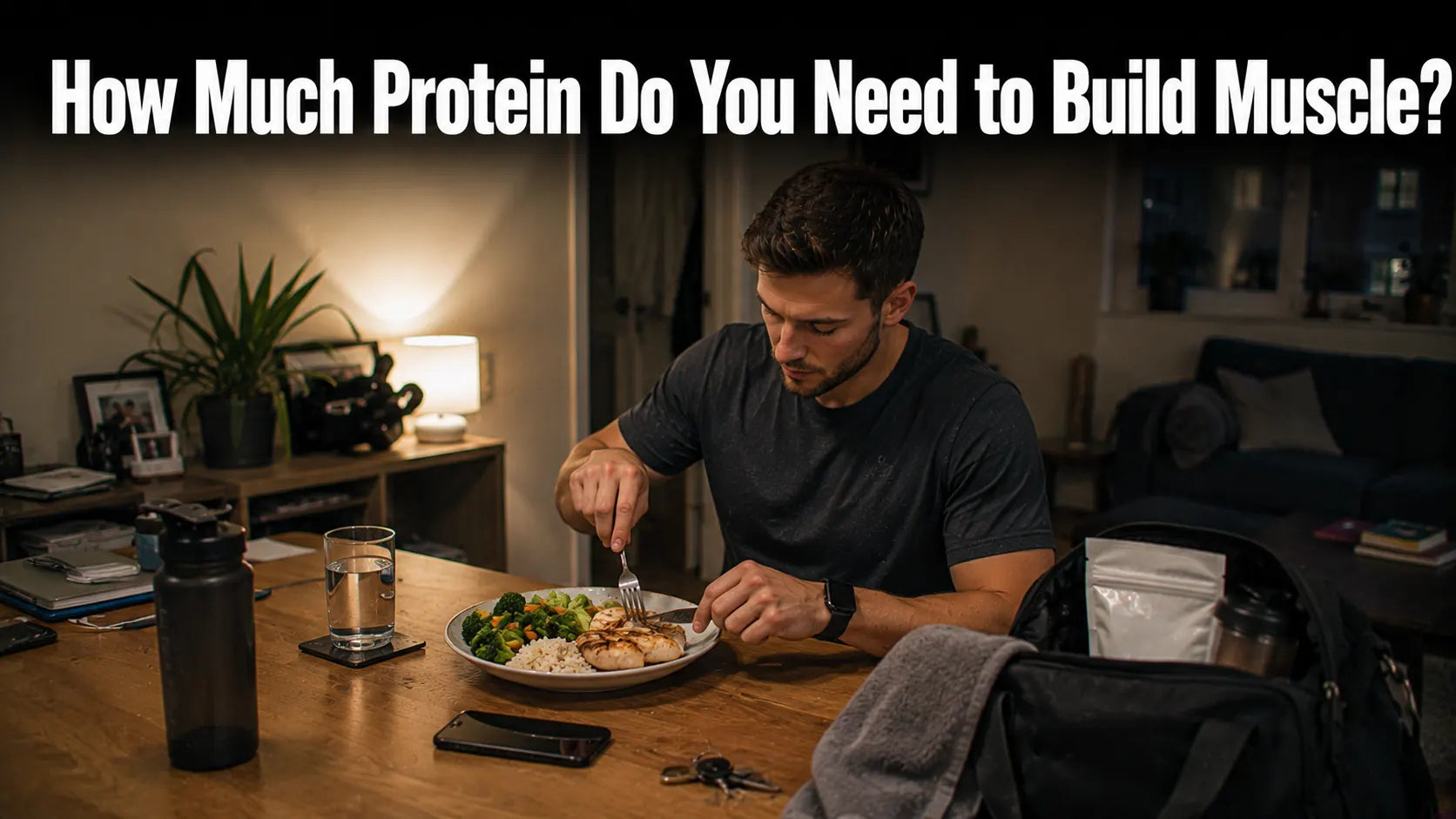
If you're trying to build muscle, you've probably been told to eat more protein.
Then more protein.
And perhaps another protein shake just to be safe.
Protein deserves its reputation. Resistance training provides the stimulus for muscle growth, while dietary protein supplies the amino acids your body needs to repair and build muscle tissue.
But that doesn't mean more protein always equals more muscle.
Once you're consuming enough, continually pushing your intake higher isn't necessarily going to produce additional growth. At that point, factors such as your training, total calorie intake, recovery and consistency become increasingly important.
So how much protein do you actually need to build muscle?
For many healthy adults regularly performing resistance training, around 1.6g of protein per kilogram of bodyweight per day is a useful evidence-based target when muscle growth is the goal.
But that's a starting point rather than a magic number.
Your bodyweight, calorie intake, training, dietary preferences and whether you're bulking or cutting can all influence what makes sense for you.
Let's turn the numbers into something you can actually use.
1. How Much Protein Do You Need to Build Muscle?
A useful target for many people trying to maximise muscle growth is approximately 1.6g of protein per kilogram of bodyweight per day.
That works out at roughly:
- 60kg: 96g protein
- 70kg: 112g protein
- 80kg: 128g protein
- 90kg: 144g protein
- 100kg: 160g protein
Those numbers might be considerably lower than some recommendations you've seen online.
That's because protein requirements for muscle growth aren't unlimited.
Resistance training increases the body's need for dietary protein, and getting enough protein matters.
But there's a difference between enough to support muscle growth and simply consuming as much as possible.
You also don't need to treat 1.6g/kg as a pass-or-fail threshold.
Someone consuming 1.5g/kg hasn't ruined their progress because they missed an arbitrary decimal point. Likewise, increasing from an already adequate intake to an enormous amount doesn't guarantee additional muscle.
Think of your daily protein target as a practical range to consistently aim around, rather than an exact number you need to hit to the gram.
And remember what protein cannot do.
You still need progressive resistance training.
You still need sufficient energy.
You still need sleep and recovery.
Protein supports the process.
It doesn't replace the process.

2. How Much Protein Do You Need Per Kilogram of Bodyweight?
Using bodyweight makes protein recommendations much more useful.
Telling everybody to eat "150g of protein per day" ignores the enormous difference between a 55kg person and somebody weighing 100kg.
For someone regularly resistance training, approximately 1.6g/kg/day provides a sensible reference point when the goal is muscle growth.
The calculation is straightforward:
Bodyweight in kilograms × 1.6 = approximate daily protein target in grams
An 80kg lifter, for example:
80 × 1.6 = 128g protein per day
You may also see higher recommendations approaching roughly 2g/kg/day or beyond.
That doesn't automatically mean they're wrong.
Protein requirements aren't identical for everyone, and higher intakes can be useful in particular circumstances. Someone dieting aggressively while trying to preserve muscle, for example, may approach protein differently from somebody comfortably eating at maintenance or in a modest calorie surplus.
Body composition can complicate calculations too.
If someone carries a very high proportion of body fat, blindly multiplying total bodyweight by increasingly high protein targets can produce an unnecessarily large number.
That's why protein-per-kilogram recommendations should be treated as a tool, not a law of physiology.
For most recreational lifters, you don't need to spend your evening debating whether 1.61g/kg is superior to 1.59g/kg.
Get yourself into a sensible range.
Then focus on doing it consistently.
3. Does Eating More Protein Mean More Muscle Growth?
Up to a point, increasing protein can help.
Beyond that point, the relationship stops being so simple.
Imagine somebody eating very little protein while resistance training.
Increasing their protein intake could meaningfully improve their ability to support muscle repair and growth.
Now imagine somebody who's already consistently consuming plenty of high-quality protein.
Doubling their intake doesn't mean they'll double their muscle growth.
Muscle gain is constrained by far more than protein availability.
Your training needs to provide an appropriate stimulus.
Your overall diet needs to support that training.
You need adequate recovery.
And if you're deliberately trying to gain size, your total energy intake matters too.
That's where something like Applied Nutrition Cream Of Rice can fit naturally into a muscle-gain diet. It isn't protein, nor does it need to be. Carbohydrate-rich foods can contribute energy to the wider diet and help support demanding resistance training while your protein requirements are met elsewhere.


This is an important distinction.
A muscle-building diet isn't simply:
Protein + more protein + even more protein.
Carbohydrate and dietary fat still have important roles.
Fruit, vegetables and other nutrient-rich foods still matter.
Calories still matter.
And training definitely matters.
Once your protein intake is already sufficient, obsessively increasing it can simply crowd out other useful parts of your diet.
More isn't automatically better. Enough, consistently, is the goal.
4. How Much Protein Should You Eat at Each Meal?
Your daily protein intake is the first priority.
But how you distribute that protein across the day can also be useful.
One persistent gym myth claims your body can only absorb around 20–30g of protein in one sitting and everything above that is "wasted".
That's far too simplistic.
Your digestive system doesn't suddenly stop processing protein because your chicken breast was larger than expected.
The more useful question is:
How much protein should you eat at each meal to support muscle protein synthesis across the day?
Rather than consuming very little protein for most of the day and then trying to eat almost your entire target at dinner, distributing protein across several meals is a sensible approach.
For many people, that might mean eating three to five protein-containing meals or snacks across the day.
The exact amount per meal will depend on your body size and total target.
If your daily target is around 120g, for example, you could spread it relatively evenly across four meals at approximately 30g each.
If your target is 160g, four meals averaging around 40g would get you there.
It doesn't need to be mathematically perfect.
Breakfast doesn't fail because it contained 27g while dinner contained 36g.
What you're trying to avoid is becoming so obsessed with individual meals that you lose sight of the bigger picture.
Get enough protein across the entire day, then distribute it reasonably well.

5. Do You Need More Protein When Bulking or Cutting?
This is where protein requirements become more interesting.
When bulking, you're deliberately providing your body with enough energy to support muscle gain.
But eating more total calories doesn't mean your protein intake needs to increase indefinitely.
Once you're consuming enough protein to support muscle growth, the additional calories required for a surplus can come from an appropriate balance of carbohydrate and fat rather than simply piling more protein onto every meal.
During a cut, the situation changes.
You're consuming fewer calories than you're expending, while ideally trying to retain as much muscle as possible.
Maintaining a relatively high protein intake becomes particularly useful alongside resistance training.
Depending on factors such as the size of your calorie deficit, your body composition and how lean you are, your protein requirements may therefore warrant more attention during a cutting phase.
But don't turn that into:
"Cutting means eat nothing except protein."
You still need a balanced diet.
And protein isn't the only evidence-backed consideration in strength and physique training.
Animal Creatine Capsules, for example, provide creatine rather than protein. Creatine and dietary protein have completely different roles, and taking one doesn't reduce the need for the other.

The same principle applies more broadly.
Your nutrition should be built around what each nutrient or supplement actually does—not around trying to force everything into the protein category.
When bulking, get enough protein and enough total energy.
When cutting, keep protein appropriately high while managing your calorie deficit and continuing to resistance train.
In both cases, consistency beats extremes.
Intermission
So far, the answer is considerably less dramatic than social media might suggest.
You don't need 300g of protein simply because you own a gym membership.
For many people resistance training for muscle growth, around 1.6g/kg of bodyweight per day provides a useful target to build from.
An 80kg person would therefore be looking at roughly 128g per day.
A 100kg person would be around 160g.
But those aren't magic numbers.
Protein requirements exist within the context of your bodyweight, calorie intake, training and goals.
And once you've got enough protein, repeatedly adding more doesn't automatically produce more muscle.
In Part 2, we'll look at whether beginners and experienced lifters need different amounts, what happens to your protein target on rest days, whether occasionally missing your target matters, how much should come from normal food versus protein powder, and how to calculate a practical daily target for yourself.
Part 2
6. Do Beginners Need Less Protein Than Experienced Lifters?
Not necessarily.
It's tempting to imagine protein requirements rising neatly alongside training experience:
Beginner = less protein.
Advanced lifter = more protein.
But that's not a particularly useful way to calculate your intake.
A beginner can actually experience a very strong muscle-building response when they first start resistance training. Their body is adapting to a completely new stimulus, and muscle growth can occur relatively quickly when training and nutrition are appropriate.
An experienced lifter may have considerably more muscle mass, but they're also typically closer to their genetic potential and may gain new muscle more slowly.
That doesn't mean training experience is irrelevant.
It means you shouldn't calculate protein requirements simply by how many years you've been lifting.
Bodyweight, total calorie intake, training demands and your current goal provide much more useful information.
The same applies to supplements used around training.
Something such as Naughty Boy Menace V2 might be used to support someone's training session, but being an experienced enough lifter to use pre-workout doesn't suddenly put you into a different protein category.


Beginners should establish the fundamentals early:
Train progressively.
Consume sufficient protein.
Eat an appropriate overall diet.
Recover properly.
Then keep doing those things long enough for them to work.
You don't need to "earn" an adequate protein intake by becoming an advanced lifter.

7. Do You Need the Same Amount of Protein on Rest Days?
Generally, keeping your protein intake relatively consistent makes sense.
Your muscles don't stop recovering when you leave the gym.
Resistance training creates a stimulus, but the subsequent repair and adaptation occur during the recovery period that follows.
That includes your rest days.
So dramatically reducing protein every time you don't train isn't particularly logical.
If your usual target is around 130g per day, for example, you don't need to deliberately drop to 60g because it's Sunday and you're not touching a barbell.
Your calorie intake might change between training and rest days if that's how you've structured your diet.
Your carbohydrate intake might vary.
Your meal timing might look different because you're not planning food around a workout.
But you can still aim for a broadly consistent daily protein intake.
This also makes life considerably easier.
Instead of having one protein calculation for Monday, another for Tuesday and a third because Wednesday happens to be leg day, you can establish a sensible daily target and build your normal diet around it.
Training days provide the stimulus. Rest days are part of the adaptation.
Both deserve appropriate nutrition.
8. Can You Build Muscle Without Hitting Your Protein Target Every Day?
Yes.
Missing your protein target occasionally does not suddenly stop muscle growth.
This is worth emphasising because fitness tracking can make nutrition feel far more precise than human physiology actually is.
Suppose your target is 130g.
You consume:
125g one day.
134g the next.
118g on Saturday because you went out.
Then 132g on Sunday.
You haven't destroyed your progress.
Your protein target is something to consistently aim around, not a daily examination where 129g counts as failure.
Of course, consistently consuming substantially less protein than you need is different.
If you're regularly aiming for 130g but actually eating 60–70g, improving that intake could be worthwhile.
But occasional variation is normal.
It's also useful to remember that foods and products around training don't all need to provide protein. High 5 Energy Gel, for example, is primarily relevant as a carbohydrate source for exercise rather than something you'd use to reach a protein target.


That's perfectly fine.
Your diet contains different nutrients doing different jobs.
Protein intake is accumulated through your protein-containing foods and drinks across the wider day.
The goal should therefore be long-term consistency without unnecessary obsession.
Hit a sensible intake most of the time.
If one day isn't perfect, carry on normally tomorrow.
9. Should Most of Your Protein Come From Food or Protein Powder?
For most people, normal food should form the foundation of the diet.
Protein powder is useful because it's convenient.
A shake can provide a substantial amount of protein quickly, requires very little preparation and can make a higher daily protein target easier to achieve.
But that doesn't mean you should progressively replace every protein-containing meal with powder.
Whole foods can provide far more than protein.
Depending on what you eat, your wider diet supplies:
- vitamins and minerals
- essential fats
- carbohydrate
- fibre
- energy
- a variety of other nutrients and food components
That's why looking at nutrition purely through the lens of protein grams can become misleading.
The same principle applies when considering something like Applied Nutrition Critical Greens. A greens supplement isn't a substitute for building a varied diet around fruit and vegetables, just as protein powder doesn't need to replace ordinary protein-rich foods.

Instead, use protein powder for what it does exceptionally well:
Convenience.
If breakfast, lunch and dinner already provide most of your protein but you're consistently falling 20–30g short of your target, a shake can be an easy solution.
If you've just trained and won't be able to eat a proper meal for a while, protein powder can be practical.
If you're travelling or working and preparing another meal isn't realistic, convenience matters.
There's no nutritional medal for refusing to use protein powder.
There's also no advantage to living almost entirely on shakes when you could comfortably eat a varied diet.
Food first, supplements where useful is a sensible middle ground.

10. How Can You Work Out Your Daily Protein Target?
You don't need a complicated calculator.
For a straightforward starting point when resistance training for muscle growth, take your bodyweight in kilograms and multiply it by approximately 1.6.
For example:
65kg × 1.6 = 104g
75kg × 1.6 = 120g
85kg × 1.6 = 136g
95kg × 1.6 = 152g
That gives you a practical daily target.
From there, consider your circumstances.
Are you resistance training consistently?
Are you trying to gain muscle?
Are you currently dieting?
Are you already relatively lean?
Is the target realistic within your normal diet?
Your answer doesn't necessarily need to be one precise number either.
If your calculation produces 136g, you could simply aim for roughly 130–140g per day rather than worrying about landing on exactly 136g every evening.
Then work backwards from your meals.
Suppose you want around 140g and normally eat four times per day.
You could roughly distribute that as:
Breakfast: 30–35g
Lunch: 30–35g
Afternoon/post-workout: 30–35g
Dinner: 35–40g
Those numbers don't have to be identical.
Some meals will contain more.
Others will contain less.
And protein from smaller foods and snacks throughout the day contributes too.
Track your intake for a short period if you genuinely don't know how much you're eating. You may discover you're already close to your target.
Or you might find the opposite.
Once you understand what an appropriate day of eating looks like, you don't necessarily need to spend the rest of your life weighing every chicken breast.
The calculation is the easy bit.
Bodyweight × sensible protein target = starting point.
Consistently eating, training and recovering well is what turns that number into something useful.
Conclusion
So, how much protein do you need to build muscle?
For many healthy adults performing regular resistance training, approximately 1.6g of protein per kilogram of bodyweight per day is a useful evidence-based target.
At 70kg, that's around 112g.
At 80kg, around 128g.
At 90kg, around 144g.
At 100kg, around 160g.
But don't mistake a useful guideline for a magic formula.
Muscle growth doesn't suddenly switch on when you hit exactly 1.6g/kg.
And eating dramatically more protein doesn't guarantee dramatically more muscle.
Your protein intake needs to sit alongside effective resistance training, sufficient calories, appropriate recovery and an overall nutritious diet.
Spread your protein reasonably across the day.
Keep it relatively consistent on rest days.
Use ordinary food as the foundation of your diet and protein powder when convenience makes it useful.
And if you occasionally finish the day a few grams below your target?
Don't panic.
Building muscle happens over months and years of consistent training and nutrition—not because you managed to make every single day mathematically perfect.
FAQ
1. How much protein do I need to build muscle?
Around 1.6g of protein per kilogram of bodyweight per day is a useful target for many healthy adults performing resistance training for muscle growth. Individual requirements can vary.
2. How much protein should an 80kg person eat to build muscle?
Using 1.6g/kg as a starting point, an 80kg person would consume approximately 128g of protein per day.
3. Does eating more protein build more muscle?
Increasing protein can help when your intake is inadequate, but the benefits don't increase indefinitely. Once you're consuming enough, continually adding more protein doesn't automatically produce additional muscle growth.
4. How much protein should I eat per meal?
There's no single amount that works for everybody. A practical approach is to distribute your daily protein across roughly three to five protein-containing meals or snacks rather than consuming most of it at once.
5. Do you need more protein when cutting?
Keeping protein relatively high can become particularly useful during a calorie deficit when you're trying to preserve muscle. Exact requirements depend on factors including your body composition, training and size of the deficit.
6. Do beginners need less protein to build muscle?
Not simply because they're beginners. Training experience alone isn't a good way to determine protein requirements. Bodyweight, training, calorie intake and goals provide more useful context.
7. Do you need protein on rest days?
Yes. Recovery and muscular adaptation continue after training, so keeping your daily protein intake relatively consistent on rest days is a sensible approach.
8. Can you build muscle if you don't hit your protein target every day?
Yes. Occasionally falling short doesn't erase your progress. Consistently consuming an appropriate amount over the long term matters far more than hitting an exact number every single day.
9. Can you eat too much protein when building muscle?
Consuming more than you need doesn't mean you'll build proportionally more muscle. Extremely high intakes can also make it harder to maintain a balanced diet by displacing carbohydrate, fats and nutrient-rich foods.
10. How do I calculate my protein intake for muscle gain?
Multiply your bodyweight in kilograms by approximately 1.6 for a practical starting point. An 85kg person, for example, would get a target of around 136g per day.


