


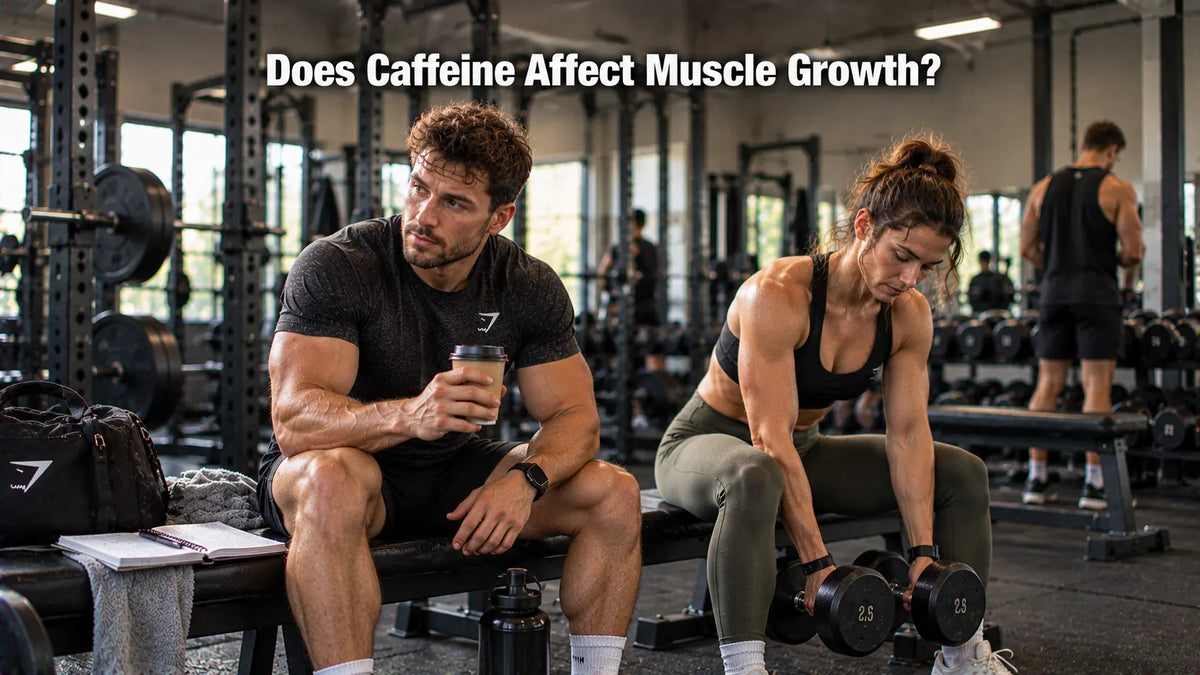
Walk into almost any gym before the evening rush and you'll see the ritual. Someone is finishing an espresso, another is shaking a brightly coloured pre-workout, and a third is explaining how they can't possibly train without caffeine.
There's a reason caffeine has become such a familiar part of fitness culture. It can increase alertness, reduce perceived effort and improve certain aspects of exercise performance. But if your goal is bigger muscles rather than simply feeling more energised, an important question remains: does caffeine affect muscle growth?
The answer is more complicated than supplement marketing sometimes suggests.
Caffeine may help you perform better during a workout, potentially allowing you to complete more repetitions or maintain training quality. Yet performing better in one session doesn't automatically translate into greater long-term muscle hypertrophy.
And there's another consideration. The same stimulant that helps you feel alert for a late workout may make it harder to sleep afterwards.
Here's what the evidence tells us about caffeine, strength training, muscle protein synthesis and recovery — and how to decide whether it deserves a place in your routine.
1. Does Caffeine Affect Muscle Growth?
Caffeine can influence factors involved in muscle growth, particularly training performance, but it has not been conclusively shown to directly increase long-term muscle hypertrophy.
Muscle growth occurs through repeated training and adaptation. Resistance exercise creates a stimulus, while sufficient protein, energy, recovery and time support the body's response.
Caffeine can change how a workout feels. Research suggests it may improve muscular endurance, movement velocity and, in some circumstances, strength.
That could help someone maintain training quality or complete slightly more work.
However, a better workout is not the same thing as a proven increase in muscle size.
Most caffeine research examines immediate performance rather than months of muscle growth measured under controlled conditions.
There is also no convincing evidence that ordinary caffeine consumption automatically prevents muscle growth.
For many gym-goers, the most relevant question is whether caffeine helps them train consistently without interfering with sleep, appetite or recovery.
Someone who trains well after a morning coffee may benefit from the stimulant effect. Someone who needs several energy drinks to get through an evening session may be making a less helpful trade-off.
Caffeine is an optional performance aid, not an essential muscle-building nutrient.

2. How Does Caffeine Work in the Body During Exercise?
Caffeine primarily acts on the central nervous system.
One of its best-known mechanisms involves adenosine, a chemical messenger associated with sleep pressure and tiredness.
As the day progresses, adenosine signalling contributes to the feeling that you need rest. Caffeine blocks certain adenosine receptors, making you feel more alert.
It doesn't replace sleep or eliminate the body's need for recovery. It temporarily changes how tiredness is perceived.
During exercise, caffeine may also influence attention, motivation and perceived exertion — the subjective sense of how hard an activity feels.
These effects help explain why the same training session can sometimes feel more manageable after caffeine.
Researchers have also investigated caffeine's effects on neuromuscular function, although the exact contribution of different mechanisms varies with exercise type and dose.
How Caffeine Can Affect a Workout
Absorbed and distributed through the body.
Caffeine blocks certain receptors associated with tiredness.
Greater alertness and, sometimes, improved exercise output.
Simplified mechanism. Individual responses and performance outcomes vary.
Caffeine's effects also depend on individual sensitivity, habitual intake, genetics and timing.
Two people consuming the same amount may experience very different results. One feels focused; the other feels anxious, shaky or uncomfortable.
More stimulation is not necessarily better performance.
3. Can Caffeine Help You Train Harder and Lift More Weight?
Potentially, yes.
Scientific reviews have found that caffeine can improve some measures of muscular strength, muscular endurance and exercise performance, although the benefits are generally modest and not universal.
For resistance training, that might mean completing an additional repetition, maintaining bar speed or finding a demanding set slightly more manageable.
Over time, consistently productive training can support progressive overload — gradually increasing the challenge placed on muscles.
But it would be misleading to assume that one extra repetition after caffeine guarantees additional muscle growth.
The training programme, effort, recovery and total workload still matter.
For people who choose to use a caffeinated pre-workout, ABE All Black Everything Ultimate Pre-Workout provides a relevant example. Its published formula contains 200mg of caffeine per full serving, alongside other ingredients such as creatine monohydrate and beta-alanine.
That 200mg is an important number to consider alongside body weight, caffeine tolerance and any coffee or energy drinks consumed earlier in the day.
Because this is a multi-ingredient product, its overall effects shouldn't automatically be attributed to caffeine alone.
Training harder also requires judgement. Feeling less fatigued doesn't mean you should ignore technique, pain or the need for adequate rest.
The best use of caffeine is to support sensible training, not to override your body's warning signs.
4. Does Caffeine Directly Increase Muscle Protein Synthesis?
Muscle protein synthesis is the process through which the body builds new muscle proteins.
Resistance training stimulates muscle protein synthesis, while dietary protein provides amino acids that support the process.
Because caffeine can improve some aspects of exercise performance, it's tempting to assume it must also increase muscle protein synthesis.
But these are different outcomes.
There is insufficient convincing human evidence that ordinary caffeine supplementation directly increases muscle protein synthesis in a way that produces greater long-term muscle growth.
Some experimental research has investigated cellular signalling pathways and the effects of caffeine under specific conditions. These findings shouldn't be treated as proof that drinking coffee after a workout builds more muscle.
For practical hypertrophy training, the fundamentals remain far more established:
- Progressive resistance training: Provide a meaningful stimulus and increase demands appropriately.
- Adequate dietary protein: Supply amino acids needed for muscle maintenance and growth.
- Sufficient energy: Avoid persistently under-fuelling demanding training.
- Recovery: Allow time for adaptation between sessions.
- Consistency: Repeat productive training over weeks and months.
Caffeine might help with the first item in some circumstances. It doesn't replace the others.
This distinction matters because muscle-building supplements are often judged by how noticeable they feel.
A stimulant produces an immediate sensation. Muscle hypertrophy, by contrast, is a gradual adaptation that cannot be assessed by how energised you feel during a session.

5. Can Too Much Caffeine Interfere With Muscle Recovery?
Excessive caffeine may interfere with recovery indirectly, particularly when it causes poor sleep, anxiety or difficulty winding down.
That doesn't mean every caffeinated drink damages muscle repair.
The concern is more practical: if caffeine keeps you awake, reduces sleep quality or makes you feel overstimulated, it can undermine conditions that support consistent training.
Large doses can also cause palpitations, nervousness, gastrointestinal discomfort and other unwanted effects.
One mistake is forgetting how quickly caffeine can accumulate.
For example, Applied Nutrition Body Fuel Energy Shot contains 200mg of caffeine per 60ml shot, according to its published label.


Combining one such shot with a 200mg caffeinated pre-workout would already total 400mg, before counting any coffee, tea or other sources.
That is the European Food Safety Authority's general daily level considered not to raise safety concerns for most healthy adults, rather than a target to aim for.
EFSA also identifies 200mg as a single-dose level generally not raising safety concerns for healthy adults, with important individual exceptions.
CAFFEINE STACKING: A PRACTICAL EXAMPLE
200mg pre-workout + 200mg energy shot = 400mg caffeine.
This example is arithmetic, not a recommended combination. Check all caffeine sources and follow product instructions.
High caffeine intake may also mask tiredness without correcting its cause.
If you're repeatedly exhausted before training, the answer may be to review sleep, workload, nutrition or training volume rather than increase your stimulant dose.
Recovery is not improved simply because caffeine makes you feel less tired.
6. Does Caffeine Affect Sleep and Overnight Muscle Repair?
Sleep is one of the strongest reasons to think carefully about caffeine timing.
Caffeine's half-life is commonly around four to six hours, although metabolism varies considerably between individuals.
A half-life describes how long it takes the body to eliminate approximately half of the caffeine present.
For illustration, if someone consumes 200mg of caffeine and has a five-hour half-life, approximately 100mg could remain after five hours and 50mg after ten hours.
These are simplified calculations, not exact predictions for every person.
Sleep supports many processes involved in recovery, including normal hormonal regulation, tissue maintenance and readiness for subsequent training.
Research shows caffeine can affect sleep duration and quality, particularly when consumed close to bedtime.
For people training in the evening, avoiding caffeine may therefore be more valuable than the short-term performance benefit it might provide.
One option is a genuinely caffeine-free pre-workout.
ABE All Black Everything PUMP Pre-Workout is listed as a stimulant-free formula without caffeine. It includes ingredients such as citrulline malate, creatine and beta-alanine, making it an example of a pre-workout that doesn't depend on caffeine for its formulation.


Being caffeine-free doesn't guarantee better sleep, nor does it prove that a product improves muscle growth. It simply removes caffeine from that particular decision.
If you train late, consider experimenting with a caffeine cut-off at least six to eight hours before bed, or earlier if you're sensitive.
A slightly less stimulating workout followed by a good night's sleep may be a better long-term trade-off than an energised session followed by hours of wakefulness.

7. Is Coffee Different From Pre-Workout Supplements for Muscle Growth?
Yes in formulation and convenience, but not necessarily in the fundamental action of caffeine.
Caffeine from coffee and caffeine from a pre-workout both interact with the body's adenosine receptors.
However, coffee contains numerous naturally occurring compounds, and its caffeine content varies with bean type, brewing method and serving size.
Pre-workout supplements often provide a more clearly labelled caffeine quantity per serving, alongside ingredients intended for different training purposes.
Ready-to-drink energy products are another option.
For example, Applied Nutrition ABE Carbonated Cans are listed in Uncle Gym's pre-workout collection, offering a convenient ready-to-drink format rather than coffee or a powder that needs mixing.


The exact caffeine content should be checked on the selected can before consumption; it shouldn't be assumed from the brand or product category.
| Option | Main consideration | Muscle-growth evidence |
|---|---|---|
| Coffee | Caffeine varies with preparation and portion | May aid performance; no guaranteed hypertrophy benefit |
| Caffeinated pre-workout | Check caffeine and other active ingredients | Potential short-term performance benefit |
| Energy drink | Check caffeine, sugar and serving size | No special muscle-growth advantage established |
| Stimulant-free option | Avoids caffeine; other ingredients vary | Muscle growth remains possible without stimulants |
Ultimately, neither coffee nor pre-workout is a prerequisite for hypertrophy.
The most useful choice is the one that suits your tolerance, training schedule and sleep — not whichever product produces the strongest sensation.
8. Can You Build Muscle Without Using Caffeine?
Absolutely.
Caffeine is not required for muscle protein synthesis, progressive overload or long-term muscle growth.
People can build substantial strength and muscle through consistent resistance training, adequate nutrition and recovery without using stimulants.
If you enjoy caffeine and tolerate it well, there's no need to assume it must be avoided.
But if caffeine makes you anxious, affects your sleep or leaves you feeling dependent on a pre-workout ritual, training without it is entirely reasonable.
Stimulant-free products exist for people who enjoy the convenience of a pre-workout routine without caffeine.
One example is InnovaPharm NovaPump Neuro, which Uncle Gym lists as a stimulant-free pre-workout. Its published formula includes citrulline malate, glycerol and several focus-oriented ingredients.


That doesn't establish that the product builds muscle, and anyone taking medication or managing a medical condition should check the full ingredient list before use.
More importantly, no pre-workout supplement is necessary for effective resistance training.
A useful caffeine-free approach includes arriving properly fed, following a structured programme, warming up appropriately and allowing sufficient rest between demanding sets.
Music, a familiar routine and a clear training plan may also help you approach a session with focus.
Consistency, training quality and recovery matter far more to hypertrophy than whether your shaker contains caffeine.
9. How Much Caffeine Is Appropriate Before Strength Training?
Research frequently studies caffeine doses of approximately 3–6mg per kilogram of body weight for exercise performance.
However, this is a research-based performance range, not a universal recommendation or a target everyone should pursue.
Some people may experience benefits at lower amounts, while others experience side effects before reaching those doses.
For a 70kg adult, 3mg/kg equals 210mg. At 6mg/kg, the amount would be 420mg — already above EFSA's general 200mg single-dose level considered not to raise safety concerns for healthy adults.
That illustrates why performance research doses should not be confused with routine safety guidance.
| Body weight | 2mg/kg | 3mg/kg | 6mg/kg |
|---|---|---|---|
| 60kg | 120mg | 180mg | 360mg |
| 70kg | 140mg | 210mg | 420mg |
| 80kg | 160mg | 240mg | 480mg |
| 90kg | 180mg | 270mg | 540mg |
Important: These are mathematical examples of doses studied in exercise research, not recommended intakes. Higher figures can exceed general safety guidance and increase adverse effects.
EFSA considers single doses up to 200mg and total daily intake up to 400mg generally not to raise safety concerns for most healthy adults. These limits are not appropriate for everyone.
Pregnant people are advised to limit caffeine to 200mg per day. People with cardiovascular conditions, anxiety, certain medication interactions or particular sensitivities may need lower amounts or to avoid it.
For timing, caffeine is often studied approximately 30–60 minutes before exercise, but absorption and individual responses vary.
Start by considering whether you need caffeine at all. If you choose to use it, avoid stacking products and follow the manufacturer's instructions.
The lowest amount that provides a useful effect without unwanted symptoms is generally a more sensible aim than the highest dose you can tolerate.

10. Should You Reduce Caffeine Intake When Trying to Build Muscle?
Not necessarily. But reducing caffeine may be worthwhile if it's interfering with your sleep, causing unpleasant symptoms or encouraging you to train through persistent exhaustion.
Muscle growth is a long-term process. The ability to recover and repeat productive sessions matters more than feeling exceptionally stimulated during one workout.
Someone who drinks a morning coffee, sleeps well and trains consistently may have no compelling reason to reduce caffeine solely for hypertrophy.
Someone who takes a large pre-workout at 7pm and struggles to sleep until midnight has a stronger reason to reconsider their routine.
There are several practical approaches:
- Move caffeine earlier: Reduce the likelihood that it interferes with bedtime.
- Lower the dose: More caffeine doesn't guarantee better performance.
- Count every source: Include coffee, tea, energy drinks and supplements.
- Try caffeine-free sessions: Find out whether your training genuinely depends on stimulation.
- Reduce gradually if necessary: Sudden withdrawal can cause headaches, tiredness and irritability in habitual users.
You don't need to stop caffeine on rest days for muscle growth, although reducing unnecessary intake may help manage tolerance and sleep.
Equally, there is no requirement to consume caffeine every training day.
If your performance has stalled, investigate training structure, energy intake, protein, sleep and recovery before assuming you need a stronger stimulant.
For muscle growth, caffeine should remain an optional addition to a good routine — never the foundation of it.
Conclusion
So, does caffeine affect muscle growth?
It can influence training performance, and that may be useful for people who respond well to it. Research supports modest improvements in certain measures of strength, endurance and exercise output.
But caffeine has not been conclusively shown to directly increase muscle protein synthesis or guarantee greater long-term hypertrophy.
The biggest practical concern is often sleep. If caffeine helps you squeeze out another repetition but regularly leaves you awake at night, its short-term benefits may not justify the trade-off.
Whether you prefer coffee, a caffeinated pre-workout or no stimulant at all, the fundamentals remain unchanged: train progressively, eat enough protein, recover properly and stay consistent.
Caffeine may help you get more out of a workout. It isn't what makes muscles grow.
Frequently Asked Questions
1. Does caffeine help build muscle?
Caffeine may improve certain aspects of training performance, but it hasn't been conclusively shown to directly increase long-term muscle growth.
2. Can caffeine stop muscle growth?
Normal caffeine use isn't known to automatically stop muscle growth. Excessive intake may indirectly undermine progress if it regularly disrupts sleep or recovery.
3. Does coffee affect muscle gains?
Coffee provides caffeine that may improve alertness and exercise performance. Its impact on muscle gains depends more on overall training, nutrition and recovery than on coffee itself.
4. Does caffeine increase muscle protein synthesis?
There isn't sufficient convincing human evidence that caffeine directly increases muscle protein synthesis in a way that produces greater hypertrophy.
5. Can caffeine help you lift heavier weights?
Some research shows modest improvements in strength and muscular endurance, although responses vary between people and exercises.
6. Does caffeine interfere with muscle recovery?
It may interfere indirectly when it causes sleep disruption, anxiety or other adverse effects. This doesn't mean every caffeinated drink damages recovery.
7. Can you build muscle without pre-workout?
Yes. Resistance training, adequate protein, sufficient energy and recovery are the foundations of muscle growth. Pre-workout supplements are optional.
8. How much caffeine should you take before the gym?
There is no universal requirement. Research commonly examines 3–6mg/kg for performance, but this can exceed general safety guidance. Lower amounts may be sufficient, and some people should avoid caffeine.
9. When should you stop drinking caffeine before bed?
Avoiding caffeine for at least six to eight hours before bedtime is a reasonable starting point, although sensitive individuals may need a longer gap.
10. Should bodybuilders avoid caffeine on rest days?
Not necessarily. Rest-day caffeine isn't inherently incompatible with muscle growth, but avoiding unnecessary stimulation may be useful if sleep or tolerance is becoming a problem.


