


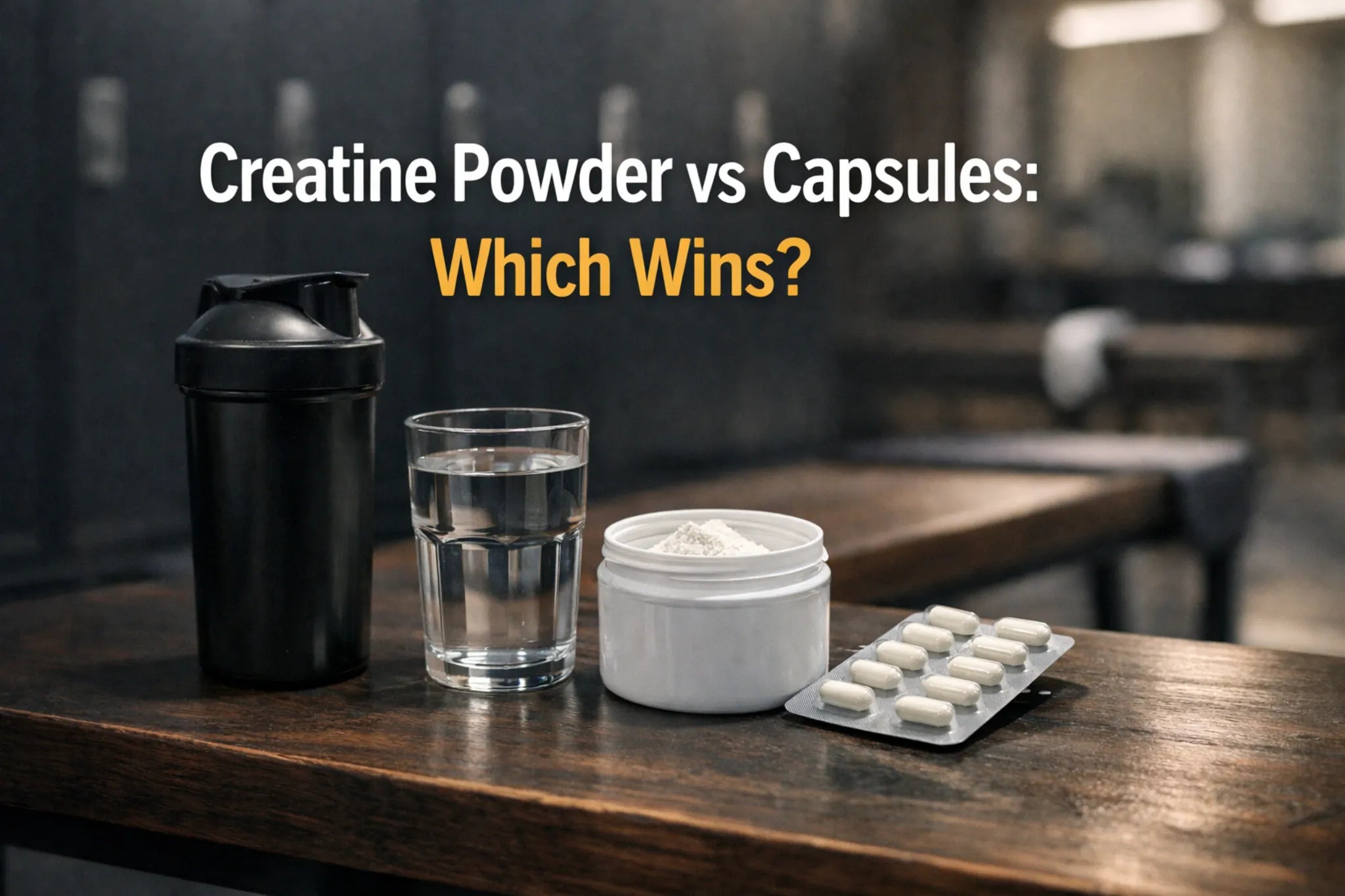
Creatine is one of the most proven performance supplements ever studied. It improves strength, enhances power output, supports muscle growth, and helps you sustain high training intensity. Yet despite its simplicity, one question continues to divide gym-goers:
Should you take creatine as a powder or capsules?
Walk into any supplement store and you’ll see tubs of powder sitting beside neatly packaged capsules, each promising the same results. Both usually contain creatine monohydrate — the most researched and effective form available — but the way you take it can influence consistency, cost, hydration habits, and long-term usability.
And those factors matter more than most people realise.
Creatine works through muscle saturation. Taken daily, it increases phosphocreatine stores in muscle cells, allowing you to produce more energy during high-intensity exercise. Miss doses or underdose, and you limit its benefits.
That’s why choosing the right format isn’t about which one works.
It’s about which one you’ll actually take every day.
1. Is Creatine Better in Powder or Capsule Form?
From a physiological standpoint, both forms deliver the same active compound. Once ingested, creatine increases phosphocreatine availability, helping regenerate ATP — the energy source used for explosive movement.
That means both forms can:
-
increase strength output
-
improve power and explosiveness
-
support muscle growth
-
enhance performance across repeated sets
So effectiveness isn’t the deciding factor.
Consistency is.
A powder such as Naughty Boy Prime Creatine allows you to take the full clinical dose in one scoop and easily integrate it into a shake or hydration drink.
Capsule formats — like Applied Nutrition Creatine 3000 120 Caps — offer convenience and pre-measured dosing, making supplementation simple and portable.
The better option is the one that fits your routine and removes friction from daily use.

2. Do Creatine Capsules Work as Well as Powder?
Yes — creatine capsules work just as well when taken at the correct daily intake.
Creatine’s benefits come from muscle saturation. Once muscles are saturated, users typically notice:
-
improved strength and lifting capacity
-
enhanced training endurance
-
better recovery between sets
-
improved muscle fullness and performance
Capsules contain the same creatine monohydrate found in powder.
The difference lies in dosage delivery.
Capsule products like Applied Nutrition Creatine 3000 120 Caps provide measured servings, making intake simple. However, reaching an optimal daily intake may require multiple capsules.
Powder simplifies this by delivering the full dose at once and can be mixed into a hydration routine — especially useful when combined with an electrolyte drink like Per4m Hydrate to support fluid balance and muscle function during training.
3. Is Creatine Less Effective in Pill Form?
Creatine is not less effective in pill form.
However, results may differ if users unintentionally underdose. Skipping capsules because taking several feels inconvenient can prevent muscles from reaching full saturation.
Hydration also plays an important role. Creatine draws water into muscle cells to support energy production and strength output. Without adequate hydration, some users may experience mild discomfort or reduced performance benefits.
Maintaining proper fluid intake supports muscle function and helps optimise creatine uptake and performance output.
When dosing and hydration are correct, capsules perform just as effectively as powder.

4. Which Form of Creatine Absorbs Faster?
A common myth suggests that powder absorbs faster than capsules.
In reality, absorption speed is nearly identical.
Capsules dissolve in the stomach before absorption. Powder dissolves in liquid before ingestion. In both cases, creatine enters the bloodstream and is transported into muscle cells.
Absorption efficiency depends more on:
-
daily consistency
-
muscle demand from training
-
hydration status
-
carbohydrate intake
-
overall muscle creatine depletion
Focusing on consistent intake and hydration will have a far greater impact than worrying about absorption speed.

5. Is Powdered Creatine More Cost-Effective Than Capsules?
This is where powder has a clear advantage.
Creatine powder is typically more cost-efficient per serving due to simpler manufacturing and packaging processes.
Capsules require additional materials, encapsulation, and packaging, which increase production costs.
For long-term supplementation — where creatine delivers the greatest performance benefits — powder often provides better value.
This is one reason performance-focused lifters gravitate toward powder formats: they combine effectiveness, flexibility, and affordability.
Intermission
So far, we’ve established that both creatine powder and capsules deliver the same proven performance benefits when taken consistently. Capsule formats like Applied Nutrition Creatine 3000 offer portability and convenience, while powder options provide flexibility and better long-term value. Hydration and daily consistency play a bigger role in results than the form itself.
In Part 2, we’ll explore real-world decision factors: convenience vs lifestyle, digestive comfort, dosing accuracy, who each form suits best, and the smartest way to take creatine for maximum results.
PART 2 — Creatine Powder vs Capsules: Which Wins?
In Part 1 we established that creatine powder and capsules deliver the same proven performance benefits when taken consistently. The real differences come down to usability, cost efficiency, hydration habits, and how easily the format fits into your daily routine.
Now we move from theory to real-world decision factors — the practical considerations that determine which form actually delivers results.
6. Are Creatine Capsules More Convenient for Daily Use?
Convenience is where capsules shine.
A capsule option such as Applied Nutrition Creatine 3000 120 Caps removes friction from supplementation:
-
no mixing required
-
no shaker bottle needed
-
easy to carry to work or the gym
-
ideal for travel
-
discreet and quick to take
For busy lifestyles, this simplicity often improves consistency — and consistency is what drives results.
However, reaching an effective intake may require several capsules daily. Some users prefer this simplicity, while others find a single scoop easier.
Powder options like Naughty Boy Prime Creatine integrate easily into a hydration routine. Mixing creatine with an electrolyte drink such as Per4m Hydrate supports fluid balance and muscle function while making supplementation part of your pre-workout routine.
The most convenient form is the one that fits seamlessly into your day.

7. Does Creatine Powder Cause More Stomach Discomfort?
Digestive discomfort is rarely about form — it’s about hydration and dosage.
Discomfort can occur when:
-
large doses are taken at once
-
insufficient water is consumed
-
powder isn’t fully dissolved
-
loading phases are too aggressive
Capsules may feel gentler because they dissolve gradually, but dehydration can cause discomfort with either format.
Because creatine increases intracellular water uptake, maintaining proper hydration is essential. Electrolytes support fluid balance and muscle contraction efficiency, helping prevent cramps and early fatigue.
Splitting doses and staying hydrated usually eliminates digestive issues regardless of format.
8. How Do Dosing Accuracy and Flexibility Compare?
This is where powder offers a clear advantage.
Powder
✔ precise dosing
✔ easy adjustment (3g vs 5g)
✔ suitable for loading phases
✔ adaptable to bodyweight and training intensity
Capsules
✔ pre-measured servings
✔ simple daily use
✔ no measuring required
Capsules provide simplicity, but powder provides flexibility.
Athletes who want to fine-tune intake often prefer powder, while those prioritising convenience may prefer capsules.
9. Who Should Choose Creatine Capsules Over Powder?
Capsules aren’t inferior — they simply suit different lifestyles.
Capsules may be ideal if you:
-
travel frequently
-
dislike mixing supplements
-
want maximum convenience
-
need a portable option
-
prefer simple dosing
-
struggle to stay consistent with powders
A product like Applied Nutrition Creatine 3000 120 Caps fits easily into busy schedules and eliminates preparation time.
Powder may be better if you:
-
want best value long term
-
prefer fewer pills daily
-
mix supplements into drinks
-
want dosing flexibility
-
prioritise performance efficiency
For performance-focused training and long-term strength progression, powders such as Naughty Boy Prime Creatine offer flexibility, simplicity, and cost efficiency.

10. What Is the Best Way to Take Creatine for Results?
Creatine works through muscle saturation, not immediate stimulation. You won’t feel it instantly like caffeine. Instead, performance improvements build gradually as muscle stores increase.
To maximise results:
✔ take 3–5g daily
✔ stay consistent
✔ train with resistance
✔ maintain hydration
✔ prioritise recovery
Hydration is critical. Creatine increases water uptake inside muscle cells, supporting strength and endurance. Maintaining fluid and electrolyte balance supports muscle contraction and reduces fatigue during longer sessions.
Recovery also influences performance. As training intensity increases, managing inflammation and joint stress helps maintain consistency. Omega-3 intake, such as Per4m Omega 3, supports recovery and joint comfort during demanding training phases.
Stress management is equally important. Chronic stress elevates cortisol, which can impair recovery and performance. Adaptogenic support such as Applied Nutrition Ashwagandha can support resilience and training sustainability.
Conclusion — Powder vs Capsules: Which Wins?
There is no universal winner — only the right choice for your routine.
Creatine powder wins for:
✔ cost efficiency
✔ dosing flexibility
✔ long-term value
✔ performance-focused training
Creatine capsules win for:
✔ convenience
✔ portability
✔ simplicity
✔ busy lifestyles
Both forms deliver the same proven benefits when taken consistently.
If convenience helps you stay consistent, capsules like Applied Nutrition Creatine 3000 120 Caps are an excellent choice. If you prioritise value, flexibility, and performance efficiency, a powder such as Naughty Boy Prime Creatine is the practical option.
The real winner isn’t the format.
The real winner is daily consistency, proper hydration, and consistent training.
FAQ
Do creatine capsules work as well as powder?
Yes. Both forms provide the same benefits when taken at the correct daily dose.
Is creatine powder cheaper than capsules?
Typically yes. Powder is more cost-efficient due to lower manufacturing costs.
Does creatine powder absorb better?
No. Absorption rates are similar once ingested.
Are creatine capsules easier to take?
Yes. Capsules are more convenient and portable.
How much creatine should I take daily?
3–5 grams per day is effective for most people.
Does hydration matter when taking creatine?
Yes. Proper hydration supports muscle function and performance.
Can creatine cause stomach discomfort?
Discomfort is usually linked to hydration and dosage rather than format.
Should I load creatine?
Loading is optional. Daily use will saturate muscle stores over time.
Do I need to cycle creatine?
No. Creatine can be taken continuously.
How long before I see results?
Most users notice improvements within 2–4 weeks.


