


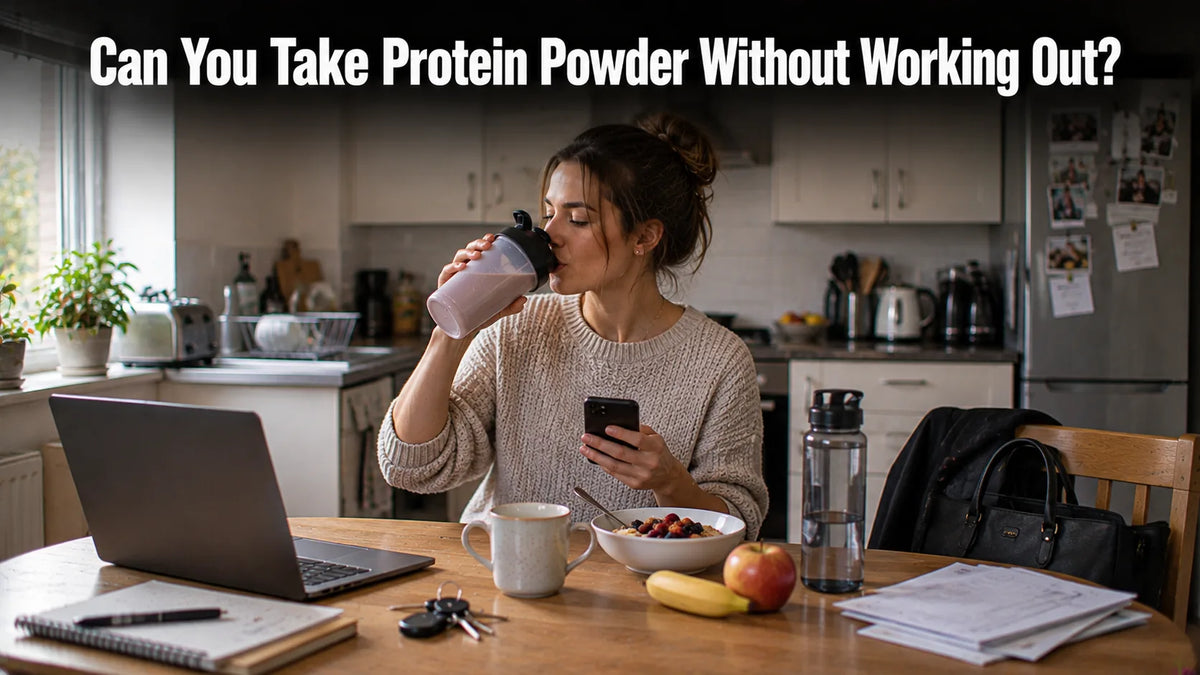
Protein powder has become so closely associated with gyms that it's easy to assume the two have to come as a package.
Lift weights. Drink shake. Repeat.
But protein isn't a gym-exclusive nutrient.
Your body needs dietary protein whether you're training six days a week, exercising occasionally or not currently working out at all. Protein contributes amino acids that the body uses for a huge range of normal functions, including maintaining and repairing body tissues.
So, can you take protein powder without working out?
Yes.
Protein powder is essentially a convenient way of adding protein to your diet. Your body doesn't suddenly become incapable of digesting whey or plant protein because you haven't visited the gym that day.
What changes is why you might need it.
Someone resistance training regularly may deliberately consume more protein to support adaptation and muscle growth. Someone who doesn't exercise may have lower protein requirements but could still find a shake useful if their normal diet isn't providing enough.
There's also the question of calories.
Protein shakes don't automatically make you gain weight when you stop exercising—but adding calories you don't need can.
And no, simply drinking more protein won't reproduce the muscle-building effects of resistance training.
Let's separate what protein powder actually does from what the gym culture surrounding it sometimes makes people think it does.
1. Can You Take Protein Powder Without Working Out?
Yes. You don't have to work out to take protein powder.
The simplest way to understand this is to stop thinking of protein powder as a bodybuilding substance and start thinking of it as a concentrated dietary protein source.
A whey product such as Per4m Whey Hydrate still provides protein whether you drink it after lifting weights, with breakfast on a rest day or during a period when you aren't training at all.


Exercise isn't required to "activate" the protein.
Your digestive system breaks dietary proteins down into amino acids and smaller peptides, which can then enter the body's amino-acid pool and be used for normal physiological processes.
Resistance training changes the context.
When you lift weights, you provide a stimulus that encourages muscular adaptation. Consuming sufficient dietary protein helps provide the amino acids required to support that process.
Without that training stimulus, drinking the same shake doesn't suddenly instruct your muscles to grow.
But that doesn't make the protein useless.
You still require dietary protein for normal health and tissue maintenance.
So the question isn't really:
"Am I allowed protein powder if I don't exercise?"
It's:
"Do I have a useful reason to add more protein to my diet?"
If the answer is yes, protein powder can be one convenient way of doing it.

2. What Happens If You Drink Protein Shakes Without Exercising?
Usually, nothing particularly dramatic.
Your body doesn't detect that you've missed the gym and suddenly treat a protein shake as something completely different.
You digest it.
The amino acids become available to the body.
And they're used according to your body's requirements.
What protein doesn't do is automatically travel directly to your biceps.
The body uses amino acids for numerous purposes, including the continual turnover of proteins throughout tissues.
If you consume more dietary protein than is required for building and maintaining body proteins, the excess isn't simply stored as a dedicated reserve of "spare protein" waiting for your next workout.
Amino acids can be metabolised, with their nitrogen-containing components processed for excretion, while their remaining carbon structures can enter various metabolic pathways and contribute to energy metabolism.
That doesn't mean:
"Extra protein immediately turns into body fat."
That's another oversimplification.
Changes in body weight and body-fat stores need to be understood within the context of overall energy balance.
If adding protein shakes causes your total calorie intake to consistently exceed the amount of energy you expend, weight gain can occur over time.
If the shake simply fits within the energy you already require, drinking it without exercising doesn't automatically make you gain weight.
The protein shake isn't waiting to punish you for skipping the gym. Your total diet still matters.
3. Do You Need to Work Out for Protein Powder to Be Useful?
No.
Exercise is one reason somebody might deliberately increase their protein intake.
It isn't the only reason protein exists in the human diet.
Even people who never enter a gym still need protein.
The body continually turns over proteins, meaning existing proteins are broken down while new ones are synthesised. Dietary protein supplies essential amino acids that the body cannot manufacture in sufficient quantities itself.
So protein powder can be useful without training when it solves a genuine dietary problem.
Perhaps someone:
- struggles to include protein-rich foods at breakfast
- has a limited appetite
- needs a convenient snack while working
- follows a diet that makes reaching their protein requirement more difficult
- regularly skips meals because of their schedule
In those circumstances, protein powder can simply make adequate protein intake easier.
But there's an equally important flip side.
Needing protein doesn't automatically mean needing protein powder.
If you're already eating enough protein from your normal meals, adding a shake may provide little practical benefit.
Chicken, fish, eggs, dairy foods, meat, soya foods, beans, lentils and numerous other foods can all contribute towards protein intake.
Protein powder is useful primarily because it's convenient.
You don't earn access to that convenience by working out.
4. Can Protein Powder Make You Gain Weight If You Don’t Exercise?
It can contribute to weight gain—but not simply because you didn't exercise after drinking it.
Body weight is strongly influenced by energy balance over time.
If you consistently consume more energy than you expend, your body weight tends to increase.
A protein shake contains calories.
So do carbohydrates.
So do fats.
And the amount of energy in something described as a "protein shake" can vary enormously.
This is where a product such as Applied Nutrition Critical Mass is an important example because a more calorie-dense shake designed to provide substantial additional nutrition is fundamentally different from a basic serving of protein powder mixed with water.


That distinction becomes particularly relevant if you aren't very active.
If you're maintaining your weight on your existing diet and then add significant additional calories every day without increasing energy expenditure elsewhere, you've changed your energy balance.
Over time, that can contribute to weight gain.
But the same principle applies if those additional calories come from toast, cereal, takeaway food or anything else.
Protein powder isn't uniquely fattening.
And avoiding exercise doesn't somehow transform protein into fat.
This also explains why the question "Will protein shakes make me fat if I don't work out?" is framed incorrectly.
Ask instead:
"Does this shake push my overall calorie intake beyond what I need?"
That's much more useful.

5. Can You Build Muscle With Protein Powder Without Working Out?
Not to any meaningful extent simply by drinking protein shakes.
This is where the distinction between protein supply and training stimulus becomes crucial.
Dietary protein supplies amino acids.
Resistance training provides a powerful stimulus for your muscles to adapt.
If your goal is to build substantial amounts of muscle, you generally need both the nutritional building blocks and an appropriate training stimulus.
Imagine delivering a pile of bricks to a building site.
Having more bricks available doesn't automatically construct another floor.
Something still has to create the demand for construction.
That's broadly the mistake behind the idea that protein powder itself builds muscle.
It doesn't.
Protein intake supports the processes involved in muscle maintenance, repair and adaptation, but drinking progressively larger shakes while remaining sedentary isn't a substitute for progressive resistance training.
This is also why someone who begins lifting weights may benefit from examining their protein intake without assuming that protein was previously "doing nothing".
The context has changed.
Their muscles are now being challenged to adapt to repeated resistance exercise, and adequate dietary protein helps support that adaptation.
You also don't need protein powder specifically to build muscle.
It's the protein and amino acids it provides that are useful, and those can also come from normal foods.
Protein powder simply makes increasing intake convenient.
If your goal is muscle growth, don't expect the shake to provide the stimulus that training is supposed to provide.
Intermission
So far, the answer to "Can you take protein powder without working out?" is straightforward:
Yes.
You don't need to earn your protein shake by going to the gym.
Protein is an essential part of the human diet, and protein powder is simply one convenient way of obtaining it.
What changes without exercise is the reason you're using it.
If your diet already provides all the protein you need, adding shakes simply because you own a tub isn't particularly useful.
If protein powder helps fill a genuine gap, it can still serve a purpose.
The same logic applies to weight gain.
A shake doesn't automatically make you gain fat because you didn't work out that day. But additional shakes provide additional calories, and consistently consuming more energy than you expend can lead to weight gain.
And when it comes to building muscle, there's an important limit to what nutrition can accomplish alone.
Protein provides building materials. Resistance training provides the muscle-building stimulus.
In Part 2, we'll look at using shakes to meet protein requirements without training, whether protein powder really is a "gym supplement", taking protein on rest days, food versus protein powder and the situations where using protein powder without exercising genuinely makes sense.
Part 2
6. Can Protein Shakes Help You Meet Your Protein Needs Without Training?
Yes.
You still need dietary protein even if you're not currently exercising.
Training can increase the importance of protein in particular contexts, especially when you're trying to support muscle growth and adaptation, but protein has functions throughout the body that have nothing to do with completing a gym session.
The real question is whether your normal diet already provides enough.
If it doesn't, a product such as Per4m Plant Protein can offer a convenient way to increase protein intake without requiring another cooked meal or relying exclusively on animal-derived protein sources.


That can be useful for someone who:
- regularly eats low-protein breakfasts
- struggles to organise protein-rich snacks
- follows a plant-based diet
- has a busy schedule
- simply finds a shake more convenient at certain points in the day
But don't work backwards.
Don't start with the assumption that you need a protein shake and then search for a reason to justify it.
Start with your diet.
Look at the protein you're already getting from meals and snacks, consider your individual requirements and then decide whether there's actually a gap worth filling.
Someone who doesn't exercise but already consumes adequate protein isn't automatically going to become healthier by continually adding more.
Protein powder can help you meet your protein needs without training. It doesn't mean everybody who doesn't train needs protein powder.

7. Is Protein Powder Only for People Who Go to the Gym?
No.
The enormous tubs, muscular athletes and post-workout marketing can certainly make it look that way.
But there's nothing about protein powder that restricts it to gym-goers.
A product such as Applied Nutrition Clear Whey is still fundamentally providing dietary protein, regardless of whether someone drinks it after lifting weights, during a busy afternoon or on a day containing no structured exercise whatsoever.


Protein powder is a food supplement.
The gym association largely comes from the fact that people who resistance train often pay closer attention to protein intake.
They may also have higher protein targets than less active individuals, making a convenient concentrated protein source particularly attractive.
But convenience isn't exclusive to athletes.
Someone who doesn't train might still struggle to eat enough protein because of their appetite, dietary choices or schedule.
Equally, somebody who trains intensely might never need protein powder because their normal food intake already covers their requirements.
This is why dividing people into:
"gym-goers who need protein powder"
and
"non-gym-goers who don't"
doesn't really work.
Exercise influences nutritional requirements.
It doesn't determine whether you're allowed to use a particular source of dietary protein.
8. Can You Drink Protein Shakes on Rest Days?
Yes.
And if you're following a resistance-training programme, rest days aren't days when your body suddenly stops needing protein.
Training and recovery happen across a continuing cycle.
The workout provides the stimulus, but the processes involved in adaptation don't end the moment you leave the gym.
That makes maintaining a reasonably consistent protein intake across both training and rest days a practical approach.
You don't necessarily need to copy your entire training-day diet exactly.
Your energy expenditure may be different on a rest day, depending on what you're doing.
But there's generally little reason to deliberately slash your protein intake simply because you aren't lifting weights that day.
This is particularly relevant if protein shakes are simply part of how you reach your normal protein target.
Imagine you regularly have:
Breakfast.
Lunch.
A protein shake.
Dinner.
If that pattern gives you an appropriate amount of protein, there's no automatic reason to remove the shake every Sunday because it's your rest day.
At the same time, you don't have to drink one.
If your rest-day meals already provide enough protein, the shake may be unnecessary.
The principle remains exactly the same:
Use protein powder according to what your diet needs, not according to whether today's calendar says "gym".
9. Should You Get Protein From Food Instead If You Don’t Work Out?
Whole foods should generally form the foundation of your diet whether you exercise or not.
But that doesn't mean protein powder becomes a bad choice.
The advantage of foods such as eggs, dairy, fish, meat, soya foods, beans, lentils, nuts and seeds is that they contribute more than protein alone.
Depending on the food, you may also get:
- vitamins
- minerals
- essential fats
- carbohydrates
- fibre
- other useful dietary components
Food also provides variety, texture and the satisfaction of eating actual meals.
Protein powder has a much narrower purpose.
Its greatest advantage is convenience.
If you can comfortably meet your protein needs through a varied diet, there's no requirement to add protein powder.
But there's equally little reason to create an artificial rule that says every gram of protein must come from whole foods.
A shake can sit alongside a balanced diet.
For example, someone might eat normal meals throughout the day but find that an afternoon shake is more practical than preparing another protein-rich snack at work.
That's supplementation doing exactly what it's supposed to do:
supplementing the diet rather than replacing it.
The distinction becomes particularly important if shakes begin displacing nutritious meals simply because they're easier.
Convenience is useful.
Dietary variety still matters.

10. When Does Protein Powder Make Sense If You’re Not Exercising?
Protein powder makes sense when it solves a genuine nutritional or practical problem.
Maybe your normal diet doesn't provide enough protein.
Maybe mornings are rushed and you struggle to eat a protein-rich breakfast.
Maybe your appetite makes larger meals difficult.
Maybe you need a convenient option at work.
Or perhaps you're temporarily not training but still enjoy using a shake as part of your normal diet.
Those can all be reasonable situations.
The type of shake matters, though.
A more substantial product such as USN Muscle Fuel Anabolic serves a different nutritional purpose from simply adding a modest amount of protein to an otherwise adequate diet. If somebody genuinely needs additional energy as well as protein, a more calorie-dense option may have a role. If a sedentary person already consumes sufficient calories and only wants a little extra protein, adding substantial additional energy may be completely unnecessary.


That's why choosing protein powder should start with the problem you're trying to solve.
Need more protein?
Choose an appropriate protein source.
Need more protein and significantly more energy?
That's a different nutritional situation.
Already getting enough of both?
You may not need another supplement at all.
This is far more useful than choosing a product according to whether the packaging looks suitable for someone who trains.
Protein powder isn't inherently a gym product.
It's a convenient nutritional tool.
And like any tool, it makes the most sense when there's actually a job for it to do.
Conclusion
So, can you take protein powder without working out?
Yes.
You don't need to exercise for your body to digest and use dietary protein, and you don't need a gym membership before you're allowed to drink a protein shake.
But that doesn't mean everybody needs one.
If your normal diet already provides enough protein, adding more powder may offer little practical benefit.
If you're struggling to meet your protein requirements, however, a shake can provide a convenient way to fill that gap regardless of whether you're currently training.
The same perspective helps clear up two of the biggest misconceptions surrounding protein powder without exercise.
First, drinking a shake doesn't automatically make you gain fat because you haven't worked out. Weight gain depends on your overall energy balance over time.
Second, protein powder won't build substantial muscle on its own. Dietary protein supplies amino acids, but resistance training provides the stimulus that drives meaningful muscular adaptation.
So don't judge protein powder according to whether you went to the gym today.
Judge it according to your diet.
If it fills a genuine nutritional gap, it can be useful. If it doesn't, you probably don't need it.
FAQ
1. Can you take protein powder without working out?
Yes. Protein powder is a source of dietary protein and can be consumed whether or not you exercise. The more important question is whether you actually need additional protein.
2. What happens if you drink protein shakes without working out?
Your body still digests the protein and uses the resulting amino acids for normal physiological processes. Not exercising doesn't automatically cause the shake to be stored as fat.
3. Will protein shakes make you gain weight if you don't exercise?
They can contribute to weight gain if they cause you to consistently consume more calories than you expend. Protein shakes don't automatically cause weight gain simply because you aren't exercising.
4. Can you build muscle with protein powder without working out?
Protein alone isn't a substitute for resistance training. Meaningful muscle growth generally requires an appropriate training stimulus alongside sufficient protein, energy and recovery.
5. Is protein powder useful if you don't exercise?
It can be if your normal diet doesn't provide enough protein or you need a particularly convenient protein source. If you're already meeting your requirements, additional powder may be unnecessary.
6. Is protein powder only for people who go to the gym?
No. Athletes and gym-goers commonly use it because of their nutritional and training goals, but protein powder itself isn't exclusively an exercise supplement.
7. Can you drink protein shakes on rest days?
Yes. Your body still requires protein on rest days, and people who resistance train don't need to deliberately reduce protein simply because they aren't training that day.
8. Do you need protein powder on rest days?
Not necessarily. If your normal meals provide sufficient protein, you don't need a shake. If a shake normally helps you reach an appropriate daily intake, it can remain part of your rest-day diet.
9. Should you get protein from food instead of powder?
Whole foods should generally provide the foundation of a varied diet because they can supply protein alongside many other nutrients. Protein powder can then provide additional convenience where needed.
10. Can you take whey protein without going to the gym?
Yes. Whey is simply a source of high-quality dietary protein. You don't have to exercise for your body to digest it, although drinking whey alone won't reproduce the muscle-building stimulus of resistance training.


