


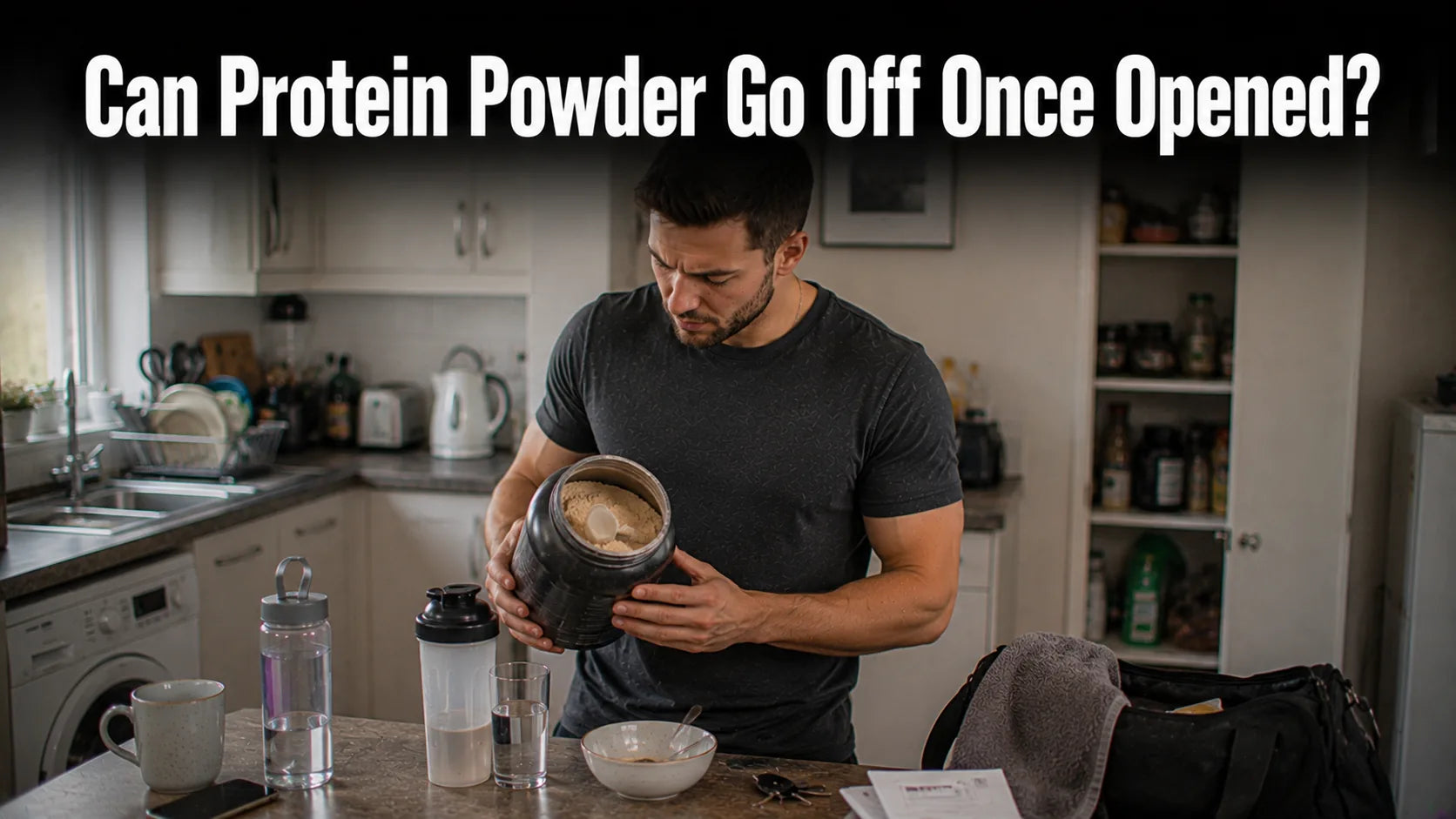
You open a tub of protein powder, use it religiously for a few weeks, then life gets in the way.
Months later, you find it at the back of the cupboard.
The lid has been on.
The powder looks reasonably normal.
But there's one obvious question:
Can protein powder go off once opened?
Yes, it can.
Protein powder is a dry product with a relatively long shelf life, but that doesn't make it indestructible. Once you've opened the container, how you handle and store the powder becomes increasingly important.
Heat, humidity, moisture, contamination and poor storage can all affect its quality—and potentially shorten the period for which it remains suitable to use.
That doesn't mean an opened tub automatically becomes unsafe after an arbitrary number of weeks.
Nor does finding a few small clumps necessarily mean you need to throw the entire thing away.
The sensible approach is to consider the date on the packaging, storage conditions and condition of the powder itself.
Here's what to look for.
1. Can Protein Powder Go Off Once Opened?
Yes.
Opening protein powder exposes it to the surrounding environment every time you remove the lid.
Air gets in.
Humidity can get in.
The scoop gets handled.
And if you're careless, moisture or other contaminants can enter the container too.
A whey-based powder such as Per4m Whey Hydrate, for example, is still a dry food product once you've opened it. Keeping the container properly closed and following its storage instructions helps protect the powder for the remainder of its intended shelf life.


That distinction is important.
Opening protein powder doesn't mean it suddenly has a fixed 30-day or 60-day lifespan.
You should look at the instructions and date printed on the particular product rather than applying an arbitrary internet rule to every protein powder.
Storage conditions matter as well.
A properly resealed tub kept somewhere cool and dry is very different from a tub that's been left open in a humid kitchen for months.
And because protein powders contain more than just protein—potentially including flavourings, fats, carbohydrates, sweeteners and other ingredients—different products won't necessarily deteriorate identically.
So yes, opened protein powder can go off.
But how it has been stored matters enormously.

2. How Long Does Protein Powder Last After Opening?
There isn't one reliable number that applies to every protein powder.
You might see claims online that opened protein powder lasts a particular number of months, but that's too simplistic.
Shelf life can depend on:
- the formulation
- packaging
- manufacturing process
- date on the product
- storage temperature
- humidity
- moisture exposure
- how frequently the container is opened
- whether the powder has been contaminated
Your first reference point should therefore be the packaging itself.
Check the date.
Check the storage instructions.
And check whether the manufacturer gives any additional instructions for the product after opening.
Don't automatically assume the date printed on the container guarantees that the powder will remain in perfect condition regardless of what happens to it.
If you've repeatedly put a wet scoop into the tub, left the lid open or stored it somewhere hot and humid, poor storage can potentially compromise the product before that date.
Likewise, opening a properly stored dry powder doesn't necessarily mean you need to discard it a few weeks later simply because the seal has been broken.
The date and the storage history need to be considered together.
3. Can You Use Protein Powder After the Expiry Date?
This needs a little terminology first.
People commonly call any date printed on food an expiry date, but in the UK there is an important distinction between best-before and use-by dates.
A use-by date relates to food safety. Food shouldn't be eaten after its use-by date, even if it looks or smells normal.
A best-before date is primarily about quality. Food can sometimes remain suitable after its best-before date, although its quality may no longer be at its best.
So before deciding what to do with an "expired" protein powder, check what the packaging actually says.
Don't treat those two date types as interchangeable.
You should also consider the powder itself and how it has been stored.
A product that's beyond its best-before date, has spent months exposed to unsuitable conditions and now smells or looks unusual presents a very different situation from an unopened or carefully stored dry product that's only just passed a best-before date.
And don't rely on smell alone as a universal safety test.
Food can sometimes be unsafe without producing an obvious bad smell, particularly where a use-by date is involved.
When in doubt, throwing away an old tub is a much smaller loss than taking an unnecessary food-safety gamble just to avoid wasting a serving of protein.
4. How Can You Tell If Protein Powder Has Gone Bad?
Start by comparing it with how the product normally looks, smells and behaves.
Protein powders vary considerably.
Chocolate whey isn't supposed to look like vanilla whey.
A plant protein can have a different texture from a whey isolate.
And different flavour systems can produce completely different smells.
So you're looking for an unexpected change in that particular product, rather than one universal appearance that means every protein powder has spoiled.
With something such as Applied Nutrition Clear Whey, for example, you'd judge suspicious changes relative to how that particular powder normally looks, smells, tastes and mixes—not against the appearance or consistency you expect from a conventional creamy whey shake.


Potential warning signs can include:
- an unusual or unpleasant smell
- unexpected colour changes
- visible mould or other obvious contamination
- substantial evidence that moisture has entered the powder
- unusual deterioration in texture
- a noticeably abnormal taste or appearance
If you see visible mould, don't scoop around it and continue using the rest.
Throw the product away.
Likewise, if water has clearly entered the tub and affected a substantial portion of the powder, it's not something worth experimenting with.
Be cautious with the "tiny taste test" approach too.
If there are already obvious signs that the product may have spoiled, tasting it isn't necessary to confirm your suspicion.
If it clearly looks or smells wrong, you don't need to prove it by drinking it.

5. Does Clumpy Protein Powder Mean It Has Gone Off?
Not necessarily.
This is one of the easiest signs to misinterpret.
Protein powder can develop small clumps after exposure to humidity because dry powders can absorb moisture from the surrounding air.
That doesn't mean every tiny lump proves the entire tub has spoiled.
Imagine you've opened the container repeatedly during humid weather.
The powder may no longer be as perfectly loose as it was when you first removed the seal.
A few easily broken clumps, with no other unusual changes, are not the same thing as discovering a damp mass of powder with an abnormal smell or visible growth.
What matters is why the clumping has occurred and what else you're seeing.
Ask yourself:
Has the powder actually become wet?
Was a damp scoop put into the tub?
Has it been stored somewhere humid?
Are the clumps dry and easily broken apart?
Does anything smell unusual?
Has the colour changed?
Is there visible contamination?
If you're seeing severe clumping alongside clear moisture exposure or other signs of deterioration, that's much more concerning than minor dry clumping alone.
This is also why prevention matters.
Don't leave the lid sitting open while you finish your workout.
Don't reach into the container with wet hands.
And definitely don't put a damp scoop back into dry powder.
Clumping is a clue—not an automatic diagnosis that your protein powder has gone off.
Intermission
Protein powder can go off once opened, but breaking the seal doesn't start one universal countdown that applies to every product.
The specific product, date on the packaging and storage conditions all matter.
A best-before date also isn't the same thing as a use-by date, so check which one you're actually dealing with before casually describing a powder as "expired."
When inspecting an older tub, look for meaningful changes.
An unusual smell, unexpected colour change, visible mould, obvious contamination or significant moisture exposure gives you much more reason for concern than a couple of small dry clumps.
And storage is already emerging as one of the biggest factors.
Protein powder is designed to remain dry.
Once moisture starts getting into the container, you've changed the conditions considerably.
In Part 2, we'll look at exactly why moisture matters, whether whey lasts longer than plant protein, whether old protein powder loses its effectiveness, the best way to store an opened tub and the point at which you should simply throw it away.
Part 2
6. Can Moisture Make Protein Powder Spoil Faster?
Yes.
Moisture is one of the main things you want to keep away from an opened tub of protein powder.
Protein powder is deliberately manufactured as a dry product. Low moisture helps make it relatively shelf-stable, but allowing water into the container changes those conditions.
That can happen more easily than you might think.
You finish making a shake, rinse the scoop and put it back while it's still slightly damp.
You open the tub beside a steaming kettle.
You leave the lid off in a humid kitchen.
Or you reach into the container with wet hands.
With a larger powdered product such as Applied Nutrition Critical Mass, which may naturally remain open and in use for some time, keeping the powder dry and properly resealing the container is particularly important.


Humidity can cause clumping without necessarily meaning the product has spoiled, as we covered earlier.
But actual water entering the powder is a different matter.
Moisture can create conditions more favourable to microbial growth and accelerate deterioration. The more significant the moisture exposure, the less sensible it becomes to simply break up the lumps and carry on.
Prevention is easy:
Use a completely dry scoop.
Close the lid properly after every use.
Keep the container away from steam and excessive humidity.
And don't add water directly to the tub.
Protein powder and water belong together in your shaker.
Not in the container.

7. Does Whey Protein Last Longer Than Plant Protein?
Not necessarily.
It would be convenient if we could say:
Whey lasts X months.
Plant protein lasts Y months.
But protein powder shelf life isn't determined by the protein source alone.
A product's overall formulation matters.
Whey and plant protein products can contain different amounts and types of:
- protein
- fat
- carbohydrate
- flavourings
- sweeteners
- thickeners
- emulsifiers
- added vitamins and minerals
- other ingredients
Packaging and manufacturing conditions matter too.
That makes a product such as Per4m Plant Protein useful for understanding the distinction. Being plant-based doesn't automatically mean you should assume it spoils faster—or lasts longer—than a whey protein sitting beside it.


Instead, compare the actual products.
Look at their dates.
Follow their respective storage instructions.
And consider how each has been stored since opening.
The same applies to vegan protein powders made from pea, rice, soy or blends of several plant proteins.
"Plant protein" is a category, not a universal shelf-life specification.
Likewise, whey concentrate, whey isolate and other dairy-based protein powders shouldn't automatically be assigned identical shelf lives just because they originate from milk.
For the consumer, the practical advice remains straightforward:
Trust the information for the specific product over a blanket whey-versus-plant rule.
8. Does Old Protein Powder Lose Its Effectiveness?
Protein powder doesn't reach its best-before date and suddenly stop containing protein at midnight.
That's not how food deterioration works.
If you're wondering whether expired protein powder "still works", however, the question needs to be broader than whether some protein remains inside it.
Protein powders are formulated food products.
Over sufficiently long periods—and particularly under unsuitable storage conditions—quality can deteriorate.
Flavour can change.
Texture can change.
Other ingredients within the formulation may deteriorate.
And the product may no longer perform exactly as intended.
Storage conditions are crucial here.
A powder kept properly sealed somewhere cool and dry has experienced very different conditions from one that's spent months exposed to heat, humidity and repeated moisture contamination.
So don't reduce the decision to:
"Does it still contain protein?"
The better question is:
"Is this product still appropriate to consume?"
If a protein powder is significantly beyond its stated date, you don't know how it has been stored, or there are signs of deterioration, trying to extract a few more shakes from the bottom of the tub isn't particularly worthwhile.
And if the packaging carries a use-by date, don't consume the product beyond it.
9. What Is the Best Way to Store Protein Powder?
Protein powder generally wants a fairly boring environment:
Cool. Dry. Properly sealed.
A kitchen cupboard can be suitable provided it stays dry and isn't exposed to excessive heat.
A dedicated food or supplement cupboard elsewhere in the house can work too.
With something such as USN Muscle Fuel Anabolic, the sensible approach is to keep the product in accordance with the storage directions on its packaging and properly reseal it after use.


There are several habits worth getting right.
Keep the lid securely closed.
Use a clean, completely dry scoop.
Avoid storing the container beside the cooker, kettle or another significant source of heat and steam.
Don't leave it sitting in direct sunlight.
And don't leave the tub open for long periods unnecessarily.
Should You Keep Protein Powder in the Fridge?
Usually, there's no reason to refrigerate a dry protein powder unless the manufacturer specifically instructs you to do so.
In fact, repeatedly moving a container between cold refrigeration and warmer, more humid air could introduce condensation concerns if moisture forms.
Again, follow the storage instructions for the actual product.
Should You Transfer Protein Powder Into Another Container?
Usually, keeping it in its original packaging is useful because you retain the product information, batch details, dates and storage instructions.
If the original packaging becomes damaged and you need another container, it should be clean, dry and properly sealed—but don't lose the important information from the original packaging.
And remember that a protein shake is different.
Once you've mixed powder with water or milk, you're no longer storing a dry shelf-stable powder. Treat the prepared drink appropriately rather than assuming the powder's shelf life applies to the finished shake.

10. When Should You Throw Protein Powder Away?
Sometimes the sensible answer is simply:
Bin it.
Protein powder isn't valuable enough to justify gambling with something that shows convincing signs of deterioration.
You should be particularly cautious if you find:
- visible mould
- obvious contamination
- significant moisture intrusion
- an abnormal or rancid smell
- unexpected discolouration
- substantial deterioration from the product's normal condition
- damaged packaging that may have compromised the contents
A product beyond a use-by date should not be consumed.
With a best-before date, the date primarily concerns quality rather than acting as the same kind of safety deadline—but that doesn't mean every tub remains good indefinitely afterwards.
Storage history still matters.
If you've discovered an old tub and can't remember whether it was opened six months ago or two years ago, it's been sitting somewhere hot and humid, the powder looks strange and you're debating whether the smell is "probably fine"...
A new tub is the easier answer.
Likewise, don't scrape visible mould away, remove the damp section or attempt to rescue powder that has clearly been contaminated.
There's an important difference between avoiding unnecessary food waste and ignoring obvious warning signs.
When you have good reason to believe the product has spoiled, throw it away.
Conclusion
So, can protein powder go off once opened?
Yes.
Protein powder generally has a relatively long shelf life because it's a dry product, but opening the container means storage and handling become increasingly important.
There's no universal rule saying every opened protein powder lasts exactly three months, six months or a year.
Instead, check:
The date on the packaging.
The manufacturer's storage instructions.
How the powder has been stored.
Whether moisture could have entered.
Whether its appearance, smell or texture has changed unexpectedly.
A few small dry clumps don't automatically mean your protein powder has gone bad.
But significant moisture exposure, visible mould, unusual smells, discolouration or other obvious deterioration shouldn't be ignored.
And don't automatically treat a best-before date as though it were a use-by date. They mean different things.
Whether you're using whey, clear whey, a mass-gain powder or plant protein, good storage follows much the same basic principle:
Keep it cool, keep it dry and keep it properly sealed.
If an old tub reaches the point where you're genuinely suspicious of what's inside it, don't force yourself to drink it just because there's one serving left.
Sometimes the cheapest scoop is the one you throw away.
FAQ
1. Can protein powder go off once opened?
Yes. Protein powder can deteriorate after opening, particularly if it's exposed to moisture, excessive heat, humidity or contamination. Follow the date and storage instructions provided for the specific product.
2. How long does protein powder last after opening?
There isn't one universal period that applies to every protein powder. Formulation, packaging, storage conditions and the manufacturer's instructions can all affect its shelf life.
3. Can you use protein powder after the expiry date?
First check whether the product carries a best-before or use-by date. A best-before date primarily relates to quality, whereas food shouldn't be consumed after a use-by date.
4. How do you know if protein powder has gone bad?
Warning signs can include visible mould, unusual smells, unexpected discolouration, significant moisture contamination or obvious deterioration compared with the powder's normal condition.
5. Is clumpy protein powder safe to use?
Minor dry clumping doesn't automatically mean protein powder has spoiled and can occur through exposure to humidity. Severe clumping accompanied by moisture, unusual smells, colour changes or other deterioration is more concerning.
6. Can moisture make protein powder go bad?
Moisture can compromise a dry powder and create conditions more favourable to deterioration and microbial growth. Always use a dry scoop and reseal the container properly.
7. Does whey protein last longer than plant protein?
Not necessarily. Shelf life depends on the complete formulation, manufacturing, packaging and storage conditions rather than simply whether the protein comes from whey or plants.
8. Does old protein powder lose its effectiveness?
Protein doesn't simply disappear when a best-before date passes, but the overall quality of a protein powder can deteriorate over time, particularly when stored incorrectly.
9. Should protein powder be kept in the fridge?
Dry protein powder generally doesn't need refrigeration unless the manufacturer specifically instructs otherwise. Follow the storage instructions on the particular product.
10. Can protein powder go bad before its date?
Potentially, yes. A printed date doesn't protect a product from poor storage, damaged packaging, significant moisture exposure or contamination.


