


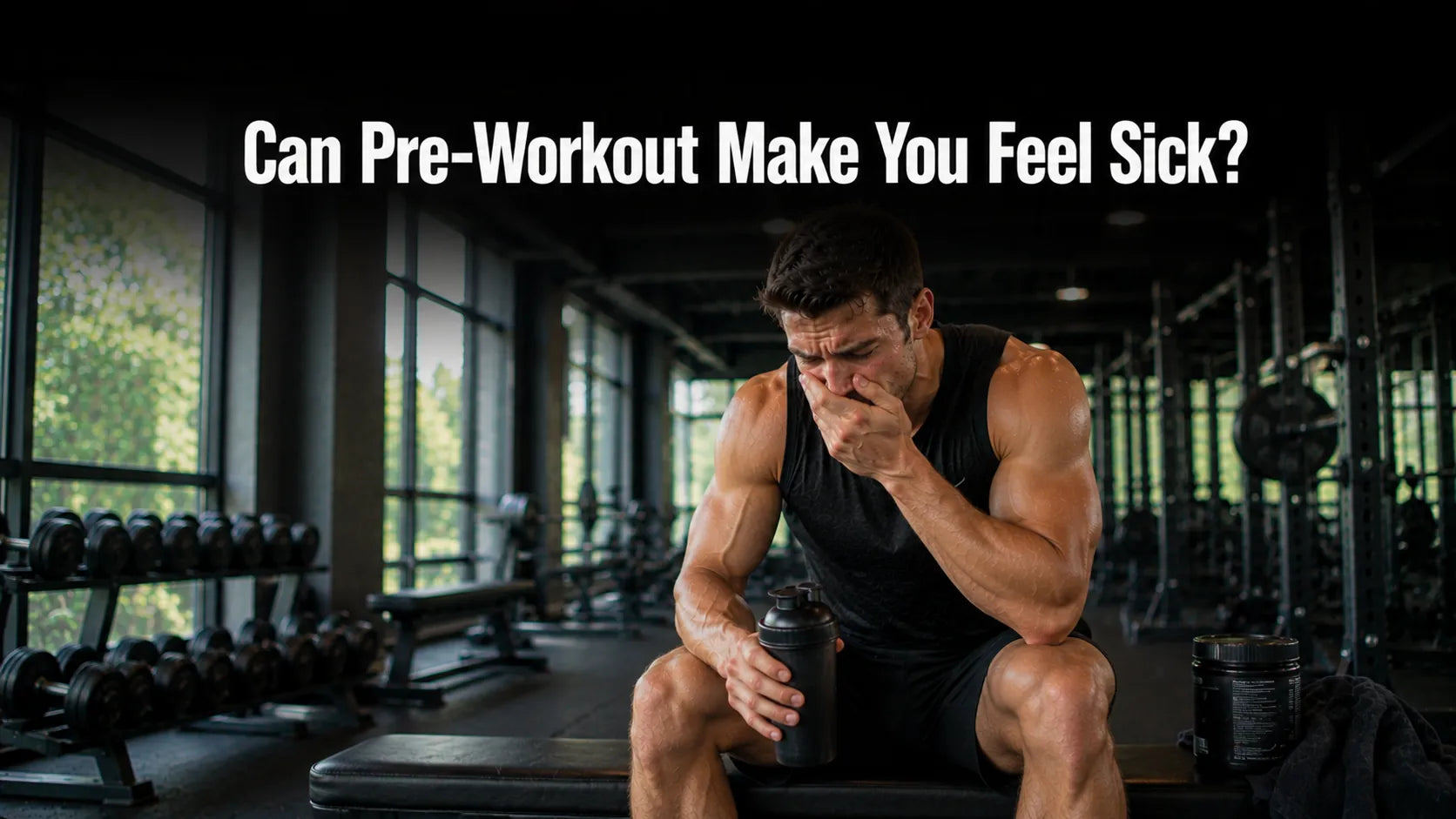
For some people, pre-workout feels incredible.
Energy increases.
Focus sharpens.
Workouts feel explosive.
For others, the experience is very different.
Instead of feeling powerful, they end up:
- Nauseous
- Shaky
- Dizzy
- Anxious
- Sweaty
- Lightheaded halfway through training
Some people even feel like they might throw up before the workout properly starts.
This creates a lot of confusion because pre-workouts are marketed almost entirely around:
- Energy
- Intensity
- Performance
Very little attention gets given to how aggressive stimulant formulas can actually feel—especially for newer users or people with lower tolerance.
The truth is that pre-workout sickness is surprisingly common.
And it’s usually caused by a combination of:
- Stimulants
- Digestion issues
- Hydration problems
- Dosage mistakes
- Training habits
rather than one single ingredient alone.
1. Why can pre-workout make you feel nauseous?
Usually because the body is becoming overstimulated.
Most pre-workouts contain ingredients designed to increase:
- Nervous system activity
- Heart rate
- Adrenaline response
- Blood flow
- Mental stimulation
That can improve performance…
…but it can also overwhelm the body if tolerance or recovery isn’t good.
Nausea often becomes more likely when:
- Caffeine doses are high
- Digestion is poor
- Hydration is low
- Anxiety is already elevated
- Training intensity spikes too quickly
This is why some people feel fine taking pre-workout casually…
…but feel terrible once hard exercise actually begins.
The body is trying to:
- Digest
- Regulate stimulation
- Manage exercise stress
all at the same time.
And sometimes it simply struggles to keep up.

2. Can taking pre-workout on an empty stomach cause sickness?
Very often, yes.
This is one of the biggest reasons people feel terrible after taking pre-workout.
Stimulants hit far harder on an empty stomach because absorption becomes:
- Faster
- More intense
- More abrupt
That can dramatically increase:
- Nausea
- Jitters
- Shaking
- Dizziness
- Anxiety
especially in people with lower caffeine tolerance.
A lot of people mistakenly think:
“Empty stomach = stronger workout.”
But in reality, it often just means harsher stimulation and worse stability during training.
This is where pre-workout nutrition matters massively.
For example:
- Applied Nutrition Cream of Rice works well before training because it provides easy-to-digest carbohydrates that help reduce the harshness of stimulant-heavy pre-workouts on an empty stomach
The goal is not to feel overstimulated.
The goal is controlled energy and stable performance.
3. Which ingredients are most likely to upset your stomach?
Usually:
- High caffeine doses
- Beta-alanine
- Artificial sweeteners
- Large stimulant blends
Caffeine is the biggest culprit for most people.
Especially in:
- High-stim formulas
- Double-scooped servings
- Stacked stimulant products
because excessive stimulation can irritate digestion heavily.
Beta-alanine can also create:
- Tingling
- Skin flushing
- Uncomfortable sensations
which some people interpret as feeling “ill.”
Artificial sweeteners and aggressive flavouring systems can sometimes worsen digestive discomfort too—especially during intense movement.
This is why some formulas feel dramatically harsher than others.
4. Can too much caffeine make workouts feel worse?
Absolutely.
More caffeine is not always better.
Once stimulation becomes excessive, performance often starts dropping instead of improving.
Too much caffeine can increase:
- Anxiety
- Shaking
- Heart rate
- Nausea
- Sweating
- Dizziness
This becomes especially noticeable during:
- Cardio
- High-volume training
- Hot environments
- Fasted workouts
A lot of people chase stronger and stronger formulas assuming:
“More stim = better workout.”
But eventually the nervous system becomes overloaded.
That’s when workouts stop feeling powerful and start feeling chaotic.
For example:
- Naughty Boy Menace V2 is a much more aggressive high-stimulant style pre-workout, which can feel overwhelming for people with lower stimulant tolerance or poor pre-workout nutrition
Sometimes the issue isn’t the workout.
It’s simply too much stimulation for the body to manage comfortably.

5. Why do beginners react badly to pre-workout?
Usually because they underestimate how powerful stimulant products can be.
Beginners often:
- Take full servings immediately
- Train fasted
- Combine caffeine sources
- Ignore hydration
- Have low stimulant tolerance
That combination can make even normal formulas feel extremely intense.
Experienced users usually build tolerance gradually over time.
Beginners don’t have that adaptation yet.
This is why many first-time users experience:
- Jitters
- Sweating
- Rapid heart rate
- Nausea
- Shaking
much more intensely.
A lot of people also confuse overstimulation with “good energy.”
They think:
“If I feel crazy, it must be working.”
But effective training energy should feel:
- Controlled
- Stable
- Manageable
not overwhelming.
Intermission
So far, we’ve covered:
- Why pre-workout can make people feel sick
- Empty stomach issues
- Ingredients that upset digestion
- Excessive caffeine
- And why beginners often react badly to stimulants
In Part 2, we’ll break down:
- Dehydration and side effects
- Tingling and shaking
- How to reduce nausea
- Lower-stim alternatives
- And when it’s time to stop using pre-workout completely
Part 2
6. Can dehydration make pre-workout side effects stronger?
Very easily.
This is one of the most overlooked causes of pre-workout sickness.
Stimulants already increase:
- Heart rate
- Body temperature
- Nervous system activity
If hydration is poor on top of that, the body often struggles much more with:
- Blood pressure regulation
- Temperature control
- Exercise tolerance
- Circulation
That’s why dehydration can make side effects like:
- Dizziness
- Nausea
- Headaches
- Shaking
- Rapid heart rate
feel dramatically worse.
This becomes especially noticeable during:
- Summer training
- Fasted workouts
- High-volume sessions
- Heavy sweating
A lot of people blame the pre-workout itself when the bigger issue is actually:
-
Poor hydration
combined with - Excessive stimulation.
For example:
- Per4m Hydrate Electrolyte Mix supports hydration and electrolyte balance during stimulant-heavy training sessions where fluid loss and nervous system stress are higher
Because stimulants and dehydration together can create a much harsher experience than either one alone.

7. Is tingling or shaking normal after pre-workout?
Usually yes—within reason.
The tingling sensation many people feel comes primarily from:
- Beta-alanine
This is a common ingredient included in many pre-workouts for performance-related reasons.
For some people, the tingling feels mild.
For others, it feels:
- Intense
- Uncomfortable
- Itchy
- Almost alarming the first time they experience it
Shaking is slightly different.
Mild trembling can happen when:
- Caffeine intake is high
- Adrenaline rises sharply
- Stimulant tolerance is low
especially during:
- Heavy lifts
- Cardio
- Intense training sessions
But there’s a difference between:
-
Mild stimulation
and - Feeling genuinely unwell
The goal should never be feeling completely out of control during workouts.
8. How can you stop pre-workout making you feel sick?
Usually by reducing the overall stress load on the body.
The biggest fixes are often surprisingly simple:
- Eat before training
- Reduce dosage
- Improve hydration
- Avoid stacking stimulants
- Train less aggressively initially
A lot of people immediately jump into:
- Full scoops
- Double scoops
- Multiple caffeine products together
without giving the body time to adapt.
Starting smaller usually works far better.
For example:
- Taking half servings initially
- Avoiding fasted training
- Using carbohydrates before training
often reduces nausea dramatically.
This is where easier pre-workout fueling becomes useful.
For example:
- Applied Nutrition Cream of Rice provides simple carbohydrates that help support more stable energy and digestion before training sessions
Because stable energy usually performs far better than chaotic overstimulation.
9. Should you switch to a lower-stim formula?
Sometimes yes.
Not everyone tolerates high-stimulant products well.
Some people naturally have:
- Lower caffeine tolerance
- Higher anxiety sensitivity
- More reactive digestion
- Greater nervous system sensitivity
For those people, aggressive formulas may simply never feel good consistently.
This is especially true with:
- Multiple daily caffeine sources
- Energy drink stacking
- High-stim fat burners
- Poor sleep
because overall nervous system stress accumulates quickly.
For example:
- EHP Labs OxyShred Ultra Energy Drink still contains stimulants, so stacking products like this alongside aggressive pre-workouts can easily push total caffeine intake too high for some people
A lower-stim approach often creates:
- Better workout quality
- Better consistency
- Less nausea
- Less anxiety
even if the “rush” feels smaller.

10. When should you stop using a pre-workout completely?
Usually when side effects consistently outweigh the benefits.
Warning signs include:
- Severe nausea
- Chest pain
- Panic symptoms
- Persistent dizziness
- Rapid heart palpitations
- Feeling ill every workout
At that point, the product is clearly not improving training quality anymore.
A lot of people force themselves to keep using high-stim products because they associate extreme stimulation with:
- Motivation
- Hardcore training
- Better performance
But workouts should feel:
- Focused
- Controlled
- Productive
—not physically miserable.
Sometimes reducing stimulants actually improves performance because the body can finally train without excessive nervous system stress.
For example:
- ABE Ultimate Pre-Workout works well for many people, but like any stimulant product, tolerance and dosage still matter massively for how well it’s tolerated individually
The best pre-workout is the one that improves performance without making you feel terrible afterwards.
Conclusion
Pre-workout can absolutely make some people feel sick.
Usually because the body becomes overloaded by:
- Stimulants
- Poor hydration
- Fasted training
- Excessive caffeine
- Digestive stress
- Low tolerance
The biggest mistake people make is assuming stronger stimulation automatically means better workouts.
In reality, the best training sessions usually come from:
- Stable energy
- Good hydration
- Proper fueling
- Controlled stimulation
not from feeling completely overwhelmed.
Because performance improves most when the nervous system feels supported—not overloaded.
FAQ
1. Can pre-workout make you feel sick?
Yes, especially when stimulant doses are too aggressive.
2. Why does pre-workout make me nauseous?
Usually because of overstimulation, digestion stress, or dehydration.
3. Can taking pre-workout on an empty stomach cause sickness?
Absolutely—it often increases nausea and dizziness.
4. Does too much caffeine make workouts worse?
Yes, excessive stimulation can reduce performance quality.
5. Is tingling after pre-workout normal?
Usually yes, especially from beta-alanine.
6. Can dehydration worsen pre-workout side effects?
Very easily, especially during intense workouts.
7. Should beginners use smaller doses?
Usually yes, to avoid excessive stimulation.
8. When should you stop using pre-workout?
When side effects consistently outweigh workout benefits.


