


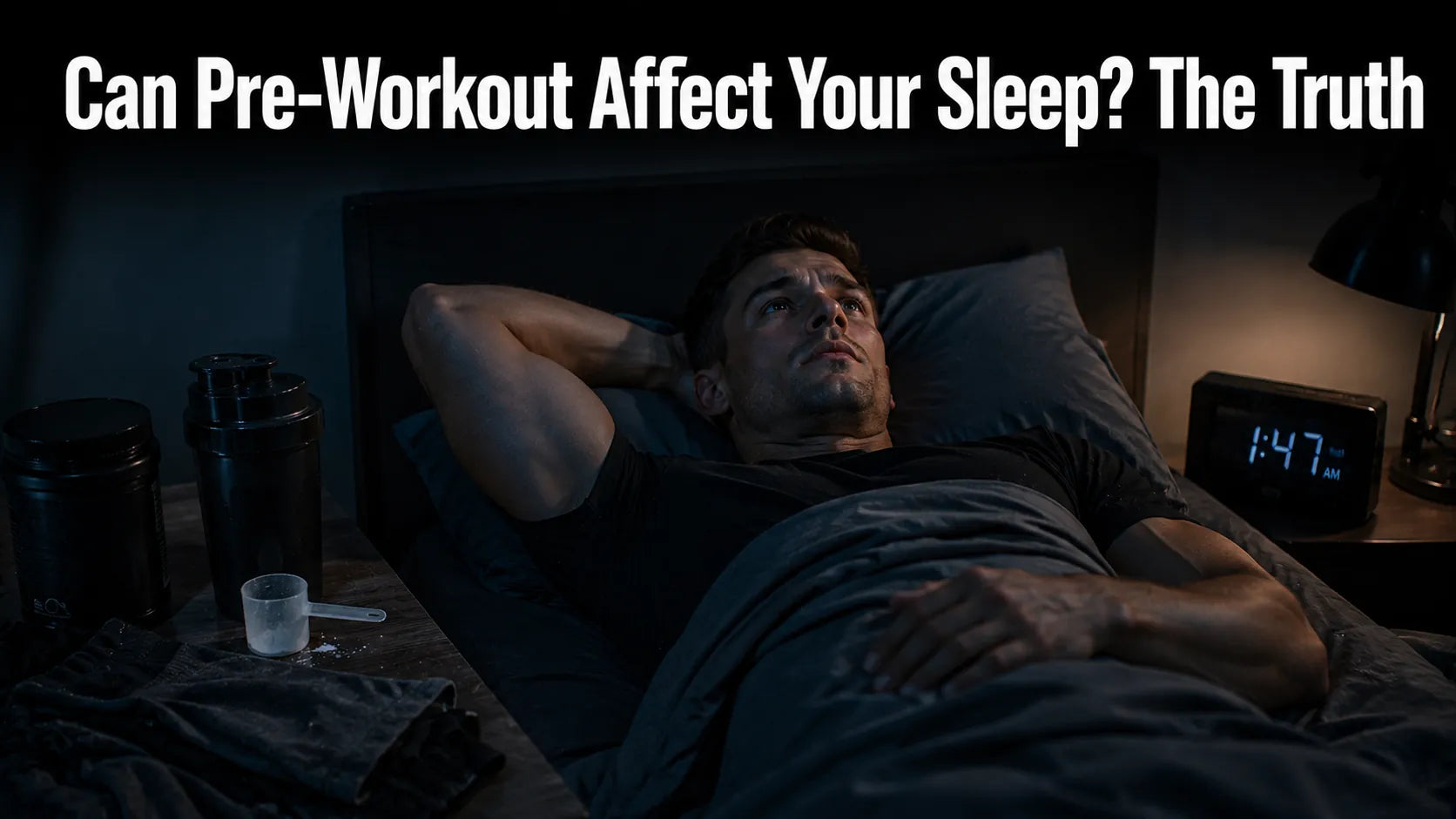
Few things are more frustrating than having a fantastic workout ruined by a terrible night's sleep.
You've trained hard.
Your energy was high.
The session felt productive.
You hit your targets.
Everything seemed to go perfectly.
Then midnight arrives.
You're lying in bed staring at the ceiling.
Your body feels tired.
Your mind doesn't.
And despite being physically exhausted, sleep simply refuses to show up.
For many gym-goers, this is the moment they start asking an important question:
"Was it the pre-workout?"
In many cases, the answer is yes.
But the relationship between pre-workout and sleep is often more complicated than people realise.
The issue isn't simply caffeine.
It's timing.
It's dosage.
It's individual sensitivity.
It's the fact that some people can take a strong pre-workout at 6pm and sleep like a baby, while others struggle after a lunchtime serving.
Understanding why that happens is important because sleep isn't just another part of recovery.
Sleep is recovery.
A pre-workout might improve a single training session.
Poor sleep can affect everything that follows it.
That's why finding the balance between performance and recovery has become one of the biggest challenges in modern supplement use.
1. Why can pre-workout make it harder to fall asleep?
The answer starts with the nervous system.
Most pre-workouts are designed to make you feel:
- more alert
- more focused
- more energised
- more motivated
Those effects are fantastic when you're about to train.
They're considerably less helpful when you're trying to sleep.
Many ingredients work by increasing stimulation throughout the body.
Your heart rate may remain slightly elevated.
Mental alertness may stay higher than normal.
Your brain may simply feel more awake.
The problem is that sleep requires the opposite environment.
To fall asleep effectively, the body generally needs to move towards a more relaxed state.
Strong pre-workouts deliberately push you in the other direction.
Products such as Naughty Boy Menace V2 - 420g are specifically designed to create a powerful training experience. That's excellent at 5pm before a heavy session. It can be less helpful when bedtime arrives only a few hours later.


The supplement hasn't failed.
It's simply continuing to do what it was designed to do.

2. How long does caffeine from pre-workout stay in your system?
Much longer than most people think.
One of the biggest mistakes gym-goers make is assuming caffeine disappears once they stop feeling it.
That's not how caffeine works.
The obvious effects may begin fading after a few hours, but caffeine can remain active in the body for significantly longer.
This means someone who takes a pre-workout late in the afternoon may still have a meaningful amount of caffeine circulating in their system when they're trying to sleep.
This is why two statements can both be true:
"I don't feel energised anymore."
and
"I still can't fall asleep."
Many people assume the first statement means the second shouldn't happen.
Unfortunately, the body doesn't always work that way.
The visible buzz often disappears before the sleep disruption does.
3. Are some pre-workout ingredients worse for sleep than others?
Absolutely.
Caffeine is usually the biggest contributor, but it isn't the only factor.
Many modern formulas combine multiple ingredients designed to support:
- energy
- alertness
- focus
- concentration
When several of these compounds are stacked together, the overall effect can sometimes feel stronger than caffeine alone.
This is one reason two products with similar caffeine levels can produce very different experiences.
A formula such as Applied Nutrition ABE All Black Everything – Ultimate Pre-Workout may feel completely different from another product with a comparable caffeine content because the overall ingredient profile influences how the experience unfolds.
This is why simply checking the caffeine number doesn't always tell the whole story.
The full formula matters.
4. Why do some people sleep fine after pre-workout while others can't?
Individual differences play a huge role.
Anyone who has spent enough time around gym-goers has seen this phenomenon.
One person takes a high-stim pre-workout at 7pm and falls asleep effortlessly.
Another takes a moderate serving at 2pm and spends half the night awake.
Neither person is necessarily doing anything wrong.
People simply process stimulants differently.
Factors that influence this include:
- genetics
- body size
- caffeine sensitivity
- training habits
- previous stimulant exposure
- sleep quality
This is why copying someone else's supplement habits can sometimes create problems.
What works perfectly for one person may be completely unsuitable for another.
The smartest approach is always understanding your own response rather than assuming everyone's experience should be identical.

5. Can afternoon workouts still affect your sleep at night?
Very easily.
This surprises many people because they assume:
"I trained hours ago."
But the body doesn't always reset immediately after a workout.
Training itself can increase:
- alertness
- adrenaline
- nervous system activity
Add a pre-workout on top of that and the effect can become more pronounced.
This is particularly true when higher-stimulant products are used later in the day.
A formula such as Optimum Nutrition Platinum Pre-Workout – 420g may provide excellent support for training performance, but timing becomes increasingly important as the day progresses.


The closer supplementation moves towards bedtime, the more likely sleep quality may become part of the conversation.
That's why many experienced gym-goers eventually stop asking:
"Will this improve my workout?"
and start asking:
"Will this improve my workout without damaging my sleep?"
That's a much smarter question.
Intermission
So far we've explored why pre-workouts can interfere with sleep, how long caffeine can remain active in the body, why ingredient profiles matter, why people respond differently to stimulants, and how afternoon training sessions can still influence sleep quality hours later.
In Part 2, we'll look at caffeine tolerance, warning signs your dosage is too high, whether poor sleep can cancel out workout benefits, the growing appeal of stimulant-free pre-workouts, and how to time your supplementation without sacrificing recovery.
Part 2
6. Does caffeine tolerance reduce the impact on sleep quality?
To some extent, yes.
But probably not as much as many people hope.
One of the most common assumptions among experienced gym-goers is:
"I've built a caffeine tolerance, so it doesn't affect my sleep anymore."
Sometimes that's true.
Often it's only partially true.
Tolerance can reduce how strongly you feel caffeine.
The obvious buzz may become less noticeable.
The jitters may disappear.
The surge of energy may feel smaller than it once did.
But sleep quality can still be affected even when the stimulation feels mild.
This is why some people are convinced caffeine isn't affecting them despite consistently:
- waking up during the night
- struggling to fall asleep
- feeling less refreshed in the morning
The stimulation may feel normal.
The recovery cost may still be there.
That's one reason experienced users sometimes underestimate how much their pre-workout habits are influencing recovery.

7. Are sleep problems a sign your pre-workout dose is too high?
Quite often, yes.
Sleep disruption is one of the clearest signs that a product may not fit your current routine.
Many gym-goers assume the ideal pre-workout dose is simply the maximum amount they can tolerate.
But tolerance isn't necessarily the goal.
Performance is.
If you're taking a full serving and consistently experiencing:
- difficulty falling asleep
- restless nights
- reduced sleep quality
- next-day fatigue
then the dosage may be creating more problems than it solves.
This doesn't automatically mean you need a different product.
Sometimes the answer is simply:
- a smaller serving
- earlier timing
- less frequent use
The strongest dose isn't always the most effective dose.
The most effective dose is the one that improves training without compromising recovery.
8. Can poor sleep cancel out the benefits of a great workout?
This is arguably the most important question in the entire article.
Because many people obsess over pre-workout performance while completely overlooking recovery.
A fantastic workout matters.
But adaptation doesn't happen during the workout.
It happens afterwards.
Sleep influences:
- muscle recovery
- training adaptation
- hormone regulation
- energy levels
- motivation
- future performance
This creates a strange situation where someone can use a pre-workout to improve one training session while simultaneously reducing the quality of the recovery needed to benefit from it.
That's not a great trade.
This is why recovery-focused products such as Per4m Advanced Magnesium - 120 Caps have become increasingly popular among serious gym-goers. The goal isn't simply to train harder.

The goal is to recover well enough to keep training hard consistently.
Because one excellent workout means very little if poor sleep starts affecting the next three.
9. Are stimulant-free pre-workouts a better option for evening training?
For many people, absolutely.
This is one of the biggest shifts happening within the supplement industry right now.
Many experienced lifters eventually reach a point where they realise:
"I want the performance benefits, but I don't necessarily want the stimulants."
That's where non-stimulant formulas become interesting.
Products such as ABE All Black Everything – PUMP Pre Workout 500g focus on:
- pumps
- blood flow
- workout quality
- training performance
without heavily stimulating the nervous system.


For someone training at 7pm or 8pm, that can be a game changer.
Instead of choosing between:
a great workout
or
a great night's sleep
they may be able to support both.
That's a very attractive option for anyone who trains later in the day.

10. What's the best time to take pre-workout without ruining your sleep?
There's no universal answer because everyone responds differently.
However, there is a simple principle that tends to work well:
The earlier you train, the more flexibility you generally have.
The later you train, the more carefully you need to think about stimulant intake.
Many people spend enormous amounts of time comparing ingredients while ignoring timing entirely.
In reality, timing is often the deciding factor.
A high-stim pre-workout taken early in the day may cause no issues at all.
The exact same product taken several hours later may create a completely different experience.
This is why products such as Naughty Boy Menace V2 - 420g, Applied Nutrition ABE All Black Everything – Ultimate Pre-Workout, and Optimum Nutrition Platinum Pre-Workout – 420g often work best when users match them appropriately to their training schedule rather than simply taking them whenever convenient.
The smartest approach isn't asking:
"What's the strongest pre-workout?"
It's asking:
"What's the strongest pre-workout I can use without compromising recovery?"
That's usually where the best long-term results come from.
Conclusion
Pre-workout can absolutely affect sleep.
For some people the impact is small.
For others it's significant.
The difference often comes down to:
- timing
- dosage
- ingredient profile
- individual sensitivity
- overall caffeine intake
The mistake many gym-goers make is viewing workout performance and recovery as separate conversations.
They're not.
A pre-workout may help you perform better in the gym.
Sleep is what allows your body to benefit from that performance afterwards.
That's why the goal isn't simply finding the most powerful supplement available.
It's finding the right balance between stimulation and recovery.
For many people, that means:
- using stimulants earlier in the day
- reducing excessive caffeine intake
- considering non-stimulant alternatives for evening sessions
- prioritising sleep as highly as training itself
Because the best workout in the world loses much of its value if it comes at the expense of recovery.
FAQ
1. Can pre-workout affect your sleep?
Yes. Many pre-workouts contain stimulants that can make it harder to fall asleep and may reduce sleep quality.
2. Can pre-workout stop you from sleeping?
It can, particularly if taken late in the day or if you're sensitive to caffeine.
3. How long before bed should you avoid pre-workout?
This varies between individuals, but many people benefit from avoiding stimulant-heavy products several hours before bedtime.
4. Does caffeine tolerance prevent sleep disruption?
Not necessarily. You may feel less stimulated while still experiencing poorer sleep quality.
5. Can pre-workout cause insomnia?
In some individuals, particularly when taken late in the day, stimulant-based products can contribute to insomnia-like symptoms.
6. Are stimulant-free pre-workouts better for evening workouts?
For many people, yes. They may support performance without affecting sleep as heavily as stimulant-based products.
7. Is poor sleep worse than missing a pre-workout?
For long-term progress, recovery and sleep are often more important than a temporary boost in workout performance.
8. What's the best time to take pre-workout?
Generally, earlier training sessions provide more flexibility, while evening sessions require greater consideration of stimulant intake.


