


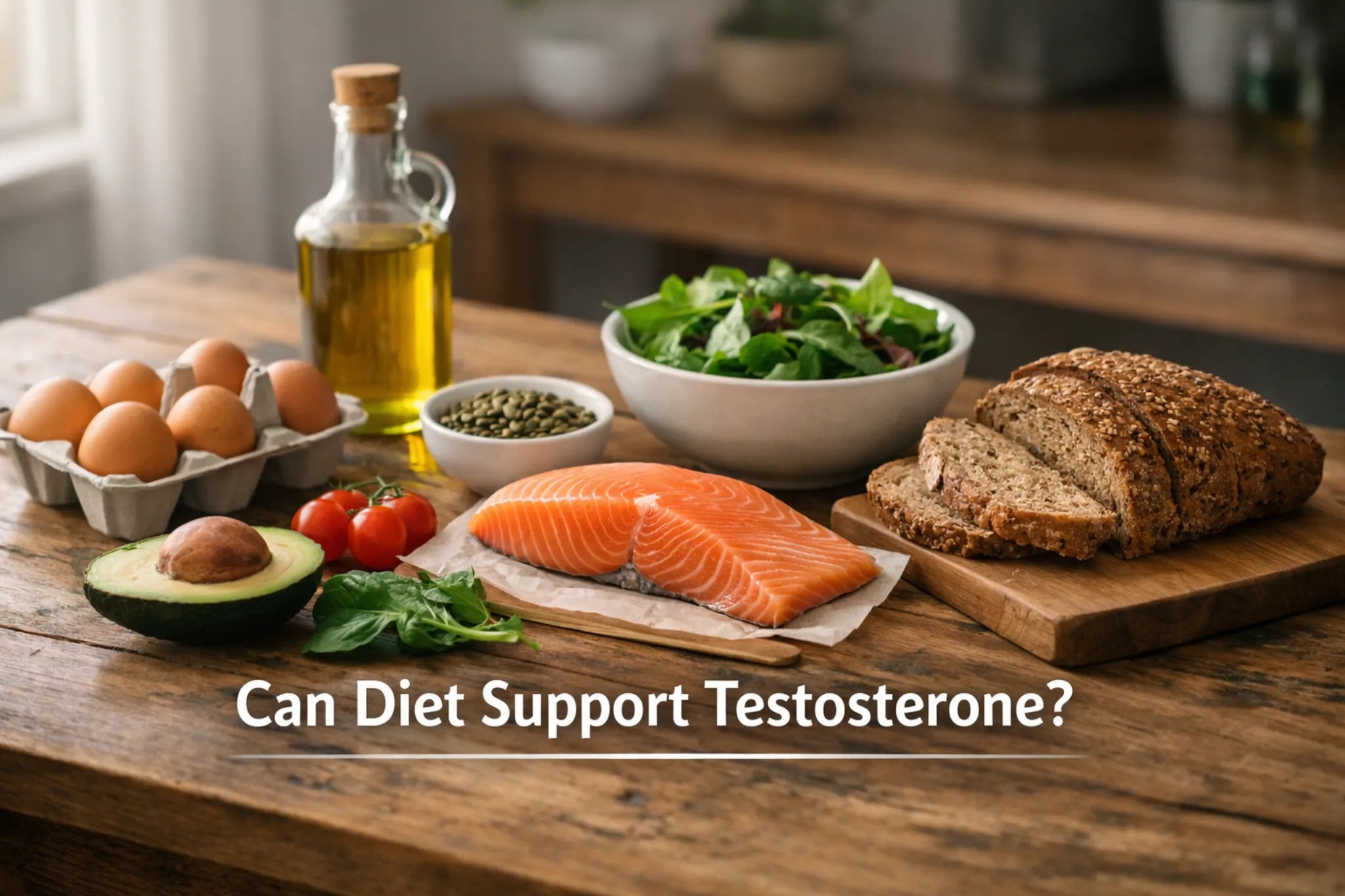
Can Diet Support Testosterone?
Part 1 — What Nutrition Can (and Can’t) Do for Male Hormones
Testosterone is one of the most misunderstood hormones in modern fitness culture.
It’s blamed when energy dips. It’s chased when muscle stalls. It’s feared when blood tests come back “borderline.” And it’s marketed relentlessly by products that promise far more than biology allows.
Diet sits right at the centre of this confusion.
Some people believe testosterone is almost entirely genetic. Others think a few “superfoods” can fix everything. Most men sit somewhere in the middle — eating reasonably well, training inconsistently, sleeping poorly, and wondering why motivation, recovery, or drive doesn’t feel quite right anymore.
So the real question isn’t whether diet matters.
It’s how much it matters, where its limits are, and when nutrition supports testosterone versus when it simply stops it from falling further.
This matters because testosterone isn’t a switch you flip. It’s a signal the body produces when it feels safe, fuelled, and recovered enough to do so. Diet plays a role in all three — but not in the way social media often suggests.
1. Can Testosterone Actually Be Increased Through Diet Alone?
Short answer: sometimes — but usually only if it’s low for nutritional reasons to begin with.
Testosterone production is regulated by the hypothalamic–pituitary–gonadal (HPG) axis, a feedback loop that responds to energy availability, micronutrient status, stress levels, and overall health. Diet feeds into this system, but it doesn’t override it.
If testosterone is low because of:
-
chronic under-eating
-
very low fat intake
-
micronutrient deficiencies
-
prolonged dieting
-
poor recovery
then diet can make a meaningful difference.
If testosterone is low because of:
-
age-related decline
-
sleep deprivation
-
chronic psychological stress
-
medical or endocrine conditions
diet alone usually won’t “boost” it — but it can stop things getting worse.
This distinction matters.
Men often expect dietary changes to elevate testosterone beyond their natural baseline. In reality, nutrition is more about restoring normal signalling than pushing levels higher than biology intends.
This is why calorie intake, protein sufficiency, and fat quality matter more than any single “testosterone food.”
Under-eating — even unintentionally — is one of the fastest ways to suppress testosterone. When energy intake drops too low, the body prioritises survival, not reproduction or muscle maintenance. Testosterone falls as a consequence, not a failure.
This is where products like Per4m Advanced Whey Protein fit into the discussion — not as hormone enhancers, but as tools to maintain adequate intake when appetite, time, or calorie targets make whole food intake inconsistent. Protein adequacy doesn’t raise testosterone directly, but chronic insufficiency reliably lowers it.
Diet doesn’t override hormones.
It sets the conditions under which hormones are allowed to function.

2. What Foods Actually Support Healthy Testosterone Levels?
When diet supports testosterone, it does so quietly and indirectly.
Testosterone production depends on:
-
sufficient energy
-
adequate dietary fat
-
enough protein
-
micronutrients that support enzymatic processes
Not “boosters.” Foundations.
Dietary Fats
Testosterone is a steroid hormone derived from cholesterol. Very low-fat diets — especially over long periods — are consistently associated with lower testosterone levels.
This doesn’t mean high-fat diets are magic. It means fat avoidance is risky.
Foods that tend to support hormonal balance include:
-
eggs
-
oily fish
-
red meat (in moderation)
-
dairy
-
olive oil
This is why omega-3 intake often appears in testosterone discussions. Supplement Needs Omega 3 doesn’t raise testosterone directly, but it supports cell membrane health, reduces inflammation, and improves hormonal signalling efficiency — all of which matter when testosterone is already under pressure from training or stress.
Protein
Protein supports muscle maintenance, training adaptation, and metabolic health. But extremes matter.
Very low protein intake is associated with:
-
muscle loss
-
impaired recovery
-
suppressed anabolic signalling
On the flip side, extremely high protein combined with very low fat and calories can also suppress testosterone.
Balance matters more than maximisation.
Micronutrients (Through Food First)
Zinc, magnesium, vitamin D, selenium — these matter, but deficiencies matter more than excess.
Eggs, meat, dairy, shellfish, whole grains, and sunlight exposure often cover the basics better than supplementation alone.
Diet supports testosterone best when it is sufficient, not extreme.
3. Which Foods and Habits Are Most Damaging to Testosterone?
Low testosterone isn’t usually caused by one bad food.
It’s caused by patterns.
Chronic Calorie Restriction
Extended dieting is one of the most reliable ways to lower testosterone.
When calories stay low:
-
leptin drops
-
thyroid output slows
-
testosterone production downshifts
This is common in men who train hard but eat “clean” without eating enough.
Ultra-Processed Diets
Diets dominated by ultra-processed foods are linked to:
-
increased inflammation
-
insulin resistance
-
disrupted hormonal signalling
Not because sugar is evil, but because poor diet quality creates systemic stress.
Alcohol
Alcohol suppresses testosterone acutely and chronically. Regular heavy intake interferes with testicular function and increases estrogen conversion.
No supplement offsets this.

4. Can Poor Nutrition Cause Low Testosterone Over Time?
Yes — and this is where diet matters most.
Low testosterone often isn’t sudden. It’s slow erosion.
Years of:
-
inconsistent eating
-
low dietary fat
-
chronic stress
-
under-recovery
-
poor sleep
create an internal environment where testosterone production is deprioritised.
This is also where lifestyle support becomes inseparable from nutrition.
High cortisol — the stress hormone — directly suppresses testosterone. This is why stress-management compounds sometimes appear in hormone discussions. Applied Nutrition Ashwagandha doesn’t “boost testosterone” in isolation, but by moderating stress responses, it can remove one of the brakes that keeps testosterone suppressed.
Again: diet and lifestyle don’t push hormones up — they stop pushing them down.

5. How Quickly Can Diet Changes Affect Testosterone?
This is one of the most searched — and misunderstood — questions.
If testosterone is low due to:
-
calorie restriction
-
fat avoidance
-
protein insufficiency
changes can be seen in weeks, sometimes sooner.
If testosterone is low due to:
-
age
-
chronic stress
-
sleep deprivation
-
endocrine factors
diet helps slowly, indirectly, or not at all.
Training quality also matters. Heavy resistance training sends a strong anabolic signal. Nutrients only support that signal — they don’t replace it. This is where Naughty Boy Prime Creatine belongs in the conversation. Creatine doesn’t raise testosterone levels, but it improves training output and strength expression, which indirectly supports an anabolic environment.
Creatine supports the signal.
Diet supports the conditions.
Neither works alone.
Part 1 Summary
Diet absolutely supports testosterone — but not as a shortcut.
It:
-
restores normal production when nutrition is the problem
-
prevents unnecessary suppression
-
supports training, recovery, and hormonal signalling
It does not:
-
override biology
-
replace sleep
-
cancel stress
-
fix medical hypogonadism
In Part 2, we’ll go deeper into:
-
eggs and cholesterol myths
-
sugar and testosterone
-
signs of low testosterone
-
when diet stops being enough
-
and when testosterone issues should be addressed beyond nutrition
Can Diet Support Testosterone?
Part 2 — Myths, Red Flags, Upper Limits, and When Nutrition Isn’t Enough
If Part 1 established what diet can do for testosterone, Part 2 is about limits — where nutrition helps, where it stops mattering, and where men often misread the signals their body is giving them.
Because the most damaging testosterone myths aren’t just wrong.
They delay real solutions.
6. Do Eggs Really Raise or Lower Testosterone?
Eggs sit at the centre of testosterone debates for one reason: cholesterol.
Testosterone is synthesised from cholesterol, which leads to the simplistic idea that eating cholesterol-rich foods automatically raises testosterone. The reality is more nuanced.
In healthy men:
-
dietary cholesterol has minimal impact on blood cholesterol
-
the body tightly regulates cholesterol synthesis
-
testosterone production responds more to energy balance and fat intake than cholesterol itself
Eggs don’t “boost” testosterone.
But they support the conditions that allow testosterone production to function normally.
Eggs provide:
-
complete protein
-
dietary fat
-
fat-soluble vitamins
-
micronutrients involved in hormone signalling
Where eggs help most is in preventing unintentional restriction — particularly in men who eat low-fat, low-calorie diets while training hard.
When calories are adequate and fat intake is reasonable, eggs are neutral-to-supportive.
When calories are too low, eggs don’t fix the problem.
The myth isn’t that eggs raise testosterone.
The myth is thinking testosterone problems come from one food choice instead of an overall pattern.

7. What Are the Most Common Signs of Low Testosterone in Men?
Low testosterone rarely announces itself clearly.
Instead, it shows up as quiet erosion.
Common early signs include:
-
reduced training drive
-
slower recovery
-
loss of strength without obvious cause
-
poor sleep quality
-
low motivation
-
increased fat gain despite unchanged habits
Later signs may include:
-
reduced libido
-
mood changes
-
persistent fatigue
-
loss of muscle mass
-
difficulty maintaining consistency
Here’s where men go wrong:
they assume supplements are the solution when the signal is lifestyle-based.
Under-fuelling, high stress, poor sleep, and chronic dieting suppress testosterone long before blood work crosses clinical thresholds.
This is why stress management matters. Applied Nutrition Ashwagandha fits here not as a hormone booster, but as a tool that may reduce cortisol — a hormone that directly suppresses testosterone when chronically elevated.
Low testosterone is often a symptom, not the disease.
8. What Is the #1 Lifestyle or Dietary Testosterone Killer?
If one factor consistently overrides diet quality, it’s chronic stress combined with under-recovery.
Not sugar.
Not soy.
Not seed oils.
Stress.
Psychological stress elevates cortisol. Cortisol suppresses testosterone. The relationship is direct, measurable, and well-documented.
Add:
-
poor sleep
-
inconsistent meals
-
heavy training volume
-
alcohol use
and testosterone production downshifts — even in men who “eat well.”
This is why diet alone often fails. You can eat perfectly and still suppress testosterone if recovery is missing.
Training intensity matters here too. Heavy resistance training supports anabolic signalling when recovery is adequate. When recovery isn’t, the same training becomes another stressor.
This is where Naughty Boy Prime Creatine fits again — not as a testosterone agent, but as a performance support that allows strength training to remain productive rather than draining. Better output with less fatigue helps maintain the hormonal environment needed for adaptation.
9. Can Testosterone Levels Become Too High From Diet or Supplements?
This is a common fear — and largely unfounded.
Diet cannot push testosterone beyond physiological limits.
No combination of:
-
eggs
-
red meat
-
supplements
-
protein
-
fats
will raise testosterone into dangerous ranges in healthy men.
Even supplements commonly associated with testosterone discussions don’t increase levels beyond normal biological ceilings.
Supplement Needs Omega 3, for example, improves lipid profiles and reduces inflammation — it doesn’t manipulate hormone production directly.
The real risk isn’t testosterone being too high.
It’s testosterone being artificially manipulated without medical oversight.
Nutrition supports balance.
Drugs override regulation.

10. When Should Low Testosterone Be Treated Beyond Diet Alone?
This is where honesty matters.
Diet supports testosterone when nutrition is the limiting factor.
Diet is not enough when:
-
sleep is chronically poor
-
stress is unmanaged
-
alcohol intake is high
-
training volume exceeds recovery
-
testosterone remains low despite adequate nutrition
-
symptoms persist alongside confirmed blood markers
At this point, nutrition becomes supportive — not corrective.
This is why the most responsible testosterone conversations always include boundaries. Diet helps restore normal function. It does not replace medical evaluation when hormones remain suppressed.
Even vitamin D fits this pattern. Applied Nutrition Vitamin D3 supports testosterone status in deficient individuals, but once sufficiency is reached, more does not mean better.
Hormones respond to balance, not excess.
11. Can Diet Support Testosterone Long-Term — or Just Short-Term?
Long-term testosterone support comes from sustainability, not optimisation.
Men who maintain healthier testosterone profiles over decades tend to:
-
eat enough consistently
-
include dietary fat
-
maintain lean mass
-
manage stress
-
sleep adequately
-
train with intent, not punishment
Protein adequacy matters here too. Per4m Advanced Whey Protein belongs in this discussion not as a shortcut, but as a practical tool to prevent under-eating when schedules or appetite make whole-food intake inconsistent.
Testosterone thrives in environments that signal safety, adequacy, and recovery.
Part 2 Summary
Diet supports testosterone by:
-
preventing suppression
-
restoring function when nutrition is inadequate
-
supporting training and recovery
Diet does not:
-
override stress
-
cancel sleep deprivation
-
fix medical hypogonadism
-
create super-physiological hormone levels
The biggest mistake men make isn’t eating the “wrong” foods.
It’s ignoring the context in which hormones operate.
Testosterone isn’t boosted.
It’s allowed.
Conclusion — Where Diet Fits in the Testosterone Equation
Diet absolutely plays a role in testosterone health — but not as a lever you pull to force levels upward. Its real power is preventative and restorative.
When men eat enough, include dietary fat, hit protein targets, manage stress, and recover properly, testosterone production is allowed to function normally. When those basics slip, testosterone is often one of the first systems the body downshifts.
That’s why chasing “testosterone foods” rarely works in isolation. Hormones respond to context, not hacks. Diet supports the environment. Training provides the signal. Recovery determines whether that signal is acted on.
If testosterone is low because nutrition has been poor, diet can make a real difference — sometimes quickly. If testosterone remains low despite good nutrition and lifestyle changes, that’s no longer a diet problem. That’s a sign to look deeper.
The smartest approach isn’t trying to boost testosterone.
It’s removing the reasons your body is suppressing it.
FAQ — Can Diet Support Testosterone?
Can diet alone increase testosterone levels?
Diet can restore testosterone when low levels are caused by under-eating, low fat intake, or nutrient deficiencies. It rarely increases testosterone beyond a person’s natural baseline.
What foods help boost testosterone naturally?
Foods that support testosterone include eggs, oily fish, red meat in moderation, dairy, olive oil, and whole foods that provide adequate calories, fats, and protein.
Can poor nutrition lower testosterone over time?
Yes. Chronic calorie restriction, very low fat intake, and poor recovery can suppress testosterone gradually, even in active men.
Do eggs raise or lower testosterone?
Eggs don’t directly raise testosterone, but they support hormone production by providing protein, fats, and micronutrients when calories and fat intake are adequate.
How long does diet take to affect testosterone levels?
If testosterone is low due to diet, improvements can appear within weeks. If low levels are caused by stress, sleep, or medical issues, diet helps more slowly or indirectly.
Is sugar bad for testosterone?
Excessive sugar intake can contribute to insulin resistance and inflammation, which may negatively affect testosterone. Moderate intake within a balanced diet is unlikely to cause issues.
Can testosterone become too high from diet or supplements?
No. Diet and legal supplements cannot push testosterone beyond normal physiological ranges in healthy men.
What is the biggest lifestyle killer of testosterone?
Chronic stress combined with poor sleep and under-recovery has a stronger suppressive effect on testosterone than any single food choice.
When should low testosterone be treated beyond diet alone?
If symptoms persist despite adequate nutrition, sleep, stress management, and training balance — especially alongside confirmed blood markers — medical evaluation is appropriate.


