


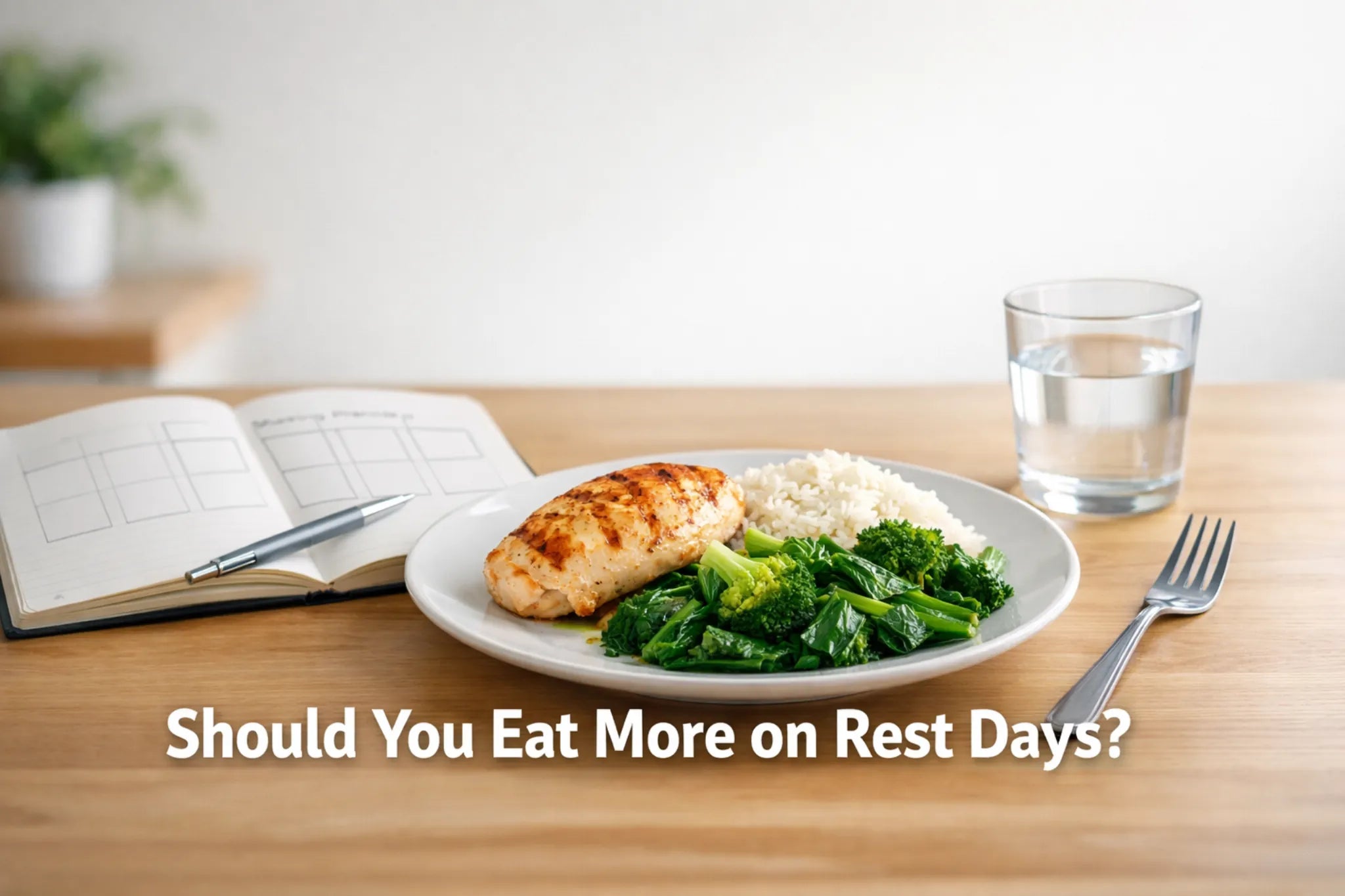
Part 1 — The Truth About Rest Day Calories (and Why Your Hunger Can Spike When You’re “Doing Nothing”)
Rest days mess with your head.
You wake up, you haven’t trained, you’ve done basically nothing athletic… and yet your stomach is acting like you’ve just run a half marathon in your sleep. Then the guilt kicks in:
“If I eat more today, am I just gaining fat?”
“Should I eat less because I’m not burning calories?”
“Why am I hungrier on the day I’m meant to ‘recover’?”
It’s a weird contradiction. You rest, but your appetite goes up.
You stop training, but your body feels like it’s demanding more.
So let’s answer the main question properly:
Should you eat more on rest days?
Sometimes, yes — but not in the way most people imagine.
Rest days aren’t “days off progress.”
They’re the days your body does the behind-the-scenes work that makes training actually count.
And the food you eat on a rest day can either support that recovery… or quietly sabotage the next week of sessions.
1. Do I Gain Weight on Rest Days?
You can gain scale weight on rest days, yes.
But here’s the important part:
Scale weight isn’t automatically fat gain.
Most people step on the scale after a rest day and panic because it’s up 0.5–2 lbs (sometimes more). But fat gain doesn’t happen that quickly from one normal day of eating.
What does happen quickly?
Water + glycogen changes
If you rest and eat more carbs (or saltier food), your muscles store more glycogen, and glycogen holds water. That’s a good thing — glycogen is training fuel.
Digestive weight
More food in your system = more weight. Revolutionary, I know.
Hydration swings
Drinking less water, drinking more water, sweating less than normal — it all changes the scale.
This is why a simple hydration habit can stop you spiralling. Optimum Nutrition Electrolyte is useful here, because when hydration is consistent, scale fluctuations often calm down. When hydration is chaotic, the scale looks like it’s trolling you.
So yes, you might “gain weight” on rest days — but most of it is not fat.

2. Do You Still Burn Fat on Rest Days?
Yes. Your body burns calories 24/7.
Even on a rest day, you burn energy through:
-
breathing
-
digestion
-
walking around
-
body temperature regulation
-
basic brain function
-
recovery processes
Also, there’s a quiet truth people forget:
You don’t stop being an active person just because you didn’t train.
Most people still:
-
walk
-
work
-
do house stuff
-
move around naturally
And recovery itself costs energy. Repairing muscle tissue isn’t free.
If your goal is fat loss, the real enemy isn’t rest day food.
It’s rest day chaos: random snacking, low protein, low structure, high “might as well.”
That’s why having a simple anchor like Per4m Advanced Whey Protein helps massively. Even on days you don’t train, protein keeps hunger stable, supports recovery, and stops the day turning into accidental overeating.
3. Should I Eat More Fat on Rest Days?
You don’t need to eat more fat on rest days — but you can use fat intelligently.
Fat is useful because it helps:
-
keep meals satisfying
-
support hormones
-
slow digestion (steady energy, fewer cravings)
But it’s also calorie-dense, which means it’s very easy to overshoot your intake if you’re mindlessly adding extra oils, nut butters, snacks, and “healthy” high-fat foods.
A good rule:
keep fat consistent, instead of swinging it wildly.
On rest days, your body still benefits from balanced meals:
-
protein + carbs + fats
not “all fats because I’m not training.”
If your appetite is out of control on rest days, fat can help satiety, but the real fix is usually:
-
better sleep
-
better protein
-
better routine consistency
Which is where Per4m Sleep fits naturally. Poor sleep increases hunger signals, makes cravings louder, and makes rest days feel like snack days. Sleep isn’t just “recovery” — it’s appetite control.

4. Should You Eat Less Carbs on Rest Days?
This is the one everyone argues about.
The truth is: it depends what you’re training for.
If you’re training to build muscle, carbs still matter on rest days because:
-
recovery happens on rest days
-
glycogen replenishment helps next session performance
-
carbs can support training volume across the week
You don’t need a huge carb day if you’re completely inactive, but going too low can backfire:
-
worse recovery
-
worse training tomorrow
-
higher cravings later
-
more “cheat” behaviour from feeling deprived
The best approach for most people is slightly lower carbs, not “no carbs.”
This is exactly where something like Applied Nutrition Cream of Rice becomes a cheat code for rest days — not because it’s magical, but because it’s controlled and clean.
If you want carbs that don’t come with chaos, Cream of Rice lets you:
-
measure your portion
-
keep digestion smooth
-
avoid super processed snack spirals
A small serving on a rest day can support recovery without pushing calories through the roof.

5. Why Am I So Much Hungrier on My Rest Days?
This is the part that feels unfair. But it makes perfect sense when you zoom out.
You’re often hungrier on rest days because:
A) Your body is recovering
Training creates damage. Recovery repairs it. Repair needs resources.
B) Your nervous system finally “unclenches”
A hard training day can suppress appetite for some people. The next day, hunger rebounds.
C) You slept better (or worse)
Sleep changes hunger hormones dramatically.
If you sleep badly, hunger gets louder, cravings increase, and you stop feeling full properly. If you sleep well, you might feel hungrier simply because your body is functioning correctly again.
That’s why Per4m Sleep isn’t just a “nice extra.” If your rest days are hungry-chaos days, improving sleep can be one of the cleanest fixes you’ll ever make.
D) Your routine changes
Rest days often = more free time = more opportunities to snack.
Hunger isn’t always physical. Sometimes it’s boredom disguised as appetite.
E) You under-ate on training days
This is a massive one.
People train hard, eat light, and then wonder why their body demands compensation.
Rest day hunger is sometimes just delayed payback.
Quick Rest Day Habit That Changes Everything
If you want a rest day routine that supports progress without overthinking it:
-
Keep protein high (whey helps)
-
Keep carbs moderate, not extreme (Cream of Rice makes this easy)
-
Hydrate properly (electrolytes reduce scale and energy swings)
-
Sleep like it matters (because it does)
-
Keep creatine consistent (rest days count)
Yes — rest days count for creatine.
This is why Naughty Boy Prime Creatine belongs in this blog. Creatine works best through daily saturation, not “only on workout days.” Taking it consistently supports performance over time — and that includes the days you’re recovering.
Part 1 Takeaway
Rest days don’t automatically make you gain fat — but they can make you gain scale weight from water, food volume, and hydration shifts.
You still burn fat on rest days. Recovery still burns energy.
And hunger on rest days is often a sign your body is repairing, replenishing, and catching up.
In Part 2, we’ll cover:
-
does muscle recovery make you hungry?
-
how to tell if weight gain is water or fat
-
what the best thing to do on a rest day actually is
-
whether 2 rest days is “too much”
-
and whether you should rest or push through
Should You Eat More on Rest Days?
Part 2 — Hunger, Water Weight, Recovery Habits (and When to Rest vs Push Through)
Rest days get treated like a pause button.
No training. No sweat. No “burn.” So people assume the rules change: eat less, do less, be smaller.
But rest days aren’t the days you stop building progress — they’re the days you lock it in.
If training is the stimulus, rest is the adaptation.
And adaptation is expensive. Your body pays for it with calories, protein, fluids, sleep, and time.
So if Part 1 was the “don’t panic” talk, Part 2 is the “do this properly” guide — without turning your life into a spreadsheet.
6. Does Muscle Recovery Make You Hungry?
Yes. And you can stop feeling guilty about it.
Recovery isn’t just “your muscles heal a bit.” It’s a full system job:
-
muscle protein synthesis
-
restoring glycogen (stored carbs in muscle)
-
repairing connective tissue
-
reducing inflammation from training stress
-
nervous system regulation
-
replenishing fluids and minerals
And all of that comes with increased demand for fuel.
This is why hunger on rest days often feels… louder.
Not just “I could eat.” More like “I need food now.”
Also, hunger is sometimes your body compensating for what you didn’t do on training days.
A lot of people under-eat when they train, because training makes them feel virtuous. Then rest day arrives and the body goes:
“Nice session yesterday. Now pay the bill.”
If you want to keep hunger controlled, the goal isn’t to starve on rest days. It’s to make rest day eating structured enough that it doesn’t turn into grazing.
That’s where Per4m Advanced Whey Protein becomes a practical cheat code: it lets you hit protein quickly without needing a full meal straight away, and higher protein typically makes rest-day hunger less chaotic.

7. How to Tell If Weight Gain Is Water or Fat?
This is the rest day scale anxiety chapter.
Because most “I gained weight on a rest day” panic is actually water weight, not fat gain.
Signs it’s water weight
-
scale jumps up quickly (overnight / 24 hours)
-
you feel a bit “puffy” or tighter around the waist
-
you trained hard the day before (inflammation + fluid)
-
you ate more carbs or more salt
-
you slept poorly (water retention can increase)
-
you’re sore (your body holds water in damaged tissue)
Signs it might be fat gain
Fat gain is slower and requires consistent calorie surplus over time. It’s not typically:
-
1 day → +2 lbs of fat
That’s not how fat storage works.
If your weight trend is up for weeks, and your waistline and photos match it, then you’ve probably been in a surplus.
But one rest day spike? Almost always water + food volume.
This is why hydration consistency matters. People underestimate how much “scale weirdness” comes from being slightly under-hydrated one day, then salty food the next, then “drank loads” the next.
If your hydration is inconsistent, your scale will be inconsistent.
Optimum Nutrition Electrolyte is useful here because it supports more stable hydration — which often means less scale drama and fewer “I’ve ruined everything” moments after a rest day.
8. What’s the Best Thing to Do on a Rest Day?
The best rest day isn’t a day where you do nothing.
It’s a day where you recover well enough to train better tomorrow.
Here’s what actually works:
1) Eat like a person who trains
Not a person who trains only on training days.
Rest day nutrition should still include:
-
protein at each meal
-
carbs somewhere (even if lower)
-
good hydration
-
enough calories to recover
You don’t need a “bulk day.” You need a stable day.
2) Keep carbs controlled, not eliminated
Carbs help recovery and training performance across the week.
This is where Applied Nutrition Cream of Rice is genuinely perfect. It’s controlled, easy to digest, and it stops rest day carbs becoming:
-
biscuits
-
cereal
-
random snack loops
-
“I deserved it” food
Cream of Rice gives you a clean way to fuel without the chaos.
3) Do light movement
Rest days don’t have to be sedentary to count.
Things like:
-
walking
-
gentle mobility
-
a light bike ride
-
stretching and band work
can reduce stiffness and keep you feeling athletic.
4) Sleep properly
If you want faster recovery and better body composition long-term, sleep is non-negotiable.
Bad sleep can make rest days feel harder than training days:
-
more hunger
-
more cravings
-
lower energy
-
worse mood
-
poorer recovery
This is where Per4m Sleep fits naturally. It supports the kind of rest day that actually restores you — instead of the kind where you’re tired, snacky, and frustrated.
9. Is 2 Rest Days a Week Too Much?
For most people… no.
Two rest days a week is often exactly what keeps training sustainable.
It’s easy to think “more workouts = more progress,” but the truth is:
More recoverable workouts = more progress.
If you train 5 days a week but recover poorly, you’ll plateau.
If you train 4 days a week and recover well, you’ll improve.
The sweet spot for many people is:
-
3–5 sessions per week
with 2 rest days that are actually supportive (not chaotic).
Rest days are where you keep the engine running smoothly.
Also — rest days are not an excuse to stop your routine entirely.
For example, Naughty Boy Prime Creatine still belongs on rest days. Creatine is about saturation and consistency, not “timing it perfectly.” Keeping it daily is one of the easiest long-term performance habits you can build.

10. Should I Rest or Push Through?
This is the real question under the rest day question.
Because most people aren’t asking about calories.
They’re asking:
“Am I being lazy… or am I being smart?”
Here’s a clean way to decide.
You should rest if:
-
your performance is dropping repeatedly
-
you feel run down or moody
-
you’re sleeping badly
-
you’re constantly sore
-
you’re dreading training (not just “not motivated,” but mentally drained)
-
you feel achey in joints/tendons
-
you’re getting ill often
That’s not laziness. That’s recovery debt.
You can push through if:
-
you’re just slightly tired
-
your body feels fine once you warm up
-
your session quality is still decent
-
your motivation is low but your energy is okay
The key is intensity management.
Most people don’t need “skip training” or “train like a psycho.”
They need:
Train, but reduce the load. Reduce the stress. Keep the habit.
And the best part? That also fits perfectly with stable rest day nutrition — a moderate day that supports tomorrow’s training instead of punishing you for not earning food today.
Conclusion — So, Should You Eat More on Rest Days?
Sometimes, yes.
Not because you’re burning more calories on the sofa — but because recovery has a cost, and your body still needs fuel to rebuild, replenish, and come back stronger.
A smarter question than “eat more or less” is:
“Should I eat in a way that supports my next session?”
For most people, that means:
-
keep protein high (Per4m Advanced Whey Protein)
-
keep carbs controlled, not eliminated (Applied Nutrition Cream of Rice)
-
hydrate consistently (Optimum Nutrition Electrolyte)
-
prioritise sleep and recovery (Per4m Sleep)
-
keep creatine daily (Naughty Boy Prime Creatine)
Rest days aren’t where progress dies.
They’re where it becomes permanent.
FAQ
1. Do I gain weight on rest days?
You can gain scale weight, but it’s often water, glycogen, food volume, and hydration swings — not fat gain.
2. Do you still burn fat on rest days?
Yes. Your body burns calories 24/7, and recovery itself requires energy.
3. Should I eat more fat on rest days?
You don’t need to increase fat, but keeping fats consistent can help satiety and steady energy.
4. Should you eat less carbs on rest days?
Often slightly less is fine, but cutting carbs too hard can harm recovery and make cravings worse.
5. Why am I so much hungrier on my rest days?
Recovery demand, stress changes, and under-eating on training days can all cause rest day hunger spikes.
6. Does muscle recovery make you hungry?
Yes — repairing tissue and replenishing fuel can increase appetite.
7. How to tell if weight gain is water or fat?
Water weight changes fast (1–2 days). Fat gain is slower and trends over weeks.
8. What’s the best thing to do on a rest day?
Eat well, hydrate, sleep properly, and do light movement like walking or mobility.
9. Is 2 rest days a week too much?
For most people, no — it often improves performance and consistency long-term.
10. Should I rest or push through?
Rest when performance, mood, and recovery are dropping. Push through when it’s mild fatigue but you still feel capable once warmed up.


