


PART 1
Resistance bands have exploded in popularity. They’re light. Portable. Cheap. Versatile. They fit in your backpack, your suitcase, your glove box — and you can use them literally anywhere. But behind all that convenience sits the real debate:
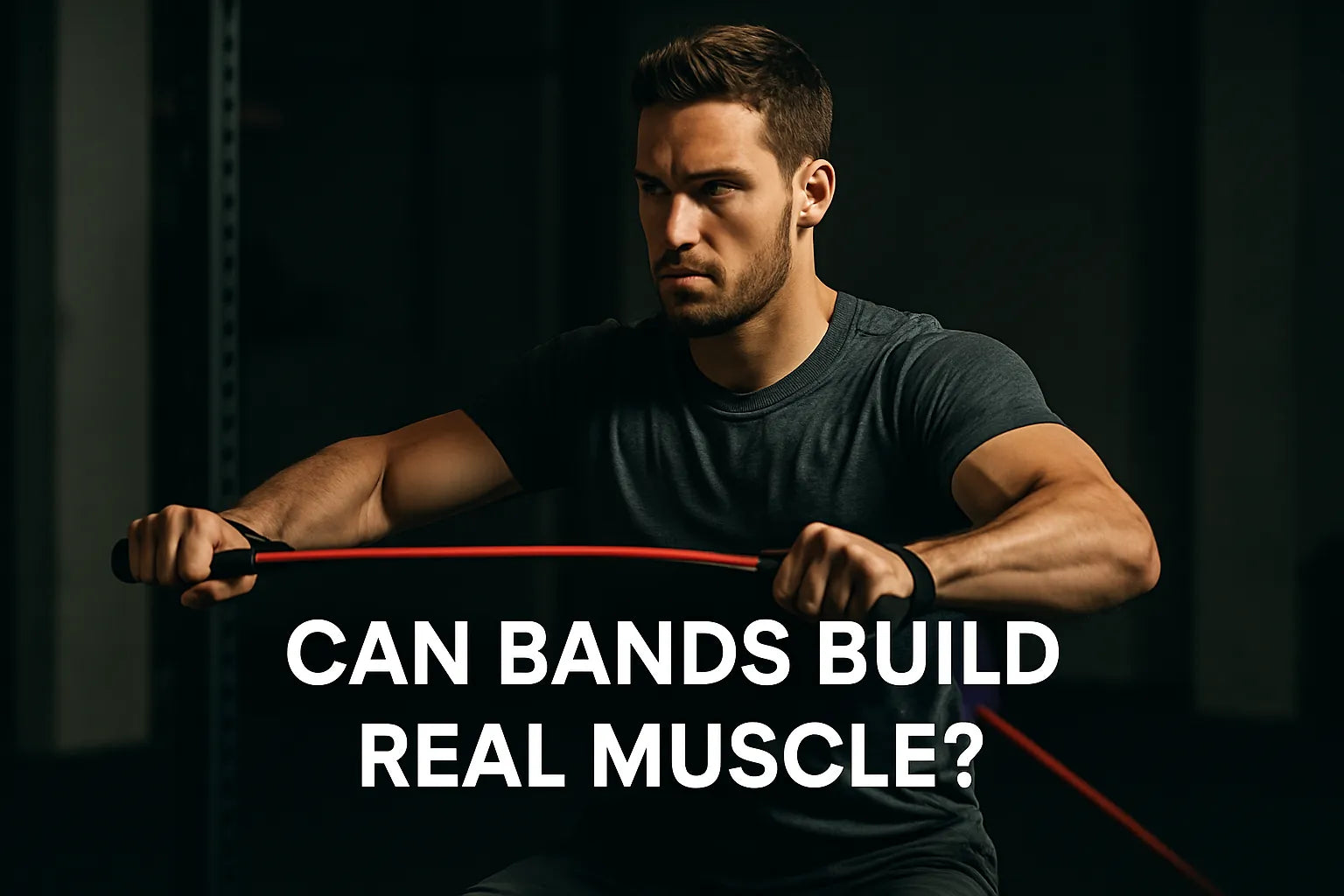
Can resistance bands actually build REAL muscle?
Or are they just a warm-up tool pretending to be something more?
For decades, free weights have been the gold standard for hypertrophy. Barbells. Dumbbells. Cable stacks. But as training science evolves — and especially after 2020 forced gym closures worldwide — research into band-based resistance training accelerated. And the truth may shock people who still assume bands are only for rehab.
Modern studies show something incredibly clear:
Resistance bands can build muscle.
Not “tone.” Not “maintain.”
Build. Actual. Muscle.
But — and this is essential — only when used correctly.
To understand why, you need to know how muscle actually grows. And that’s where this blog begins.
Along the way, the five products you selected sit in the exact environment where muscle-building occurs:
-
Applied Nutrition ABE Pre-Workout → enhances intensity, mind–muscle connection, and band tension output.
-
Naughty Boy Prime Creatine → increases force production, ATP regeneration, and stimulus needed for hypertrophy.
-
Per4m Advanced Whey Protein → provides the amino acids necessary for muscle repair after band training.
-
Per4m Glutamine → supports recovery, reduces muscle breakdown, and helps manage high-volume band days.
-
Combat Fuel Clear Whey Protein → the clean, fast-digesting option for post-band-workout replenishment.
These integrate into the physiology of every concept in this blog — naturally, realistically, and with zero salesiness.
Let’s break it down.
1. Can You Build Muscle With Resistance Bands?
Yes — absolutely.
Not in a theoretical sense.
Not “maybe.”
Not “if you’re a beginner.”
You can build muscle with resistance bands at ANY level — beginner to advanced — provided you apply the same core principles required for hypertrophy with weights:
-
Mechanical tension
-
Progressive overload
-
Training close to failure
-
Sufficient volume
-
Good technique
Bands can generate high tension — sometimes more than dumbbells at certain parts of a movement — because bands grow exponentially harder as they stretch.
Where a dumbbell gives you the same resistance throughout the entire range, a band gives you:
-
lighter tension at the start
-
moderate tension in the mid-range
-
brutal tension at peak contraction
This “ascending resistance curve” is one of the main reasons bands can absolutely stimulate hypertrophy if used properly.
If you don’t believe bands can be challenging, attach a thick band to a rack and try:
-
banded rows
-
banded deadlifts
-
banded chest presses
-
banded overhead triceps extensions
-
banded lateral raises to failure
You will quickly understand that bands are not the toy many think they are.
This is where Applied Nutrition ABE Pre-Workout plays an unexpected role. Since band workouts rely heavily on intensity and mind–muscle connection, having sharper focus, better energy, and improved pump dramatically increases the tension you can generate — which is the entire point of hypertrophy.

2. Are Resistance Bands as Effective as Weights for Strength?
Strength and hypertrophy are two different goals.
-
Hypertrophy = muscle size
-
Strength = force output / ability to produce maximal tension
Bands excel at hypertrophy.
Weights excel at maximum strength.
Here’s why:
Bands for strength
Bands can increase strength, but their main limitation is how much load they can produce at the start of a movement, where your muscles are usually strongest.
Example:
A heavy band row will feel extremely easy at the start, then extremely hard at the finish.
This creates fantastic hypertrophy stimulus but doesn’t allow maximal loading in the early range of motion — which is where maximal strength is built.
Weights for strength
Dumbbells and barbells allow consistent loading from start to finish.
This is why serious strength athletes use weights, not bands, as their foundation.
So are bands “as effective as weights” for strength?
For overall strength development: no.
For muscle-building stimulation: absolutely yes.
But there’s nuance here — and this is where Naughty Boy Prime Creatine becomes especially relevant.
Creatine enhances:
-
force output
-
explosive strength
-
peak contraction power
-
ability to produce tension
Which is EXACTLY what band training needs to stay effective long-term.
Creatine fills a physiological gap: the need for strong, high-quality reps under tension.
This allows band training to mimic the training density, fatigue, and overload you typically get from weights.
3. How Much Resistance Is Needed to Build Muscle?
Muscle does not care what tool you use — only the tension stimulus.
You could grow muscle with:
-
barbells
-
dumbbells
-
cable machines
-
resistance bands
-
bodyweight
-
sandbags
-
water jugs
-
rocks
-
a suitcase full of books
Tension is tension.
The real metric for muscle growth is this:
You must reach “near failure” within 6–30 reps.
That means the band you choose must be:
-
heavy enough
-
long enough
-
anchored properly
-
stretched enough at peak contraction
If you finish a band set and feel like you had 20 more reps in the tank, you’re not stimulating growth.
The biggest mistake people make is using bands that are too light.
If you want to grow:
-
Choose thick bands (or double up).
-
Increase the stretch distance to raise tension.
-
Slow down reps to maximise time under tension.
-
Train closer to failure than you think.
If you don’t create metabolic stress and mechanical tension, you won’t create hypertrophy.
This is also why recovery matters.
Pushing band work to true intensity creates high metabolic fatigue — and Per4m Glutamine is ideal for these sessions.
Glutamine supports:
-
muscle repair
-
gut function (which influences recovery)
-
training frequency
-
ability to handle high-volume band workouts
When people begin training properly with bands — instead of “light fitness band circuits” — they immediately feel DOMS and fatigue similar to dumbbell or cable training.
Recovery becomes just as important.

4. Can You Get a Full Workout Using Only Resistance Bands?
Yes — and not in a compromised way.
In a complete way.
With bands, you can target:
-
chest
-
back
-
shoulders
-
arms
-
legs
-
glutes
-
core
And unlike machines that lock you into rigid patterns, bands can create resistance through ANY angle you want.
You can simulate:
-
cable flyes
-
lateral raises
-
lat pulldowns
-
seated rows
-
chest press
-
triceps extensions
-
biceps curls
-
leg press patterns
-
hamstring curls
-
glute kickbacks
-
hip thrusts
-
overhead press
-
squats, lunges, split squats
The list is endless.
Bands allow you to adjust:
-
angle
-
stretch
-
tension curve
-
stability demands
-
range of motion
You can create a full-body hypertrophy split using only bands — and you can progressively overload it for MONTHS.
When paired with:
-
Applied Nutrition ABE Pre-Workout (for intensity)
-
Naughty Boy Prime Creatine (for strength and ATP output)
-
Per4m Advanced Whey Protein (for post-workout muscle repair)
You have everything required to build real muscle — without touching a single dumbbell.
People underestimate bands because they don’t use them properly.
But training them with intensity is a totally different experience.

5. Can Resistance Bands Increase Muscle Mass?
Yes — and here’s the science behind it.
Bands create high mechanical tension.
This is the number-one driver of hypertrophy.
Bands require stabilisation.
Stabiliser activation increases total muscle recruitment.
Bands create ascending resistance.
This maximises peak contraction stimulus — ideal for hypertrophy.
Bands allow deep metabolic fatigue.
Perfect for muscle growth, especially in higher rep ranges.
Bands create long time-under-tension.
A key hypertrophy variable.
Bands train muscles through full ranges.
Great for joint health and hypertrophy symmetry.
Bands allow high-volume training without joint stress.
Perfect for accumulating hypertrophy stimulus safely.
In other words:
Bands can add size to your chest, arms, back, legs, shoulders, and glutes — if you push them hard enough.
The muscles do NOT know the difference.
After a band-only push workout, having a light, fast-digesting recovery shake like Combat Fuel Clear Whey Protein helps replenish amino acids quickly without the heaviness of a full meal — ideal when the session was long, pump-heavy, and metabolically demanding.
END OF PART 1
Part 2 will include:
-
Are bands better than dumbbells or bodyweight?
-
Can you replace your gym routine with bands?
-
How often to train with bands
-
Common mistakes
-
Can bands transform your physique long-term?
-
Full recovery strategy using your 5 products
-
FAQ’s
PART 2 — Can Bands Build Real Muscle?
Part 1 established a truth that surprises a lot of people:
yes — resistance bands can build legitimate muscle.
Not beginner muscle. Not “toned” muscle. Actual, hypertrophied muscle tissue.
Now we dive deeper into the comparisons, myths, training frequency, mistakes, and long-term potential of band training. This is where most people fail or succeed — not in the theory, but the execution.
And throughout this second half, your selected supplements appear exactly where physiology demands them: intensity, recovery, protein synthesis, ATP regeneration, and training volume.
Let’s continue.
6. Are Resistance Bands Better Than Dumbbells or Bodyweight?
This question isn’t as simple as “yes” or “no.”
Each tool has strengths and weaknesses — and these differences shape your results.
Resistance Bands vs Dumbbells
Bands are better for:
-
Constant tension
-
Peak contraction overload
-
Joint-friendly training
-
Portable hypertrophy
-
High-volume metabolic stimulus
-
Adjustable tension angles
Dumbbells are better for:
-
Maximum load
-
Strength progression
-
Heavy compound movements
-
Overcoming strength sticking points
For hypertrophy specifically, both are extremely effective — but bands excel in one underrated area:
Bands create PERFECT tension at the hardest part of the rep.
Dumbbells are hardest at the mid-range.
Bands are hardest at the peak range.
Meaning:
-
curls peak where the bicep is fully shortened
-
lateral raises peak at the top
-
rows peak when the scapula fully retracts
-
chest presses peak with full pec squeeze
This is why some people experience BETTER pumps with bands than dumbbells.
This fits perfectly with Applied Nutrition ABE Pre-Workout, which enhances blood flow, focus and contraction quality — all crucial in a training system defined by peak-tension overload.
Resistance Bands vs Bodyweight
This one is not close.
Bands are dramatically superior for muscle growth.
Bodyweight limits progression unless you are extremely skilled. Most people cannot progressively overload bodyweight exercises without complex variations.
Bands let you:
-
increase tension immediately
-
customize angles
-
isolate muscles
-
reach failure safely
-
build balanced muscle
-
target weak points
For hypertrophy, bands win.
Resistance Bands vs Weights (Overall Verdict)
Weights win for maximum strength.
Bands can absolutely match weights for hypertrophy — IF you train properly.
If maximum strength is not your goal, bands are not “inferior.” They are simply a different tool. Many physique athletes would build phenomenal muscle with nothing but heavy bands, creatine, protein, and structured training.
That is where Naughty Boy Prime Creatine comes in — creatine boosts strength output regardless of whether the resistance is a barbell or a 60kg equivalent band row.
Creatine doesn’t care what you lift — only how hard your muscles contract.

7. Can You Replace Your Gym Routine With Resistance Bands?
Short answer:
Yes — if your training is structured and progressive.
Long answer:
Bands can replace weights for muscle-building, but not always for strength-based goals like heavy powerlifting.
You can fully replace the gym if:
-
hypertrophy is your main goal
-
you train close to failure
-
you progressively add tension
-
you use heavy bands (not flimsy “Pilates bands”)
-
you control range of motion
-
you maintain good programming
You CANNOT fully replace the gym if:
-
your goal is lifting maximal load
-
you’re a powerlifter or Olympic lifter
-
you want to train with barbells specifically
Everyone else?
Bands can replace 80–100% of your gym routine.
They can build:
-
bigger arms
-
a thicker chest
-
rounder delts
-
dense back muscles
-
stronger legs
-
tight glutes
You aren’t limited — you're simply shifting from iron resistance to elastic resistance.
And since band training is metabolically demanding, Per4m Glutamine becomes extremely valuable. Glutamine helps:
-
reduce muscle breakdown
-
improve muscle recovery
-
support immune function during high-volume training
-
keep you consistent session after session
Consistency is EVERYTHING when building muscle with bands.
8. How Often Should You Train With Resistance Bands?
Bands allow higher frequency because they are:
-
easier on joints
-
easier on tendons
-
easier on connective tissue
-
highly metabolically efficient
Most people can train with bands 4–6 days per week safely — even with high effort.
A realistic weekly structure:
Option A — Push / Pull / Legs (repeated)
Great for full hypertrophy.
Option B — Upper / Lower / Rest / Upper / Lower / Arms + Shoulders
Great for bandwidth-limited training.
Option C — Full Body 3–4 days a week
Perfect for beginners.
Because band training reaches deep fatigue through long time-under-tension, protein becomes essential. This is where:
-
Per4m Advanced Whey Protein — complete recovery protein
-
Combat Fuel Clear Whey — fast digestive recovery
work beautifully as a pair.
Advanced Whey → thick, satiating, post-meal recovery.
Clear Whey → perfect right after your workout when digestion is fast.
Protein timing genuinely matters more when performing metabolically heavy workouts — exactly what bands produce.

9. What Are the Common Mistakes People Make With Resistance Bands?
Most people fail with bands not because they’re ineffective — but because they’re used wrong.
Here are the mistakes that kill progress:
Mistake 1 — Using Bands That Are Too Light
If you can do 30+ reps easily, you’re doing cardio, not hypertrophy.
Choose bands that force HARD effort by rep 10–20.
Mistake 2 — Not Anchoring Bands Properly
Incorrect anchoring leads to:
-
inconsistent tension
-
sloppy movement
-
poor range of motion
-
weak mind–muscle connection
Tension must be predictable and repeatable.
Mistake 3 — Not Training Close Enough to Failure
This is the BIG one.
Muscle growth requires:
tension + fatigue + proximity to failure.
Bands don’t magically build muscle — your effort does.
Mistake 4 — Using Bands Only for “Warm-Ups”
Band pull-aparts are great…
but they’re not a muscle-building stimulus if done casually.
Bands must be used with intention.
Mistake 5 — Zero Progressive Overload
To grow, you need to:
-
increase band thickness
-
increase stretch length
-
slow reps down
-
add pauses
-
increase weekly volume
-
reduce rest time
Bands can progress — people just rarely track that progression.
This is where Applied Nutrition ABE and Naughty Boy Prime Creatine shine together:
ABE → increases workout performance
Creatine → increases strength output and improves rep quality
Together, they allow progressive overload even when you aren’t lifting metal plates.
Mistake 6 — Poor Recovery
Sometimes the problem isn’t bands — it’s recovery.
If you’re training hard and often, you MUST manage:
-
protein intake
-
amino acid levels
-
sleep
-
hydration
-
inflammation
This is where your supplement stack completes the training model:
-
Per4m Whey — muscle protein synthesis
-
Combat Fuel Clear Whey — rapid post-workout amino replenishment
-
Per4m Glutamine — reduces muscle breakdown
-
Creatine — improves overload capacity
-
ABE Pre-Workout — maximises quality of tension
Bands + recovery = actual hypertrophy.
10. Can Resistance Bands Transform Your Physique Over Time?
Yes. And not subtly.
If you train with progressive overload, resistance bands can give you:
-
bigger arms
-
thicker chest
-
wider back
-
capped delts
-
strong legs
-
peachy glutes
-
improved symmetry
-
better mobility
-
better joint health
The physique changes from band training can be dramatic — especially for people who previously trained too light, too casually, or with poor technique using weights.
Why bands transform physiques:
-
They force strict movement.
-
They train the full range of motion.
-
They overload peak contraction.
-
They produce excellent pumps.
-
They allow high volume without joint pain.
-
They improve stability and control.
-
They make mind–muscle connection unavoidable.
And over time, consistency matters more than tools.
You don’t need a gym. You don’t need heavy iron.
You need:
-
tension
-
effort
-
recovery
-
protein
-
sleep
-
ATP availability
Which is EXACTLY where your five products form a complete system:
-
ABE → effort (intensity)
-
Creatine → ATP output (strength)
-
Whey → recovery (protein synthesis)
-
Clear Whey → fast absorption (post-workout)
-
Glutamine → volume capacity (recovery & immune support)
It’s a very real, very practical hypertrophy stack — band training fits right into it.
Conclusion — Yes, Bands Build Real Muscle. Here’s Why.
Bands aren’t a downgrade.
They’re not a backup plan.
They’re not a rehab-only tool.
They are a legitimate muscle-building system, capable of transforming physiques when used with:
-
progressive overload
-
strong intent
-
high effort
-
correct anchoring
-
proper recovery
Your muscles don’t know what you’re holding.
They only know tension.
If that tension is high enough — and if your recovery supports growth — your body has no choice but to build muscle.
And with the right combination of effort and recovery tools:
-
ABE → power + focus
-
Creatine → ATP + overload
-
Whey → muscle repair
-
Clear Whey → rapid amino uptake
-
Glutamine → recovery & training frequency
…band training becomes not only viable, but extremely effective for size.
This isn’t theory.
It’s physiology.
Bands can build real muscle.
They can reshape your body.
And they might even fix the technique issues you developed lifting heavy weights.
If the tension is real — the muscle will be too.
FAQ’s
1. Do resistance bands really build muscle?
Yes — if you train close to failure and progressively overload.
2. Are bands better than weights?
Weights are best for max strength; bands can match weights for hypertrophy.
3. How heavy should bands be to grow muscle?
Hard enough that you reach failure within 6–30 reps.
4. How often should you train with bands?
4–6 days per week for most people.
5. What’s the biggest band-training mistake?
Using bands that are too light and stopping too far from failure.
6. Can I get bigger arms with bands?
Absolutely — bands load peak contraction extremely well.
7. Can bands replace the gym entirely?
Yes, for hypertrophy-focused goals.
8. Do I need supplements for band training?
Not required — but protein, creatine, and recovery supplements greatly accelerate results.
9. Do bands help legs too?
Yes — especially glutes, quads, and hamstrings with the right setup.
10. Can beginners and advanced lifters both grow with bands?
Yes — both groups respond well when tension is high.


